
Stamps from the two Waterlow trial plates were issued in January 1906.
They have W1 and W2 respectively engraved
in the bottom margin.
The Waterlow plates
The Waterlow plates were laid down in an unusual way.
It appears that the transfer roller contained five
impressions in a vertical column and all five impressions
were added to the plate in a single action.
The plates consisted of 10 rows of 24 stamps and
rows 1 and 6, 2 and 7 etc. were formed from the same
impression in the transfer roller.
The five impressions differed slightly and so it
is possible to assign each stamp in both plates
W1 and W2 to one of two rows.
They are usually referred to as Types
A, B, C, D and E with Type A corresponding to rows
1 and 6, B to 2 and 7 etc.
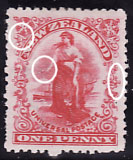
The main areas of difference are circled in the illustrated figure.
They are:
- the two lines in the scroll under the middle of the
large rosette at the top left, - the right wrist of Zealandia,
- the pearls at the middle right.
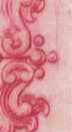
The two lines in the scroll are used to differentiate
between the five types.
They differ as follows:
- Type E: the lower line is long and touches the right
edge of the scroll, - Type D: the lower line is not quite as long as in E,
but is longer than in the other types, - Type B: the lower line is short,
- Types A and C: the lower line is intermediate between B and D.
This is shown below:
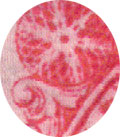
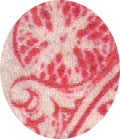
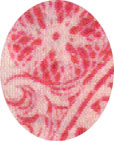

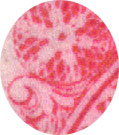
Types A, B, C, D and E


Types A and C can be differentiated because in Type A there
is a horizontal line through the right wrist of Zealandia
which is absent in Type C.

Another point to help differentiation is that, in
Type E, the pearl at the top right is in the shape of a spiral.

The pearls at the middle right are used to distinguish
between stamps from the two plates.
In plate W1, the inner two of the three pearls at the middle
right are unshaded while in W2 they are shaded.
A feature of the Waterlow plates is the number of re-entries
many causing extensive doubling of the design.
An example is given below.
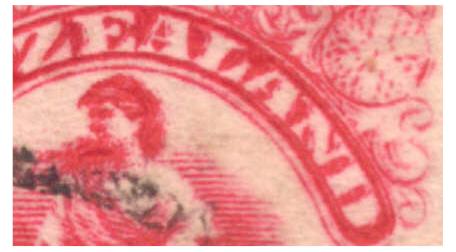
Reentry at R6/18: extensive
doubling in ZEALAND and rosette
The site with a detailed description
of the penny universal shows many
Waterlow re-entries
and a
partial reconstruction of
the second plate.
The two Waterlow trial plates were produced at the same
time as the two Royle trial plates.
Royle were subsequently chosen to produce a further pair of plates
in preference to Waterlow.


back next
The above information is taken from The Postage Stamps of New Zealand Vol 1, published by the
Royal Philatelic Society of New Zealand in 1938.
The Postage Stamps of New Zealand Vol 4 gives more detailed information on the Waterlow trial plates.
All scans were made by the author.