
New Zealand introduced a penny post in January 1901 both for internal
letters and for letters to foreign countries.
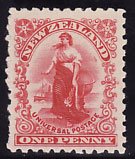
A new stamp, known as the penny universal, was introduced.
The design contains a central figure of Zealandia which is meant
to be an allegory for New Zealand.
This design (with modifications made in 1909) was to remain in use until 1926.
The plates were made by Waterlow and by Royle. Stamps from the first
Waterlow plate were printed in London while the printings from all the other
plates were made in New Zealand.
The plates of the penny universal can be grouped as follows:
- The Waterlow London plate. Stamps issued on 1 Jan, 1901.
- Three Waterlow plates printed locally, February 1901.
- Fourth Waterlow plate printed locally
(the reserve plate), April 1902. - Royle booklet plate, August 1902.
- Three Royle ‘dot’ plates, January 1904.
- Two Waterlow trial plates, January 1906.
- Four Royle plates, two trial plates in January 1906
and two more in February 1907. - Surface printed plate by Perkins Bacon & Co., December 1908.
These plates are referred to respectively as the London,
first local, reserve,
booklet, dot, Waterlow, Royle and surface plates.
A site with a very detailed description of the penny universal is available
here.
Distinguishing between the plates
The London plate, first local and reserve plates have
similar characteristics
although the reserve plate is a deeper impression
with the background to
Zealandia standing out more clearly.
Distinguishing between the London plate and the local plates
is done by colour,
papers and perforations rather than by the characteristics of the
plates themselves.
The London prints are on unwatermarked paper
and perforated from 12 to 16.
The local prints appeared first on thick paper
watermarked double line NZ and star and then
on thinner ‘Basted Mills’ paper also watermarked
double line NZ and star.
Subsequent prints were on ‘Cowan’ unwatermarked paper
and then on ‘Cowan’ paper watermarked NZ and star.
The local prints were perforated 11, 14 or compound 14 and 11.
Stamps printed from the booklet and all subsequent plates
show a flaw at
4 o’clock in the rosette at the top right.
This gives a simple way of distinguishing the London,
first local and the reserve plate from the later plates.
The flaw stands out most clearly in the dot plate in its worn state.

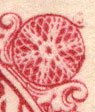
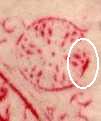
The 4 o’clock flaw: absent, present, worn
The rest of this article concentrates on distinguishing
between the booklet,
dot, the Waterlow trial and the later Royle plates.
Stamps from these plates always appear on ‘Cowan’
paper watermarked NZ and star.
The dot, Royle, Waterlow and booklet plates
distinguishing dot and Royle plates
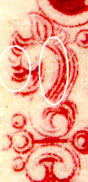
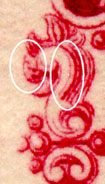
dot and Royle plates
Distinguishing between the dot and Royle plates is relatively
difficult.
They both show the 4 o’clock flaw.
The dot plate stamps normally have a dot in the middle vertical
margin, but that is also present in the Royle plates and so
cannot be used to differentiate between them.
They differ in the scroll work under the ‘N’ of ‘New’ as shown
in details from the dot and Royle plates.
Two points of interest are circled in each detail.
In the dot plates, the left oval shows incomplete leaves at the left while in the Royle plates they
are complete.
The right oval shows an inner line to the
reverse large ‘S’ shape ornament in the Royle plates
that is weak or absent in the dot plates.
distinguishing Waterlow and booklet from dot and Royle plates

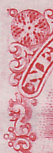
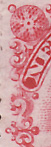
Royle, Waterlow and
booklet plates

In the dot and Royle plates the pearl at the top left is
incomplete and the pearls at the middle left are shaded.
In the Waterlow plates, the pearl at the top left is always complete and the
three pearls at the middle left are very clear and unshaded.
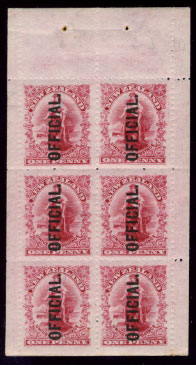
In the booklet plate, the
pearl at the top left was retouched and
is larger and stands out more clearly than in any other plate.
The outer of the three pearls at the middle
left was also retouched and is much clearer than the others.
Booklet stamps overprinted Official were issued in 1908.
In 1930, a stock of these booklets was discovered and issued.
As a result, panes with official stamps are much more common than
ordinary panes.
The two Royle and the two Waterlow plates of 1906 were trial plates.
They had plate numbers R1, R2, W1 and W2 respectively
under the 12th stamp in the bottom margin.
The Royle plates were judged superior and stamps printed
from two further Royle plates appeared in 1907.
The Waterlow plates are of specialist interest and are
covered in the next page.

next
The above information is taken from The Postage Stamps of New Zealand Vol 1, published by the
Royal Philatelic Society of New Zealand in 1938.
The Postage Stamps of New Zealand Vol 4 gives more detailed information on the Waterlow trial plates.
All scans were made by the author.