
The design of the Penny Universal was changed in 1909
in recognition that New Zealand was now a Dominion.
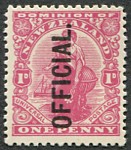
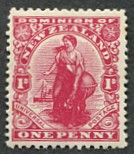
Two plates of 240 stamps were produced by Perkins Bacon
and stamps were issued on 18 November 1909.
They were on De la Rue chalk surfaced paper with watermark
NZ and star and perforation 14×15.
Stamps overprinted Official were issued in December 1909.
After 1924, there were issues on several different papers.
- June 1924: Jones chalk surfaced paper; also issued overprinted Official in 1925,
-
April 1925: small numbers on unsurfaced De La Rue paper and
surfaced paper with sideways watermark, -
July 1925: unwatermarked paper in
which a lithographed ”watermark” was printed; also issued overprinted Official in 1925, - August 1925: Cowan thick chalky paper; also issued overprinted Official in 1925,
-
1926: Cowan thick chalky paper surfaced on the wrong side and so the
stamps were issued with reversed watermark; also issued overprinted Official in 1926, -
June 1926: dull carmine on Wiggins Teape paper with
vertical mesh. Stamps from the top row were blurred.
The stamps were replaced by the King George V Field Marshall
in November 1926.
There were two plates which are recorded as 12 and 13 although
the numbers did not appear on the plate.
Plate 12 was used throughout the issue while plate 13 only
occurs on stamps on De La Rue paper.
Flaws

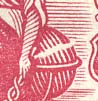

Plate 12
There are constant flaws on both plates.
On plate 12, the feather (R3/1) and globe (R5/24) flaws are best known while
another prominent flaw is the missing part of the top frame line (R6/21).
They exist on all papers.

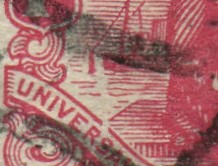
Plate 13
On plate 13, the Q flaw (R10/19) and the split in the ship’s bow (R9/19) are best known.
They only exist on stamps on De La Rue paper.
Booklet plates
The first penny Dominion booklet stamps were printed
from electrotype plates and were issued in 1910 in booklets
along with the Edward VII halfpenny.
This was replaced in 1915 by the
George V halfpenny.
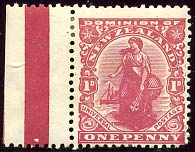

The appearance of the booklet stamps was less clear than the normal stamps
and the plates did not wear well
leading to blurred prints as shown in the image.
This was solved in 1919 when a steel booklet plate was produced by Perkins Bacon.
The stamps were on De La Rue paper until 1924
when they appeared on Jones paper.
After 1925, adverts were printed in the selvedge of the booklet panes.
The binding selvedge had Jeyes Fluid adverts while the side
selvedges had Abdulla, Dainties, Big Tree and Kaitangata Coal adverts.
There were nine different Abdulla cigarette adverts.

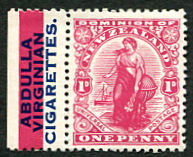
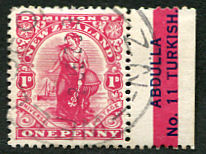

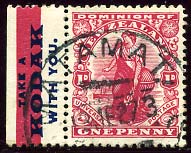
Booklets with Kodak adverts, all on Cowan paper with reversed watermark, appeared in 1927.

back
The above information is taken from The Postage Stamps of
New Zealand Vol 1, published by the
Royal Philatelic Society of New Zealand in 1938 and Vol 4 in 1964.
All scans were made by the author.