
As surface printing is cheaper, the 1½d, 2d and 3d
values of the George V definitive issue of 1915
were changed from being recess-printed.
The ½d value had always been surface printed.
The stamps
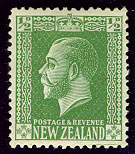
Except for the local 1½d, the dies and plates were produced
in London by Perkins Bacon.
The design was the same as the recess printed stamps.
The ½d was the only surface printed value issued on 30 July 1915.
A special ½d plate was made in 1915
from which booklet panes were produced.
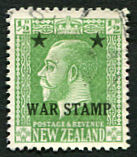
In September 1915, a war tax increased
all postage rates by ½d.
The ½d stamp was overprinted WAR STAMP and
issued on 24 September 1915 with the idea
that it would be added to all items to make up the new postage.
Instead the public just bought higher denomination stamps.
As the normal internal postage rate was now 1½d,
it was decided that the 1½d stamp should be surface printed.
To speed things up, a local die was produced by W.R. Bock
and the stamps issued in April 1916.
Stamps from a Perkins Bacon surface printed plate
were issued in September 1916.
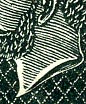
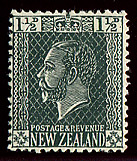

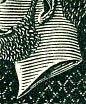
Local and Perkins Bacon plates
The stamps from the local plate are cruder and
the lines in the King’s neck are diagonal while they are
horizontal in the Perkins Bacon plates.
The surface-printed twopence was also issued in September 1916.
On 11 September 1918, the colour of the 1½d stamp
was changed to orange-brown.
The surface printed 3d was first issued in May 1919.
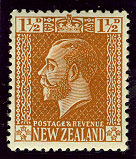
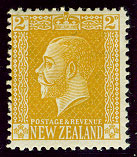

Later issues
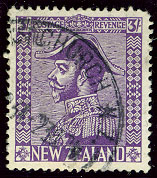
In July 1926, two shilling and three shilling stamps were
issued surface printed with
George V in the uniform of an Admiral of the Fleet.
The dies and plates were produced by Waterlow.
In November 1926 a 1d stamp was issued with George V in the
uniform of a Field Marshall.
The die was made by Waterlow and the plates by Bradbury Wilkinson.
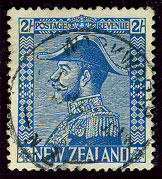
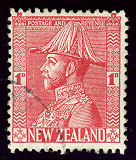
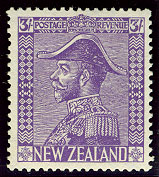
Given that they were on sale for nine years, the
two shilling and three shilling stamps are expensive.
Papers and perforations
For the pence values, each sheet had 240 stamps in
10 rows of 24 and
the initial perforation was 14 x 15.
After 1926 the pence values were
issued perf 14 (1d in 1926, ½d in 1927, 1½d, 2d and 3d in 1929)
as well as perf 14 x 15.
De La Rue paper 1915-24
The paper was chalk-surfaced and watermarked NZ and star
and was used for all values until 1924.
The watermark is easily seen and the N and Z
are fairly widely separated.
The only exception is a small printing of the ½d in December
1915 on thick paper, but with the same watermark.
Jones paper 1924, 1925
In 1924, a thicker paper was introduced for the
½d and 2d, in 1925 for the 3d value.
The impressions are poor and the watermark difficult to see.

Lithographed watermark 1925
In 1925 there was a provisional issue of
the ½d and 2d values on a paper
which had the NZ and star ‘watermark’ lithographed on the back.
Cowan paper 1925-1935
In August 1925, the ½d, 2d and 3d were issued on a thick
Cowan paper. The 1d followed in 1926 and the 1½d in 1929.
Cowan paper was used until the end of the issue in May 1935.
There was a return to a penny postage in 1923 and so
the demand for the 1½d value was greatly reduced.
That is why it was not issued on Cowan paper until 1929.
The 1½d perf 14 x 15 on Cowan paper was not issued until 1933.
Wiggins Teape 1926-1933
Printings of the 1d and 1½d (in 1930) and 2d (in 1926) on Wiggins Teape paper
differ from the other papers as it has
a vertical mesh. That is the easiest way to distinguish it.
The NZ and star watermark is narrower, but is often difficult to see.
On this paper, the 1d and 1½d are always perf 14 while the 2d
exists with both perfs.
There were several printings on Wiggins Teape paper up until 1933.
Worn plate

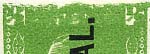
worn
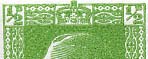
normal
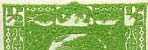
There were two ½d plates: numbered 28 and 29 although the
numbers do not appear on the printed sheets.
The top row of plate 28 became very worn.
White patches appeared and when the
plates were overinked
virtually all the detail disappeared.
This became so bad that in some of the sheets overprinted
Official the top row was removed and other
stamps patched in.
The arrow in the top selvedge had been added in June 1926.
If buffer bars had also been added this would have protected
the top row from the extreme wearing that occurred.
High values
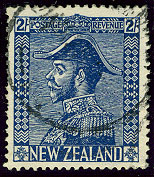
Jones paper
The sheets of the 2/- and 3/- values had eight rows of ten
and the perforation was 14.
The first printing of the 2/- and 3/- values
was on thin Jones paper in 1926.
The 2/- was in deep blue and the 3/- in mauve.
The impressions are generally rather poor.
In May 1927, the 2/- was issued on a thick
Cowan paper and the 3/- followed in September 1927.
The impressions on the Cowan paper are much better than those on the Jones.
The paper is thicker and the watermark is less easy to see
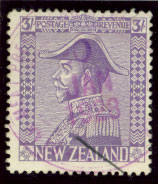
Shades on Cowan papers
Initial printings of the 2/- value on Cowan paper can be readily distinguished from the
earlier Jones paper as they are a much lighter and brighter blue.
The colour became deeper in later printings.
The 3/- on Cowan paper was initially in pale mauve (much lighter than on the Jones paper)
while later printings were much darker and in purple.


back next
The above information is taken from The Postage Stamps of
New Zealand Vol 1, published by the
Royal Philatelic Society of New Zealand in 1938.
All scans were made by the author.