
An electrotype plate of the ½d value was
produced in 1915 and a steel plate in 1919.
The booklets contained both ½d and 1d stamps.
The 1d stamps were initially the
Penny Dominion which
were replaced in 1928 by the penny Field Marshall.
Halfpenny
In booklets along with 1d Dominion
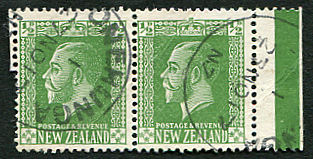
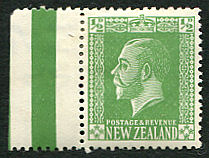
From Electrotype Plate 1915 – 1919
The first booklet plate was made from electrotypes at the Government Printing
Office in Wellington in 1915 and the stamps are more blurred than those
issued in sheet form or in the later steel booklet plate.
The layout was the same as the
1d Dominion booklet plates and were of
144 arranged in panes of six.
There were three rows of panes with each row containing 8 panes.
The panes had selvedge bars in the margin as shown in the examples.
As the example pair has a postmark dated 1917, it is definitely from the electrotype plate.
From Steel Plate without adverts 1919 – 1925
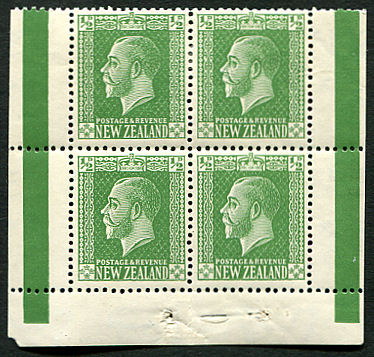
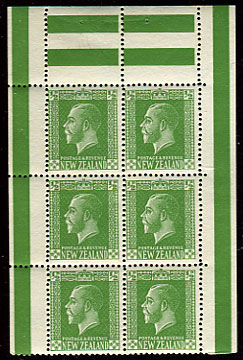
A steel booklet plate with the same layout was produced by Perkins Bacon in 1919 although
the arrangement of the selvedge bars in the margins of each pane was different.
The first pane is the rightmost of the middle row of panes and has a double row
of selvedge bars in the top selvedge and the perforations do not extend through the right margin.
The partial pane is from the bottom row and the side selvedge
extends into the bottom selvedge.
Stamps from both plates were printed on De La Rue paper while in 1924
stamps from the steel plate appeared on Jones paper.
With adverts 1925 – 1928
In 1925, stamps appeared on Cowan paper with adverts in
the side selvedge.
With the exception of the Cameron Bros booklets, the same adverts appeared
in the ½d panes and in the
1d Dominion panes.
The adverts are shown below:
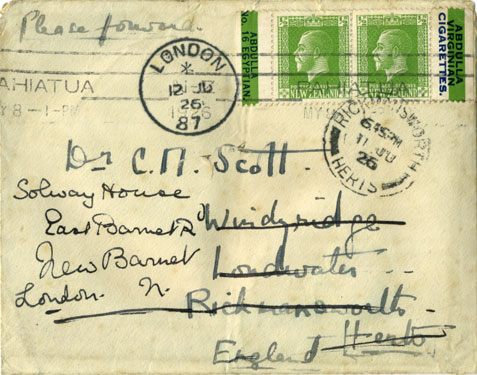
Abdulla adverts

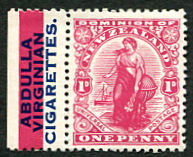
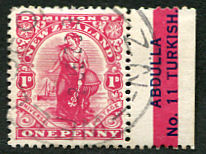
Abdulla adverts were in the side selvedges and Jeyes Fluid
adverts in the binding selvedge.
Panes with the Abdulla adverts, had Abdullah Virginian Cigarettes,
Abdullah Turkish Cigarettes and Abdullah Egyptian Cigarettes
on one side while
on the other side there were:
-
Abdullah No 70 Virginian, Abdullah No 7 Virginian,
Abdullah No 11 Turkish in one pane and - Abdullah No 16 Egyptian,
Abdullah No 17 Virginian, Abdullah No 14 Egyptian in the other pane.

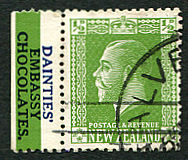
Dainties adverts
The Dainties adverts were in the side selvedges and
Jeyes Fluid adverts in the binding selvedge.
These booklets were only on sale in the Christchurch area.
There were three Dainties adverts in each block appearing on both sides.
They were: Dainties’ Nice Biscuits, Dainties’ Embassy Chocolates and Dainties’ Encore Toffee.
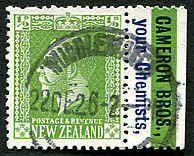


Cameron Bros adverts
Cameron Bros adverts were in the side selvedges of the ½d panes.
while one 1d Dominion pane had an advert for Big Tree and the other for Kaitanga Coal.
Jeyes Fluid adverts were in the binding selvedge.
These booklets were only on sale in the Dunedin area [1].
There were two different Cameron Bros panes.
Both had Cameron Bros., your Chemists, in one selvedge and the addresses of two different Chemist shops
in the other, either: 533 Cargill Road, Dunedin or: 3 Stafford Street.
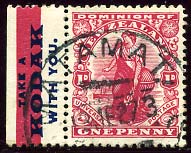
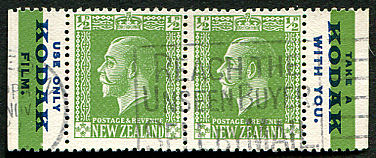
Kodak adverts
Kodak adverts were in the side selvedges while
Kodak appeared twice in the binding selvedge.
The advert take a Kodak with You appeared on on side and Use only Kodak Film on the other.
The Kodak adverts for both the ½d and 1d Dominion were always on Cowan paper with reversed watermark.
In booklets along with 1d Field Marshall
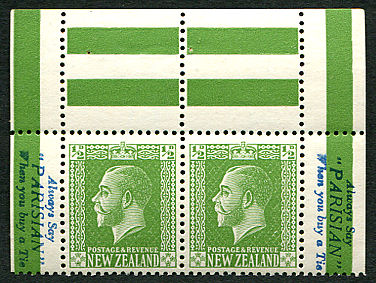
Until 1928, the halfpenny stamps appeared perf 14×15 in booklets along with the 1d Dominion
while from March 1928 they were perf 14 in booklets along with the 1d Field Marshall.

Panes from the new booklets exist both with and without adverts.
The adverts were Parisian Tie adverts on the left and right
selvedges while some panes also had Jeyes Fluid adverts on the binding.
1d Field Marshall
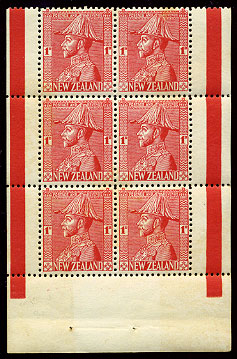
Booklets containing 1d Field Marshall stamps were first issued
in 1928 and were perf 14. There were on Cowan paper and
exist both with and without adverts in the selvedge.
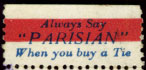
Parisian Tie adverts were on the left and right
selvedges while some panes also had Jeyes Fluid adverts on the binding.
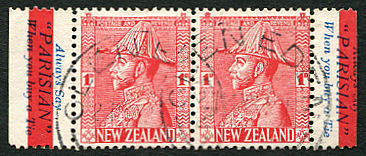
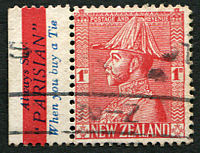
The Parisian Tie adverts exist with the writing both upwards and downwards.
In 1934, booklet stamps were issued perf 14 x 15
with Parisian Tie adverts in the selvedge.


back next
The above information is taken from The Postage Stamps of
New Zealand Vol 1, published by the
Royal Philatelic Society of New Zealand in 1938.
[1] AF Dove, Advertisements on Booklet Panes, The Kiwi, vol 47, pp39-40, 1998.
All scans were made by the author.