
This issue is one of the glories of New Zealand philately.
It shows that beautiful stamps do not have to be multi-coloured or
pictorials.
Linley Richardson from Wellington was commissioned to produce the design
of the new King George V stamps in 1911.
Several alternatives were explored and rejected.
When Sir R Heaton Rhodes became Postmaster General in 1912, he suggested
that the design should be based on the GB penny black of 1840.
The stamps
The dies and plates were produced by Perkins Bacon, the printers
of the penny black,
and the fine background design was produced by the same
Perkins Rose-engine which had been used to produce the
background in 1840.
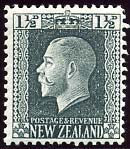
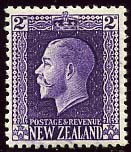
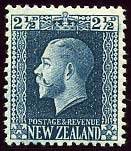
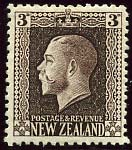

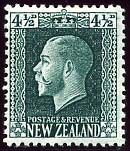
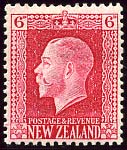
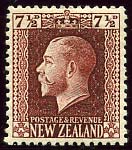
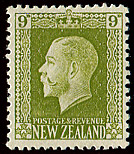
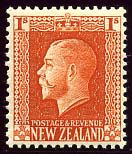
The original colours and values
The plates were received in New Zealand in December 1914, but the stamps were not
issued until 30 July 1915 due to problems in obtaining suitable inks.
The set, with minor changes, remained on sale for 20 years.
The sheets contained 120 stamps in 10 rows and were
watermarked NZ and star.
They were printed at the Government Printing Office in Wellington.
In addition to the original set of 10 recess printed stamps,
a ½d surface printed
value was issued on 30 July 1915.
Also, due to the large numbers required, the 1½d, 2d and 3d
recess printed values were replaced by
surface printed stamps;
the 1½d in April 1916, the 2d in September 1916 and the 3d
in May 1919.
Change of colour
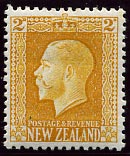
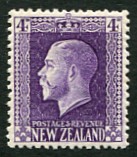
In 1916, the colours of the 2d and the 4d were swapped round.
The reason was that the 2d was used to pay duty on receipts and
pen cancels did not stand out well on a violet stamp.
New values
The 4½d and 7½d had been issued to cover parcel postage,
but a war tax of ½d was introduced in September 1915.
As it was hoped that this increase was temporary, use of the
5d and 8d Edward VII stamps was continued rather than issuing
new values.
When the increase in rates was made permanent in 1920,
it was decided that 5d and 8d GV stamps should be issued.
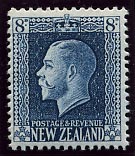
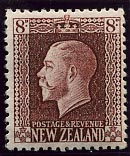
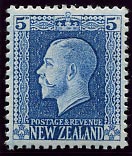
The 8d indigo blue was issued on 19 April 1921, but it was quickly
realised that its colour was too close to the 2½d and so
it was withdrawn on 26 April after very few copies had been
sold.
Due to complaints from collectors, it was re-issued on July 13.
The 8d was then issued in brown in March 1922, the colour of the
7½d which had ceased to be sold in February.
The 5d was issued in April 1922.
Perforations
The perforations of this issue have many points of interest.
The following perforations exist:
Perf 14 x 13½ throughout sheet
Used for some sheets of the 1½d,
2½d, 4d, 4½d, 6d, 7½d and 1/- values
in the initial issue and then as the normal perforation from 1922.
Top 4 rows perf 14 x 13½, lower 6 perf 14 x 14½
This is a major feature of the George V definitives and was the normal perforation from 1915 until 1922 except for the
7½d which was not issued in this form until October 1920.
It does not occur with the 5d or 8d brown
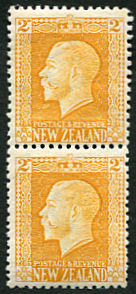
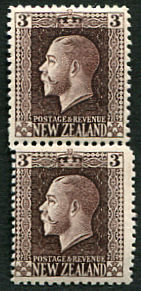
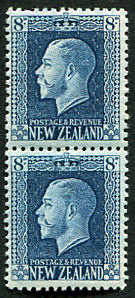
Vertical pairs from rows 4 and 5 are known as
two-perf pairs as they
have the top stamp perf 14 x 13½ and the lower stamp perf 14
X 14½.
There is also often a discontinuity in the vertical alignments
of the perforations as seen in the shown block.
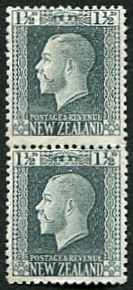



Perf 14 x 14½ throughout sheet
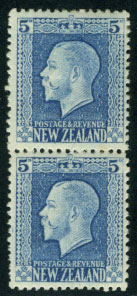
Used for some initial sheets of the 5d in 1922 and as the normal
perforation for the 1/- from 1922, the 4d from 1926, the 5d from
1934 and some sheets of the 6d in 1934.
Top 5 rows perf 14 x 14½, lower 5 perf 14 x 13½
Used for small printings of the 4d in 1927 and the 5d ultramarine
in 1930.
This perforation also results in two-perf pairs in this case with vertical pairs from rows 5 and 6.
Line perf 14
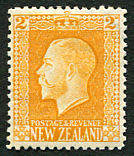
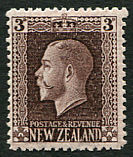
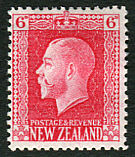
As a result of the wartime paper shortage, a provisional issue of the 1½d, 2d, 3d and 6d values
was made in 1916 using old stocks of the paper that had been produced for the 2½d of the
pictorial issue.
The 1½d was issued with upright watermark and with top 4 rows perf 14 x 13½ and lower 6 perf 14 x 14½
while the 2d, 3d and 6d values were issued line perf 14 and with
a sideways watermark.
Plate Numbers
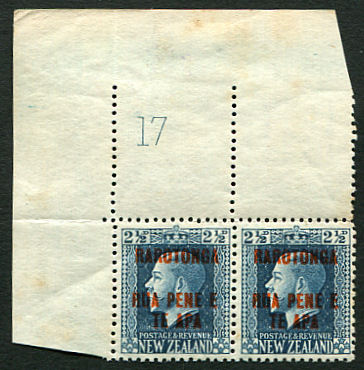
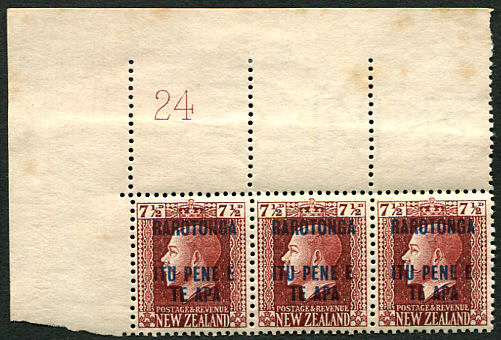
The plate number appears in the top margin above the stamp at R1/1.
Stamps from plates 14 to 27 were issued on 30 July 1915.
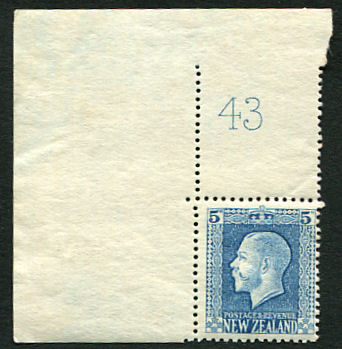
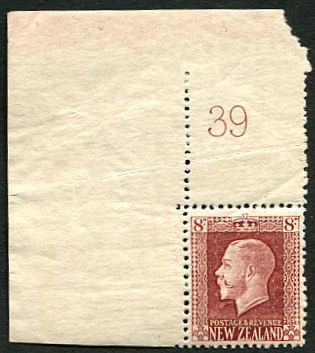
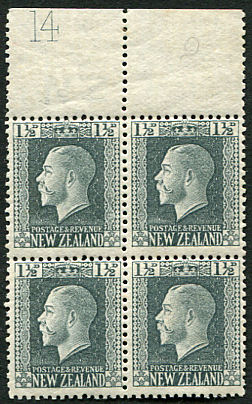
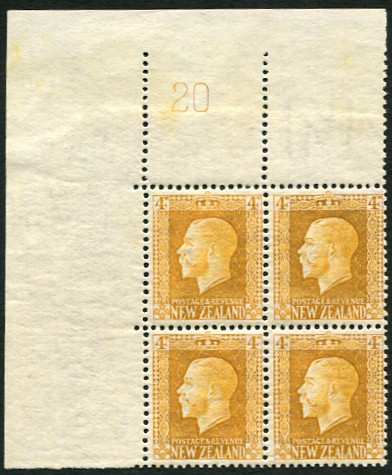
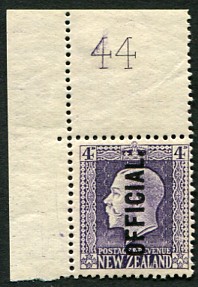
The 1½d shown is on the pictorial paper.
With that printing, the plate number often appears incomplete and there is
always far less selvedge above the number than with the normal paper.
The plate numbers used for each value are given below along with
the dates of issue of stamps from the later plates 37 to 44.
- 1½d : plate 14
- 2d : plates 15 and 16
- 2½d : plate 17
- 3d : plates 18 and 19
- 4d : plate 20 and plate 44 (July 1926)
- 4½d : plate 21
- 5d : plate 43 (April 1922)
- 6d : plates 22 and 23; plate 37 (1920) and plate 38 (1928)
- 7½d : plate 24
- 8d : plate 39 (April 1921) and plate 40 (not used)
- 9d : plate 25
- 1/- : plates 26 and 27; plate 42 (April 1922) and
plate 41 (Feb 1925)
The 2½d plate 17 and 7½d plate 24 shown below are overprinted Rarotonga (Cook Islands).
Although far fewer of the New Zealand Island Dependency overprinted stamps were printed, they are available
mint for much less than the ordinary New Zealand stamps.

next
The above information is taken from The Postage Stamps of New Zealand Vol 1, published by the
Royal Philatelic Society of New Zealand in 1938.
All scans were made by the author.