
The pence values were printed by Bradbury Wilkinson.
Although the ½d value was issued on 1 March 1938, the 1d on 1 July 1938,
the 1½d on 26 July 1938 and the 3d in September 1941,
the higher pence values were not issued until 1 May, 1947.
The plates
A feature of this issue is the large number of plates that were
used.
The position of the plate numbers also changed over time and
that is the subject of this page.
Plate number only in left margin
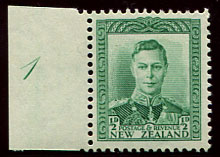
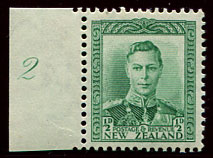
The first plates were 1 and 2 for the ½d green (isued 1 March 1938)
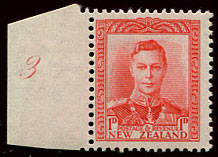
and 3 and 4 for the 1d red (issued 1 July 1938).
In these plates, the plate number appeared only in the left hand
margin opposite the 4th row of stamps.
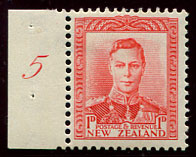
In addition, a booklet plate numbered 5 was produced
for the 1d and stamps were issued on 1 July 1938.
The plates had 210 impressions (sufficient for 35 booklet panes)
and were organised so that
15 of the booklet panes had their watermark inverted
and 20 had normal watermark.
Only 1 pane in 35 shows the plate number in the selvedge.
The booklet staple marks are visible in the selvedge.
Plate numbers in both left and right margins
Subsequently, plates 9 and 10 (issued April) and 16, 17, 18 and 19 (issued 1 July 1938)
were laid down for the ½d green.
From plate 16 onwards, the perforations extend through the
left and right margins.
Stamps from a ½d booklet plate were issued in November 1938.
The plate number was 22, but it does not appear on any of the panes.
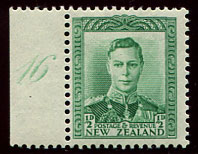
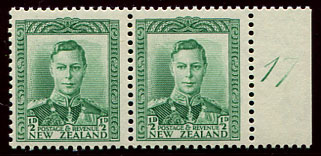
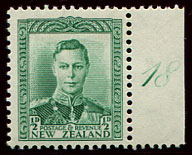
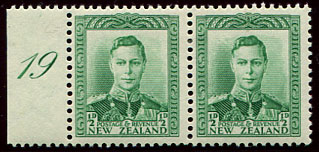
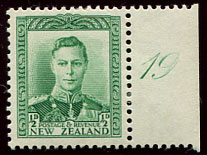

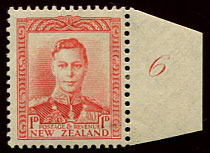
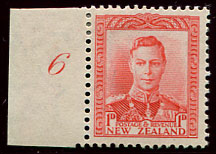
Plates 6, 7, 8, 11, 12, 13, 14 and 15 were laid down for
the 1d red and stamps issued on 1 July 1938.

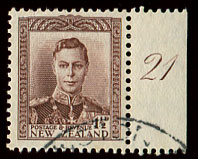
Plates 20 and 21 were laid down for the 1½d chocolate
and stamps issued on 26 July 1938 ready for use in the
Empire Air Mail Scheme.
In these plates, the plate numbers appeared in both the left
and right margins opposite the 4th row of stamps.
In November 1938, 1½d stamps were issued in booklets from
a special plate numbered 24 although the number does not appear on any panes.
Some panes had the watermark inverted.
The paper for all the above issues was fine with a vertical mesh.
Change of Colour
Plate numbers in both left and right margins
The ½d in chestnut exists printed from plates 17, 18 and 19 and first appeared on
10 July 1941.
They were printed on fine paper with a horizontal mesh.
It was issued through stamp vending machines, but stamps were supplied from the Stamps
Branch G.P.O. in Wellington for the benefit of stamp collectors.
It was May 1947 before these stamps from sheets where put on general sale.
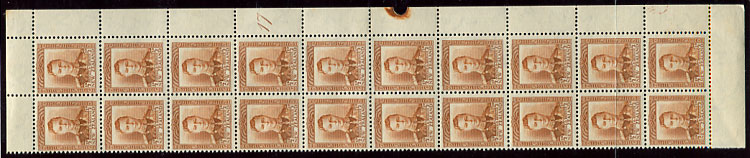
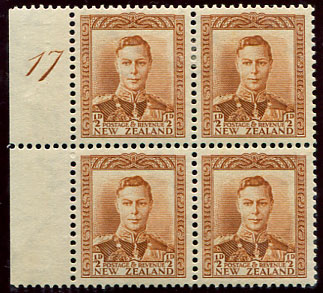
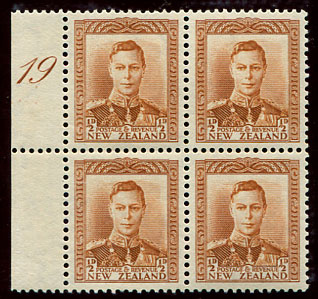
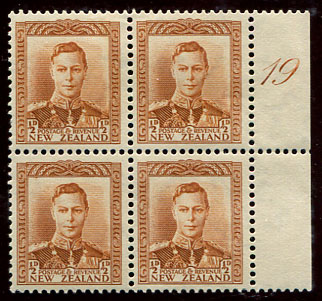
Plate numbers moved
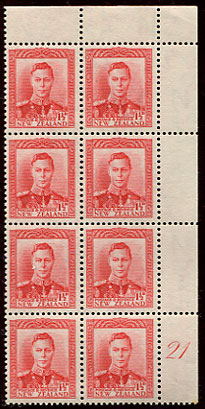
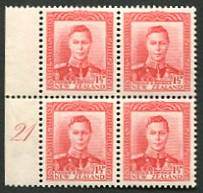
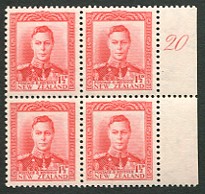
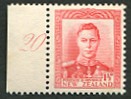
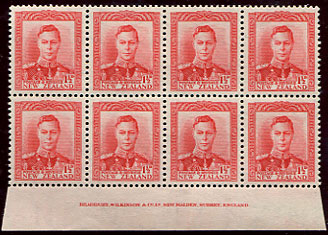
The 1½d in scarlet was initially printed on fine
paper with a horizontal mesh from plates 20 and 21
with the plate numbers at the side and the imprint at the centre of
the bottom margin.
However, stamps from these sheets were not issued until 1944
and most did not go on sale 1948.
A decision was made that the plate numbers should appear
at the bottom centre of the plate under the imprint.
Consequently, plate numbers
20 and 21 were removed from the side and re-inscribed at the bottom.
Stamps from sheets with the plate number moved to the bottom,
although printed later, were the first issued on 1 February 1944.
They were printed on a coarse paper with vertical mesh.
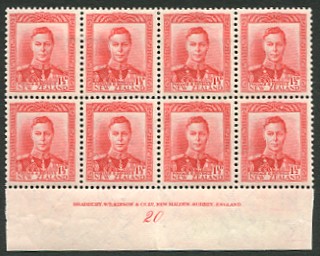
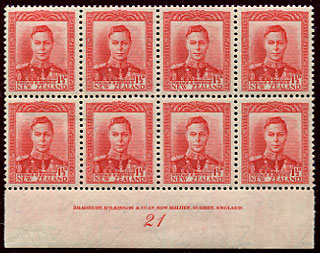
Plate numbers at centre of bottom margin
The following plates also appeared with the plate number at
the centre of the bottom margin. The dates are when they were first issued.
- ½d chestnut plate 38 (half sheets in May 1946);
- 1d scarlet plates 25 and 26 (August 1939);
-
1d green plates 26 (?) 28, 30, 31 (1944 and 1948) 29, 32 – 34, 36
(21 July 1941) 37, 42, 43 (November 1941) 47 – 50, 53 (1942)
65, 66 (April 1943) 70, 71 (July 1943) 72, 73, 77, 78, 84, 85
(November 1944); -
2d plates 40, 41, 44, 46, 51, 54, 55, 61, 62 (1 May 1947) 68,
75, 76, 79, 80, 82, 86 – 89 (May 1948); -
3d plates 27 (few November 1941, but most in 1947), 39 (26 September 1941),
45, 57, 58 (1942) 63, 67 (April 1943) and 69 (September 1943).
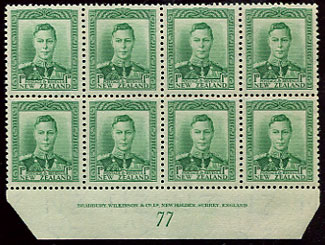
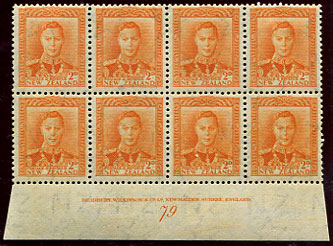

An interesting feature of the George VI stamps from these plates
is that many were first issued years after they had been printed.
For example, with the 1d green, printings from plates 29, 32, 33, 34 and 36
were issued on 21 July 1941 and some sheets from plates 28, 30 and 31
were issued in 1944 while most sheets from these plates went on sale in 1948.
The reason is that stocks were dispersed throughout the country for safe keeping
after Japan entered the World War II in December 1941.
Other supplies were lost when the ships carrying them were sunk on the
way to New Zealand.
The Centennial issue in 1940, the Peace issue in 1946 and the continued use
of many values of the Second Pictorials also contributed to the delays.
The first sheets of the twopence value were printed in 1941, but
were not issued until 1947.
Stamps from these plates exist in fine paper with both horizontal and vertical mesh
and on coarse paper with vertical mesh.
The 1d green and the 2d also exist on the coarse paper with horizontal mesh
that was primarily used for the shilling values.
Plate numbers at bottom left
The next move was that the imprint and plate numbers
appeared at the left of the bottom margin.
That layout was used with the initial
appearance of the higher pence values
and occurred on the following plates:
- ½d plates 100, 101 (September 1947) 111 (March 1949);
-
1d plates 102 – 109 (issued August 1947), 112, 113 (May 1949)
115 – 118 (February 1949) 114, 119 -122 (April 1949) 123, 124 (January 1950)
125 (January 1950) 126 (1950); - 4d plates 90 and 94 (1 May 1947);
- 5d plates 91 and 96 (1 May 1947);
- 6d plates 92 and 98 (1 May 1947);
- 8d plates 93, 95 (1 May 1947) 99 (November 1947) and 110 (September 1948);
- 9d plate 97 (1 May 1947).
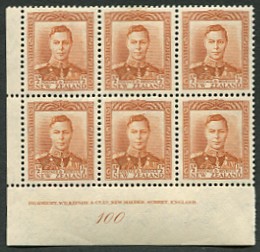
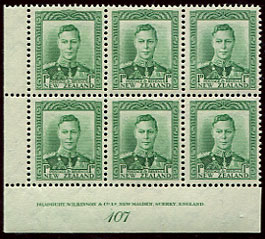
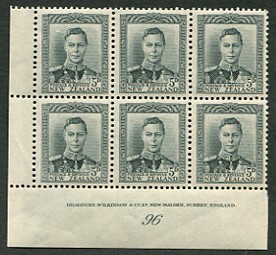

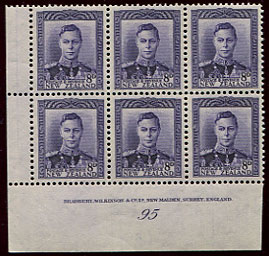
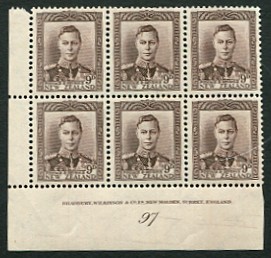
Stamps are on both fine and coarse paper with vertical mesh.
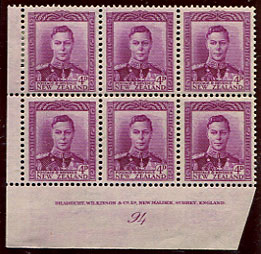
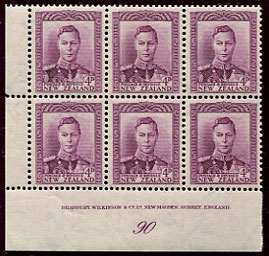
There are two distinct shades of the 4d.
The 4d on fine paper was a bright reddish purple while that on coarse
paper was in dull purple.
The shades exist on both plates.
Plate numbers at bottom right
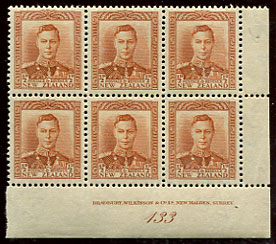

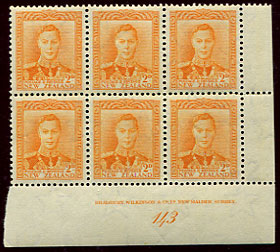
Finally, the imprint was shortened and it, together
with the plate numbers, appeared at the bottom right.
That occurred on the following plates:
- ½d plate 133 (4 December 1950);
- 1d plate 128 (January 1950);
-
1½d plates 129, 130 (17 October 1950) 131, 132 (19 February 1951)
136, 137 (5 June 1951); -
2d plates 140, 141 (4 September 1951) 142 (14 January 1952)
143 (1 April 1952) 144, 145 (1 May 1952); - 3d plates 138, 139 (2 November 1951);
- 6d plate 146 (2 November 1953);
- 9d plates 134, 135 (26 April 1951).
The stamps are on coarse paper with vertical mesh.
Counter Coil Pairs
Rolls were made up and used by counter clerks in special machines
to speed up the dispensing of stamps.
They were first used with the 2d, 5d, 6d, 8d and 1s second pictorials.
The sevedge joins had numbers applied with rubber stamps.
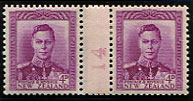
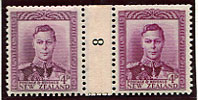
Rubber stamps were also used in the first George VI issue
with the 1d, 2d, 3d 4d, 5d and 6d values.
Later the numbers were printed and exist on 2d, 3d, 4d, 5d, 6d, 8d, 9d,
1s and 1s 3d coil pairs.
The shown coil pair numbered 8 has both shades of the 4d.


back next
The above information is taken from
The Postage Stamps of New Zealand Vols 2 and 4,
published by the
Royal Philatelic Society of New Zealand in 1950 and 1964.
All scans were made by the author.