
The aim of the Empire Air Mail Scheme (EAMS) was to provide
regular connections between the
countries of the British Empire at the very low postal
rate of 1½d per half oz.
As this was an all-up service, an air mail label was not needed.
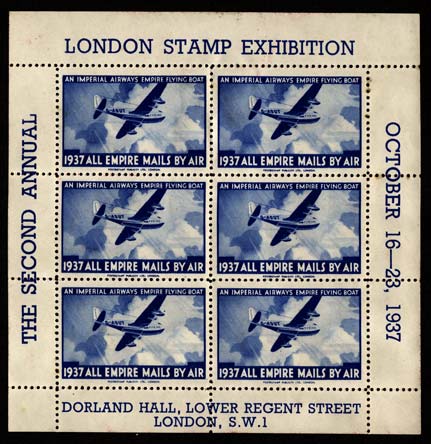
The first stage of the EAMS, between the UK and South Africa, had started on
29 June 1937.
That was commemorated by special labels produced at the London Stamp Exhibition
and shown on the right.
The second stage to Singapore started on
23 February 1938.
The third stage to Australia and New Zealand started on 26 July 1938.
From that date
all first class mail leaving New Zealand for Empire countries
was part of the Empire Air Mail Scheme.
Short S23 Empire Flying Boats had been introduced to handle the
increased postal load generated by the scheme with the first flight
from Sydney on 5 July.
The Sydney to Singapore leg was operated by Qantas with the rest
of the journey by Imperial Airways.
The New Zealand to Australia leg was still by sea.
Mail from the UK still entered Australia at Darwin, but the route within
Australia was now changed significantly and was to Sydney via Groote Eylandt, Karuma,
Townsville, Gladstone and Brisbane.
There were now three flights a week leaving Southampton on Saturday,
Wednesday and Friday and arriving in Sydney 10 days later on Tuesday, Saturday
and Monday.
The flights from Sydney left on Tuesday, Thursday and Saturday and arrived
in Southampton 10 days later on Thursday, Saturday and Monday [2].
The changes in the Australian feeder services are described by Legg [3].
First Flight from New Zealand
The last sea-mail at the 1d rate from New Zealand to the United Kingdom left Auckland on 25
July and arrived in London on 18 August, taking only 24 days.
It was sent on the SS Monterey via the USA and, as it was
the first sea-mail for almost a fortnight, consisted of 100,000 items.
The last air mail at the pre-EAMS rate
left Auckland for Sydney on the Niagara, also on 25 July.
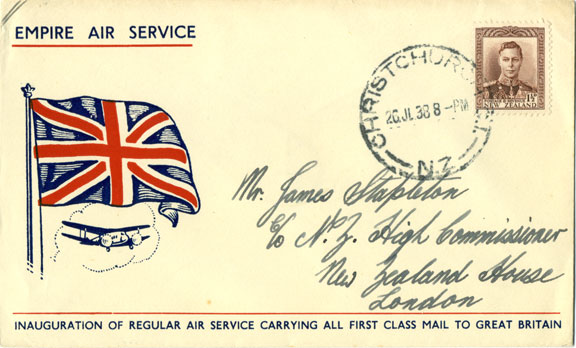
To UK
From 26 July, mail was accumulated in New Zealand and although the Awatea left
Auckland for Sydney on 1 August, it did not carry any EAMS mail.
It appears the the New Zealand Post Office wished to ensure that the first EAMS
mail did not overtake the last sea-mail.
Around 122,000 items were sent to Sydney
from Wellington on the Wanganella on 4 August and around 13,500 from Auckland on the Mariposa
on 5 August [1].
Both ships arrived in Sydney on 8 August
and the mail was flown from Sydney on 9 August,
arriving in the UK on 18 August.
Despite the fact that the flight from Australia on 9 August
was the first in the new thrice weekly service,
the mail was not backstamped on arrival in the UK.
The chief pilot was G U (Scotty) Allan, famous for his part in
the first all-Australian airmail to the
UK in 1931 and as Ulm’s co-pilot in the
first trans-Tasman airmail
in February 1934.
A 1½d value of the George VI definitives was issued on
26 July 1938 for this new service.
First day covers are shown.
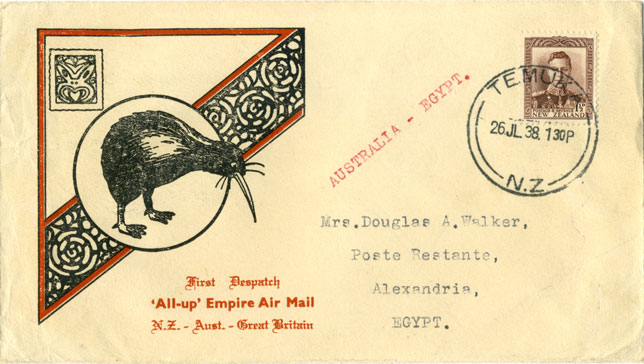
To Egypt
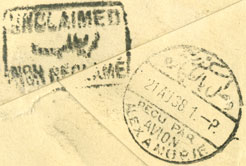
This cover is addressed to Alexandria.
While the first flight arrived in Alexandria on 16 August, the cover
is backstamped on 21 August.
It appears that the quantity of mail posted for the first flight was so large
that some of the mail was offloaded between Singapore and Karachi and had to wait
for a later flight [1].
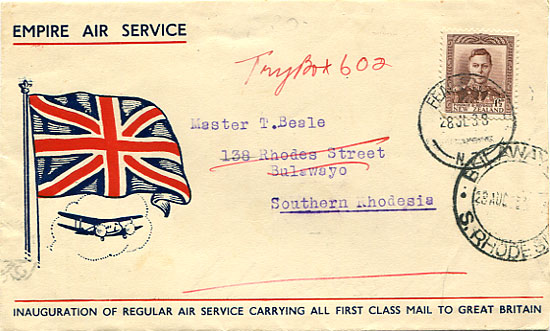
To Southern Rhodesia
The next example was flown from New Zealand to
Southern Rhodesia.
The connection with the Imperial Airways African service was made
at Alexandria in Egypt where the mail for Africa left on 18 August.

This cover was flown by IA to Beira in Mozambique where it arrived
on Sunday 21 August.
It was then flown by Rhodesia and Nyasaland Airways (RANA) to Bulawayo
via Salisbury and is backstamped at Bulawayo at 3.30pm on 22 August.
Interestingly, Walker [1] reports that the Bulawayo mail was not backstamped.
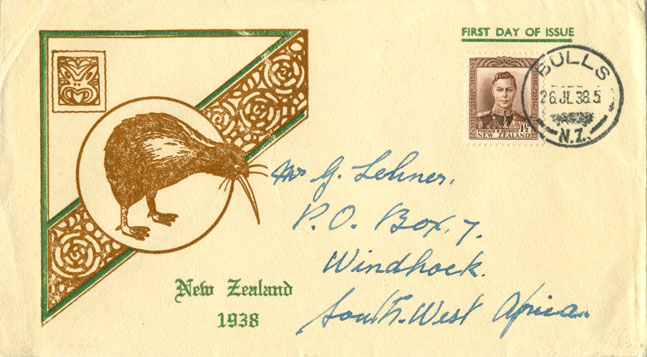
To South West Africa
The next example was flown from New Zealand to
South West Africa.
Although the mail for Egypt was delayed and did not arrive until 21 August,
the African mail connected at Alexandria on 18 August.
The mail for South West Africa was flown by IA to Laurenco Marks
in Mozambique where it arrived on 21 August.
From Laurenco Marks it was flown by South African Airways
first to Germiston Airport in Johannesburg on 22 August and from there to
Windhoek on 24 August.
Before the introduction of the EAMS, the cost of the
service to Southern Africa was 2s 9d.
First Flight to New Zealand
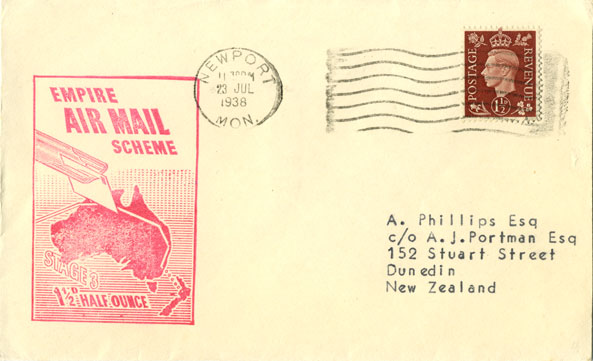
From UK
The first airmail for New Zealand at the new rate left Southampton
on July 28.
Due to the size of the mail two flying boats, Calypso and
Cameronian, were required to carry the mail [2].
The cachet on the cover was applied privately and is
a copy of the logo used on the official Post Office brochure.
The mail on the Cameronian was transferred to the Capella
in Alexandria on 29 July and the Capella then flew to Sydney arriving a day late
on 6 August with the mail for New Zealand.
The Calypso continued on from Alexandria, but had engine trouble
in Bima in the Dutch East Indies.
The mail was picked up there by the Cameronian which
arrived in Sydney on 9 August.
The mail missed the connecting trans-Tasman steamer Awatea which left on 5 August
and was sent from Sydney to Auckland
on the cargo ship Kairanga on 6 – 13 August.
As it did not arrive until late on 13 August,
mail was not delivered in Auckland until Monday 15 August while
mail for Wellington was sent on the overnight express train on 14-15 August
and was also delivered on 15 August.
Mail was not delivered in Dunedin until 16 August [1].
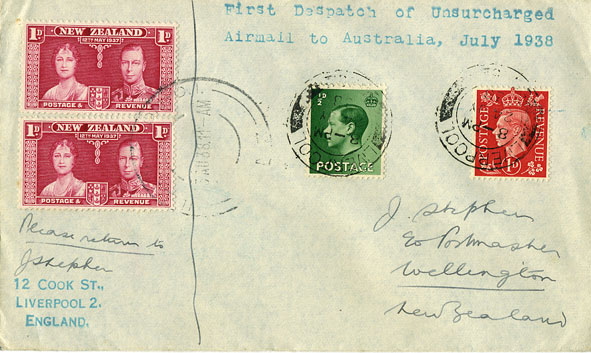
From UK and Return
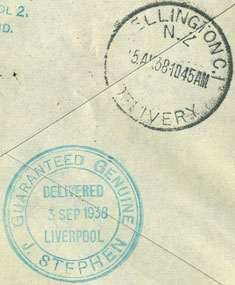
This cover was sent on the first EAMS service to New Zealand with instructions that
it should then be returned to the UK.
It is postmarked in Wellington on 15 August which fits with the arrival
date in Auckland late on 13 August.
It has a handstamp stating that it was delivered in Liverpool on 3 September.
That suggests that it was flown on service SW 7 that left Sydney
on 23 August that arrived in Southampton on 2 September.
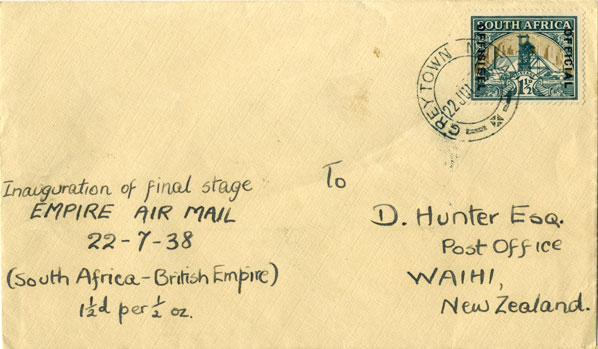
From South Africa
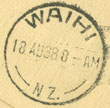
This cover is postmarked 22 July in Greytown (Natal) and would be flown from
Durban on 24 July to Alexandria.
There was plenty of time to join,
on 29 July, the flight that had left Southampton on 28 July
and be flown from Alexandria on the same flight as the previous cover.
The cover is backstamped at Waihi on 18 August.
However, Waihi is only 150 km from Auckland where the first EAMS mail
arrived on 13 August.
Similarly, a registered cover from South Africa shown in Walker [2]
is backstamped in New Zealand on 19 August.
That suggests the mail from South Africa did not connect at Alexandria
with the first EAMS flight.
When Pan American started their
trans-Atlantic route in May 1939, they
accepted mail for New Zealand. It connected with the Empire
Airmail Scheme in London.
Crash of the Calpurnia, 1938
Flying was still dangerous and there were several crashes
from which covers were salvaged.
The one from which the largest number of covers is still available
is the crash of the Calpurnia
in Iraq on 27 November 1938.
On the 23 and 24 November 1938, Short S23 Empire flying boats
left the UK for Alexandria where
Australian and New Zealand mail from both flights was
loaded on the Empire flying boat Calpurnia.
The flight from Alexandria was to Tiberias on the sea of Galilee and
from there to Lake Habbaniyah near Baghdad.
On 27 November, in the dark and during a sandstorm,
the Calpurnia crashed on landing in Lake Ramadi (12 miles
from Lake Habbaniyah)
killing the four flight crew: pilot Captain Attwood, First Officer Spottiswood, Radio Operator Bayne-Rees
and Flight Clerk Ubee.
Two passengers and the stewardess survived [7].
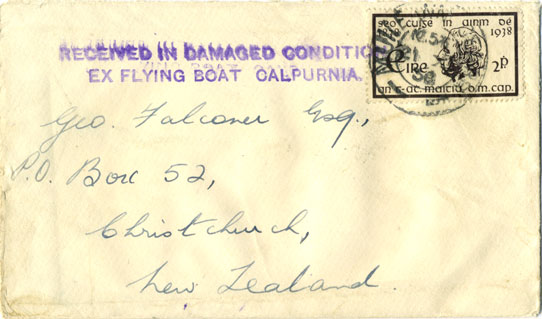
The RAF retrieved a large part
of the mail from the water including 60 of the 69 mailbags
for New Zealand.
An attempt was made to dry the mail before it was sent to
Sydney. The New Zealand mail was sent on to Auckland
where it was dried further.
Great efforts were made to deliver the mail and to decypher
washed out handwriting.
Several different cachets were applied in New Zealand: at
Auckland, Christchurch and three at Wellington.
The example cover has one of the Wellington cachets.
The cover was posted in Ireland and has a
21 November postmark.
It would have been carried to Southampton to join the Imperial
Airways flight on either 23 or 24 November.
The first mail from the flight arrived in Auckland on 19 December
with further mail arriving over the next three weeks.
A manuscript on the back states that the above cover was received
in Christchurch on 31 December.
Many of the covers had the stamps washed off and some New Zealand post offices
applied postage due markings which was against UPU regulations [7].
Later Overseas Mail
Mails to non-Empire destinations were not part of the EAMS and so cost a great deal
more.
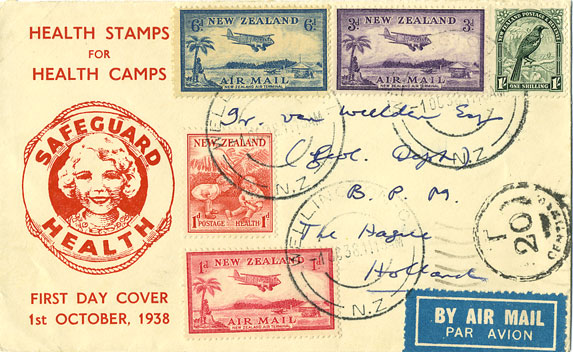
Netherlands October 1938
This cover is postmarked on 1 October 1938, the first day of issue of the
1938 Health stamps.
It is addressed to the Netherlands and is franked with 1/11 instead of the required 2/-
and so has a T 20 centimes handstamp indicating how much to pay in postage
due.
That corresponds to 2d to pay, i.e. that the cover is underfranked by 1d.
The rate to Holland had been 1s 9d in 1935.
A new winter timetable had been introduced at the beginning of October [2].
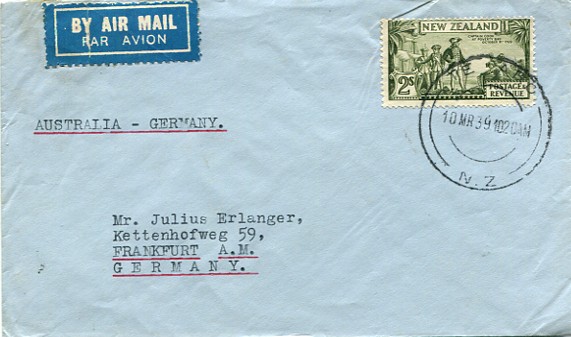
Germany March 1939
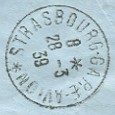
This cover is postmarked in New Zealand on 10 March 1939 and is
addressed to Frankfurt with routing instructions Australia – Germany.
It would be sent on the Awatea that left Auckland on 14 March and arrived in Sydney on 17 March.
It would be flown on SW 96 that left Sydney on 18 March.
Most mail to Germany was offloaded in Athens and was then flown by DLH to Germany.
However this cover has a Strasbourg Gare Avion transit on 28 March and so it was flown on to Brindisi, arriving there on
26 March,
and then went to Frankfurt by rail via Strasbourg.
USA June 1939
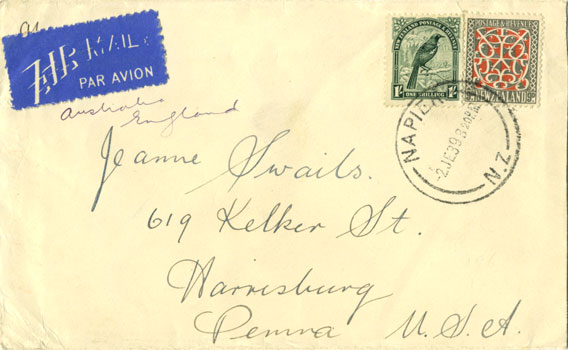
This cover is postmarked in Napier, New Zealand on 2 June 1939 and is
addressed to the USA with routing instructions Australia – England.
The route was sea to Sydney, Sydney to UK by air and UK to USA by sea.
From October 1935 until March 1938, the rate was 1s 6d, but was then increased to 1s 9d [11].
It would have been sent trans Tasman from Auckland on the Awatea on 6 June arriving
in Sydney on 9 June and then flown on the flight from Sydney on 10 June,
arriving in Southampton on 19 June.
Mail that had been flown on the previous flight from Sydney on 8 June was on the Centurion that sank
on the Hooghly River, Calcutta on 12 June [2].
The mail from New Zealand was submerged and the salvaged mail has special handstamps.
Once the PanAm trans-Atlantic airmail
started, mail on this route could also
be flown trans-Atlantic from Marseilles at a total cost of 3s 6d [4].

Italy, July 1939
The rate to Italy was 1s 9d even
though Rome was on the IA route from Australia to UK
and the Empire Airmail Scheme meant that the cost to the UK was only 1½d.
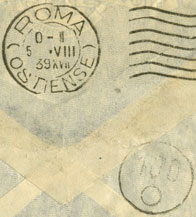
This cover is addressed to Rome.
It is postmarked on 21 July 1939,
has a Rome backstamp on 5 August and
would be flown on the flight that left Sydney on 27 July and was scheduled
to arrive in Rome on 4 August.
I am not sure of the meaning of the 100 O backstamp.

From Dutch East Indies, February 1939
This commercial cover is postmarked in Batavia on 1 February 1939 and is addressed
to Auckland.
It is correctly franked with 25c made up of 10c air mail fee plus 15c surface postage [10].
It would have been flown by either KNILM or Qantas
to Australia.
The KNILM route had been set up the previous year.
Although it has the routing instructions By Air to Australia and
onward Air transmissions, there was no air service to New Zealand from Sydney.
Last Flights before World War II
With the outbreak of war on 3 September 1939, the Empire Air Mail Scheme
was immediately suspended and postage rates returned to their
earlier levels of 1s 6d from New Zealand to the UK
and 1s 3d from the UK.
NZ Mail which arrived in UK before outbreak of war
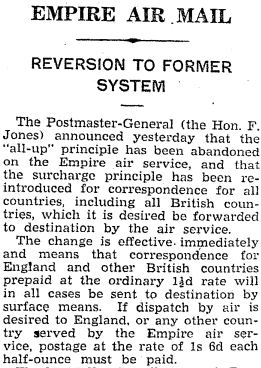
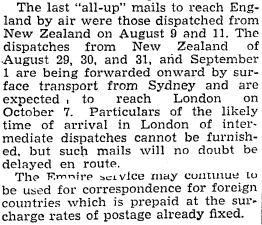
Walker [1] quotes the New Zealand Postmaster-General as saying on 4 September that the last mail
flown all the way from Australia to the UK on the EAMS left New Zealand
by sea on 9 and on 11 August and that EAMS airmail still in transit on 3 September
completed its journey by sea.
The report shown here from the Evening Post of 5 September 1939 [8] only states that
the PostMaster-General expected that this mail would no doubt be delayed en route.
However, this report does not mention mail sent between 11 August and 29 August.
Moreover, I have been unable to find any record of an 11 August dispatch to the UK.
As well as the 9 August dispatch, there were dispatches from New Zealand on 18 and 19 August that arrived in the UK before the outbreak of war.
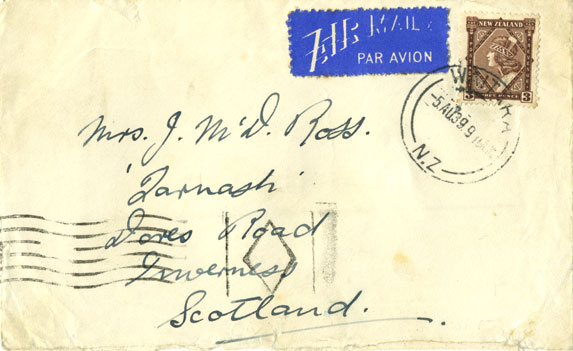
The 9 August dispatch was on the Awatea from Wellington to Sydney arriving on 12 August and then
flown on SW 160 on 15 – 24 August.
The shown cover is postmarked on 5 August in Waitara (near New Plymouth)
and was carried on the 9 August dispatch.
It is franked with the double rate of 3d.
The 18 August dispatch was on
he Wanganella from Auckland to Sydney arriving on 22 August and the
19 August dispatch was on the Maunganui from Wellington to Sydney arriving on 23 August.
Both connected with SW 164 which left Sydney on 24 August with mail due in London on 2 September
although it actually arrived on 3 September.
War was declared later that day.
Later connections from New Zealand
The Maetsuycker left Wellington on 21 August (due Sydney August 25) to connect with SW 165 which left Sydney on 26 August with mail due
in London on September 4 while
the Monowai left Auckland on 22 August (due Sydney August 26) to connect with SW 166 leaving Sydney on 29 August with mail due in
London on 7 September [8] although it arrived on 9 September.
Despite what was said by the New Zealand Postmaster-General, EAMS mail on these dispatches appear to have
been flown all the way from Sydney to the UK.
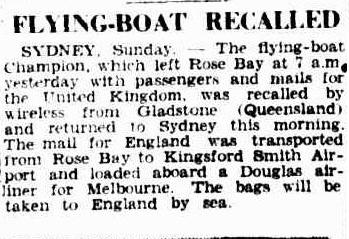
Flight SE 168 from Sydney on 2 September
However, that was not the case with SW 168 which was recalled because of concern about Italy and Japan declaring war.
According to
The Argus of Melbourne on 4 September [9]: flight SW 168 from Sydney
on 2 September was recalled from Gladstone in Queensland and the EAMS mail was flown from Sydney
to Melbourne on 3 September before being sent to Britain by sea.
Non EAMS mail from SW 168 was subsequently flown on SW 169 on 6 September.
No New Zealand mail had connected with SW 168.
New Zealand EAMS mail held up in Sydney and sent by sea
The Maunganui left Auckland on August 29 and was due in Sydney on 2 September;
the Kaituna left Dunedin on 30 August and was due in Sydney on 3 September;
while the Wanganella left Wellington on August 31 and was due in Sydney on 4 September.
The EAMS mail from these sailings was sent by sea from Sydney, although non EAMS mail was
flown from Sydney on SW 169 on 6 September.
After 28 August, the Evening Post stopped giving details of overseas dispatches.
Mail to Germany / Austria / Poland
It was not just EAMS mail that was affected, but mail services to Germany (Austria) and Poland were suspended
in early September.
Legg [6] shows a registered cover postmarked in Melbourne on 30 August and
addressed to Vienna, Germany which has an Athens transit mark on 9 September which date fits with SW 167
which left Sydney on 31 August.
It has Vienna datestamps on 13 and 14 September.
The time taken to get to Vienna is due to DLH suspending their air mail service from Athens between
1 September and 3 October [12].
So mail already in transit from Sydney was allowed to continue.
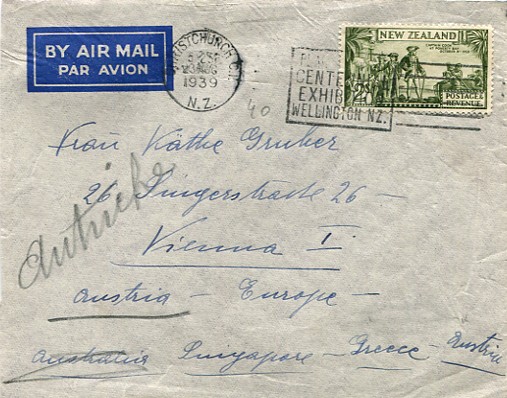
The shown cover is postmarked in Christchurch on 23 August 1939 and would have been sent on the Maunganui.
It is addressed to Vienna, Austria with routing instructions Australia – Singapore – Greece – Austria and is
correctly franked with 2s 0d.
The intention would be for it to have been flown on SW 169 on 6 September.
However, there are no transit datestamps.
As war with Germany (Austria) had been declared on 3 September, it is likely that this cover was not flown,
but held in Australia, perhaps for the duration of the war.
Not clear how it subsequently appeared on the open market.
However, I have scans of a registered cover to Vienna, postmarked in Sydney on 17 August, which has an Athens transit
on 27 August, but which does not have a Vienna arrival mark and a cover to Poland (with routing instructions Via Greece)
postmarked in Sydney on 23 August which has no transit marks although it would be expected to have been flown on SW 164
which arrived in Athens on 1 September.
However, that was the day that Germany invaded Poland and so perhaps that cover did not proceed further.


back next
All scans were made by the author.
Information on this page is taken from:
[1] Airmails of New Zealand, volume 2 (1986) compiled by
Douglas A Walker,
Air Mail Society of New Zealand
[2] Aircraft Movement on Imperial Airways’ Eastern Route, vol 2 1937-39
Peter Wingent, Winchester 2005.
[3] W Legg, Landplanes v Flying-boats, Air Mail News, vol 35,
pp 10 – 18, 1992.
[4] R P Odenweller, The 1935 Pictorial Issues and Associated Rates
with Dates of Printing of Varieties Part 2: Overseas Postage Rates and
Notable Events (1932 – 1939), The Kiwi, vol 53, pp108 – 111, September 2004.
[5] Bridging the Continents in Wartime: Important Airmail Routes 1939-45,
H. E. Aitink and E. Hovenkamp, SLTW, Enschede, 2005.
[6] W.H. Legg, Early Wartime Airmails,
Air Mail News, vol 46, pp 197-204, November 2003.
[7] Sanford K.C., Air Crash Mail of Imperial Airways and Predecessor Airlines,
published by The Stuart Rossiter Trust Fund, 2003.
[8] Evening Post Wellington 1916-1945, Papers Past,
available at: paperspast.natlib.govt.nz/cgi-bin/paperspast
[9] Australian Newspapers 1803-1954,
Trove, National Library of Australia
[10] Air Mail Operations During World War II, T H Boyle, American Air Mail Society, 1998.
[11] New Zealand Overseas Airmail Postage Rates, R M Startup, Mowbray Collectables &
Air Mail Society of New Zealand, 2013.
[12] Private communication, P Wingent.