
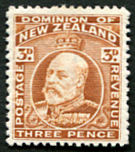
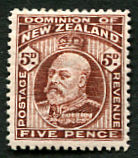
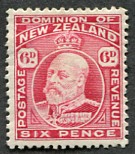
Edward VII was King from 1901 until 1910, but the definitives were
not issued until 8 November 1909.
The stamps were withdrawn after a few weeks so that remaining stocks
of the first pictorials could be sold.
Few were therefore sold during the lifetime of Edward VII.
The stamps
The halfpenny was surface printed from plates with 240 impressions
made by Perkins, Bacon
while the other values were recess printed from plates with
120 impressions made by Royle.
Printing was at the Government Printing Office in Wellington.



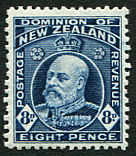
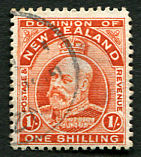
Change of colour
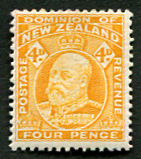
It was felt that the 4d could be easily confused with the 1/-
value and so its colour was changed to yellow. The stamp
in the new colour was issued on 5 January 1912.
Most values were replaced by the George V definitives in 1915,
but that issue initially did not have 5d or 8d values and so
these Edward VII stamps remained in use until December 1922
and May 1921 respectively.
Booklets
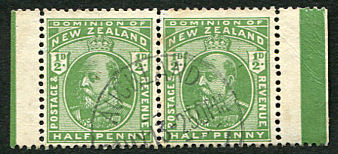
Stamps were issued in 1910 from booklets along with the
penny dominion.
Two special electrotype plates were made at the Government
Printing Office in Wellington.
In the second plate, one stamp in each block of six was
replaced by a star so that ½d could be charged for
the booklet.
The quality of the impression from the electrotype
plates is poorer than from the ordinary sheet stamps
and this became worse as the plates became worn.
On 19 May 1912, there was a second issue of booklets containing 18 1d stamps and 12 ½d
stamps and so the block containing the star was not used.
The blocks in this issue had selvedge bars which were not present in the first issue.
Perforations
The following perforations exist:
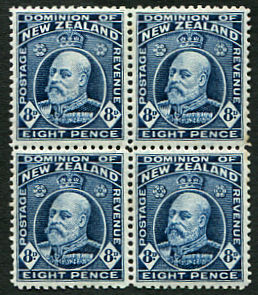
Line perf 14
The 3d, 4d (orange), 5d, 6d and 1/- exist with
this perforation and were issued in 1909 or 1910.
The 8d value with this perforation
always has a sideways watermark and was issued in August 1916.
Only 2000 sheets were printed and it is on the paper previously
used for the 2½d of the first pictorial issue.
Line characteristics can be clearly seen in a block of four.
Comb perf 14 x 15
Used for the ½d value only.
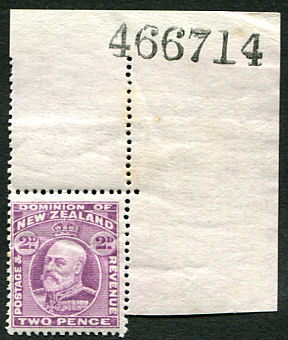
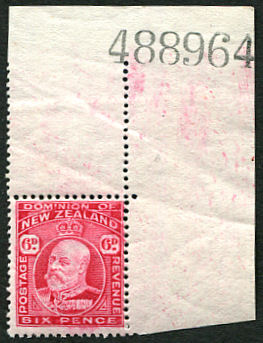
Comb perf 14 x 14½ throughout sheet
All recess-printed values (including both colours of the 4d) exist
with this perforation.
The examples on the right have this perforation and show the
sheet number.
As stamps with these perforations often show line characteristics,
they are not always
easy to distinguish from those with line perf 14.
Comb perf 14 x 13½ throughout sheet
This machine was introduced in 1914.
It was only used throughout the sheets for the 3d and 6d values.
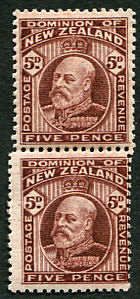
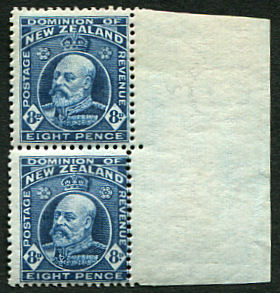
Top 4 rows perf 14 x 13½,
lower 6 perf 14 x 14½
This combination was used for the 3d, 5d, 6d and 8d values.
It leads to “two-perf pairs” where the top stamp is perf 14 x 13½
and the lower stamp 14 x 14½.
There is often a discontinuity in alignment
between the two perforations
as in the two-perf pairs on the right.
The plates
There were several plates of the recess printed stamps.
There were no plate numbers, but for values where more than one plate was used,
dots were added by the printer to the bottom selvedge.
-
2d: four plates were made, but two were defective.
Stamps were issued from plates with 2 and 4 dots in the selvedge. - 3d: four plates were made and used with 1, 2, 3 and 4 dots in the selvedge.
- 4d: one plate was made and used.
- 5d: one plate was made and used.
- 6d: four plates were made and used with 1, 2, 3 and 4 dots in the selvedge.
- 8d: two plates were made and used with 1 and 2 dots in the selvedge.
- 1s: two plates were made and used with 1 and 2 dots in the selvedge.
Overprinted Official
The ½d, 3d, 6d, 8d and 1s values were overprinted OFFICIAL.
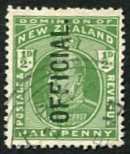
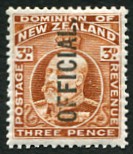
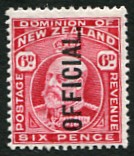
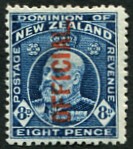
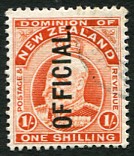
The ½d, was issued in January 1910; the 3d perf 14 x 14½ in October 1910 and a small issue
in two perf sheets in August 1915; the 6d perf 14 x 14½ in June 1910; the 8d in two perf sheets
in May 1916 and the 1s perf 14 x 14½ in November 1910.

next
The above information is taken from The Postage Stamps of New Zealand Vol 1, published by the
Royal Philatelic Society of New Zealand in 1938.
All scans were made by the author.