
New Zealand’s first two commemoratives were for the Christchurch
Exhibition in 1906 and for the Auckland Exhibition in 1913.
Christchurch Exhibition 1906

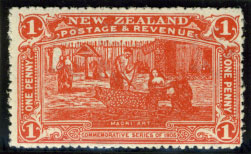
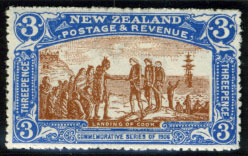
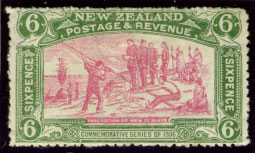
W. R. Bock produced the dies in Wellington and electrotype
plates were produced at the Government Printing Office.
There were four values: ½d, 1d, 3d and 6d.
The sheets were arranged in two panes of thirty. The watermark
was sideways NZ and star and often appears inverted.
The perforation was 14.
The stamps were on sale at the Exhibition from November 1906
until April 1907. Initially, there was a limit on how many
stamps could be bought at one time. The total number issued
was not large:

½d: 120,000
1d: 240,000
3d: 60,000
6d: 80,000
The fact that the current catalogue value of the 6d value is several
times that of the 3d suggests that a significant number
of the 6d issue remained unsold and were destroyed.
An initial printing of the 1d was in claret,
but most of this stock was destroyed.
One sheet was sold, but most copies were not recognised
at the time and so this stamp is a great rarity.
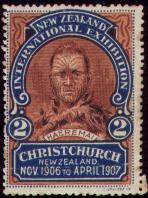
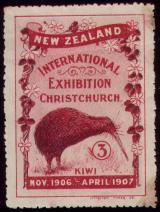
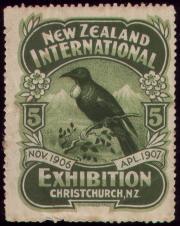
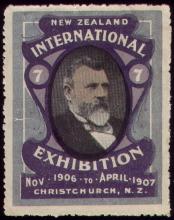
A set of commemmorative labels were issued to celebrate the exhibition.

Auckland Exhibition 1913
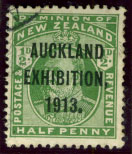

Although George V was now King, this issue consisted of
overprints on the ½d, 3d and 6d Edward VII definitives
and on the 1d dominion.
The stamps were on sale from 1 December 1913 until 18 April 1914.
Sales were not high.
The estimated numbers sold are:
½d: 20,000
1d: 50,000
3d: 10,000
6d: 15,000
They are therefore relatively uncommon and consequently expensive.
Collectors should be on their guard against forgeries.

back
The above information is taken from The Postage Stamps of New Zealand Vol 1, published by the
Royal Philatelic Society of New Zealand in 1938.
All scans were made by the author.