
The Centennial Issue was issued in 1940 to celebrate the centenary
of British sovereignty.
The plates were produced by Bradbury, Wilkinson & Co who
recess printed the stamps in the UK.
The stamps were issued on 2 January 1940
and the second pictorials
were withdrawn from sale.
The aim was that this issue was to be the definitive issue
during 1940 after which they would be withdrawn and the
second pictorials put back on sale.
However, due to wartime conditions, they remained on sale
until stocks were exhausted which, except for the ½d
and 1½d values, was during 1941.


The 2½d and 5d values were issued in sheets of 160 while the
other values were in sheets of 120.
They were watermarked multi NZ and star.
The 2½d value was perf 14 x 13½, the 5d was perf
13½ x 14 while the other values were perf 13½.

Due to the increase in postal rates in World War II, the
7d value was no longer required while an 8d value was needed for
parcel post.
The 7d value was withdrawn on 7 March 1940 and
an 8d value, in the same design and colour as the 7d, was
issued the next day.

Due to changes in postal rates, there was little demand for the
½d and 1½d values.
The ½d value was eventually withdrawn on 31 May 1946.
New Zealand introduced an airgraph service with a postal rate of 10d.
To satisfy this, the remaining stocks of the 1½d Centennial
value were withdrawn on 31 January 1944 and 3,842,280 were surcharged 10d.
The surcharged stamp was issued on 1 May 1944.
The need for the 10d stamp did not last very long as the airgraph fee
was reduced from 10d to 3d on 24 August 1944.
The total numbers printed are given below with
the numbers subsequently overprinted Official
given in brackets.
The 5d and 7d were not overprinted.

½d: 38,040,000 (1,082,760)
1d: 79,279,920 (3,452,880)
1½d: 11,552,000 (361,200) with 3,842,280 surcharged 10d
2d: 117,180,000 (6,960,360)
2½d: 2,280,000 (241,600)
3d: 8,760,000 (904,200)
4d: 3,840,000 (481,200)
5d: 3,280,000
6d: 6,480,000 (661,200)
7d: 1,140,000 with 591,608 sold
8d: 3,600,000 (240,840)
9d: 2,640,000 (241,200)
1/-: 3,978,360 (372,840)
Plate Blocks
A large number of plates were used for the 1d and 2d values this issue.
For the 1d, there were frame plates 1 – 6 and centre plates A – J while with
the 2d, there were frame plates 1 – 10, and centre plates A – L although not all possible combinations exist.
There were two frame and two centre plates for the ½d, 3d and 10d values, two frame and
three centre plates for the 1½d, one frame and two centre plates for the 9d
while the other values had one centre and one frame plate A1.
Examples of the 1½d, 2½d and 10d are shown below.


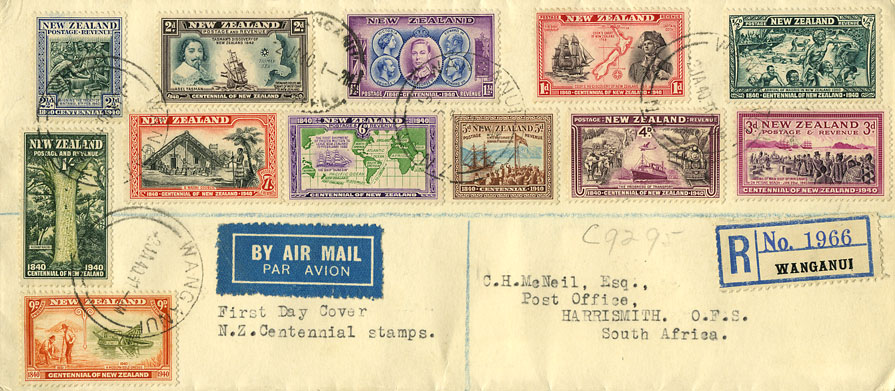
First day cover
This first day cover, addressed to South Africa, has the complete set issued on 2 January.


back next
The above information is taken from The Postage Stamps of
New Zealand Vol 2, published by the
Royal Philatelic Society of New Zealand in 1950.
All scans were made by the author.