
This page deals with the gradual introduction of Short S23 flying boats on the
Imperial Airways Eastern Route.
Until February 1937, the Paris – Brindisi stage of the Eastern Route was by rail.
In February 1937, Short S23 flying boats were introduced on the Southampton –
Alexandria section; in October 1937, on the Southampton – Karachi section;
in February 1938, on the Southampton – Singapore section; and in June 1938,
on the complete route to Australia.
The introduction of flying boats was central to the introduction
of the different stages of the Empire Air Mail Scheme with the
first stage to Africa being started on 29 June 1937, the second stage to India and Malaya
in February 1938 and the third stage to Australia and New Zealand in July – August 1938.
Southampton – Alexandria by Flying Boat, February 1937
From the flight that left Brisbane on 24 February 1937, Alexandria – Southampton
was by flying boat.
The route from Alexandria was via Mirabella (Crete), Athens, Brindisi, Rome and
Marseilles to Southampton.
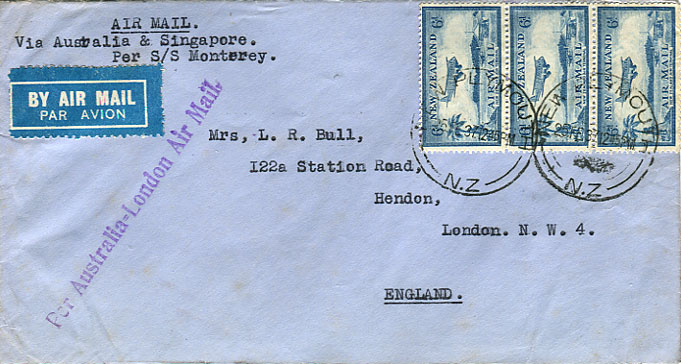
Per Australia=London cachet
This cover is postmarked in New Plymouth on 25 February.
The next trans-Tasman sailing was not until 2 March on the Awatea which
arrived in Sydney on 5 March [11] and would have connected with
the fourth service, IW 529, on the new route.
Due to bad weather, the previous service IW 528 had the Macon to Paris stage by train
and the leg from Paris was to Croydon, not Southampton [3].
This cover has an unusual cachet Per Australia=London Air Mail.
There were articles about this cachet in the Kiwi several years ago [9] and
it is discussed in Walker [1].
All the examples are postmarked, like this one, in New Plymouth and
dates range from 1936 to 1939.
A possible explanation is that the cachet was applied by the post office to
covers that did not have the correct routing instructions.
After going to Sydney by sea,
New Zealand air mail for Great Britain was taken by overnight rail to Cootamundra and
flown from there
by Butler Air Transport to Charleville where it joined
the Brisbane – Southampton service.
With the introduction of flying boats on the Alexandria – Southampton section,
the only part of the route from
Sydney that was not flown was now the leg to Cootamundra.
Mail from Melbourne and Adelaide to the UK was also first sent to Cootamundra by rail.
According to Legg [6], this was because of the influence that the railway companies
had with the Australian Government.
Other destinations from New Zealand: off-loaded in Italy
Mail for Germany, Switzerland and Finland was off-loaded in Italy (Brindisi) and then
continued to its destination by rail.
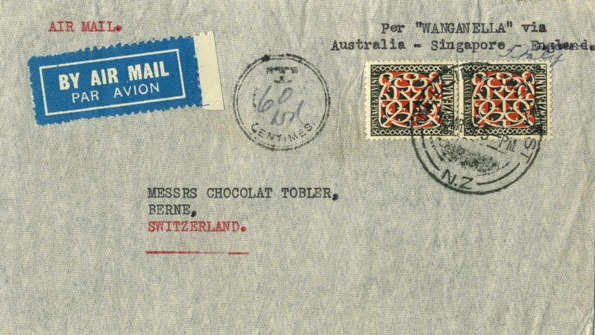
to Switzerland, March 1937
The rate of 1s 6d was for the complete journey from New Zealand to the UK.
Although the route to the UK was via Greece, Italy and France,
the postage rate to these countries from New Zealand was 1s 9d.
This cover is postmarked in Wellington on 18 March 1937 and is
addressed to Switzerland.
However, it only has franking of 1s 6d rather than the required 1s 9d
which is why it has a postage due T imprint with
60 centimes to pay.
That corresponds to the cover being underfranked by 3d.
The Wangenella left Wellington on 18 March and was due in Sydney on 21 March.
The cover has routing instructions Australia – Singapore – England, but the
England has been scored out and replaced by Italy as it would have
been off-loaded in Brindisi on flight IW 534 that arrived there on 4 April [3].
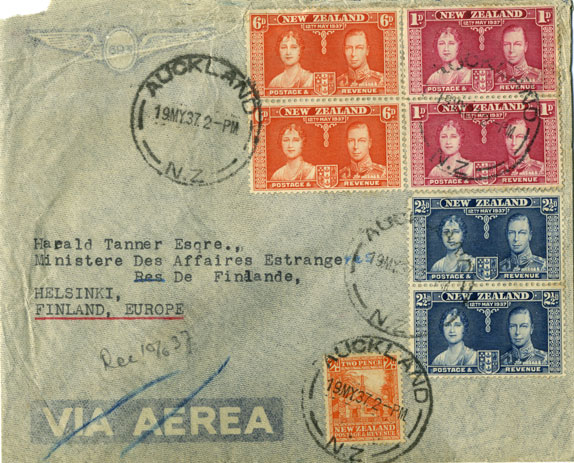
to Finland, May 1937
This cover is addressed to Helsinki and has the correct franking of 1s 9d.
It was posted in Auckland on 19 May and has a manuscript
note that it was received on 10 June.
The Awatea left Auckland on 19 May and so this cover
would be flown on flight IW 552 that left Brisbane on
26 May and arrived in Brindisi on 5 June.
Athough, it has no routing instructions, it would be offloaded in Brindisi
and have gone from there to Helsinki by rail.
The Via Aerea has been crossed out by two parallel blue lines
to indicate that the airmail part of the route was over.
However, the Brindisi handstamp was a thick black cross [4] while the lines seem to have been
applied with a blue pencil and so may have been added later in the journey.
IW 552 was in Karachi on 2 June and the mail would have been expected to
be transferred to the HP 42 Hengist.
However, it had been destroyed by fire in Karachi two days earlier.

to Germany, August 1937
This next cover is addressed to Germany and has routing
instructions Per Australia-Italy Airmail.
It has a Late Fee handstamp which is the reason that
it is franked with 1s 10d rather than the usual 1s 9d.
This cover is postmarked in Wellington at 4pm on 20th August 1937.
The mail for the Awatea closed at 3pm on 20th August, but was accepted at the Central Post Office
in Wellington up to 4pm for the payment of a late fee.
The Awatea was due in Sydney on 23rd August and so the mail would connect at Charleville with
service IW 578 which left Brisbane on 25 August and arrived in Brindisi in the afternoon of 4th September.
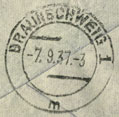
It would be offloaded there and taken to Germany by train, arriving in
Braunschweig on 7 September.
Other destinations: to / from Africa
to South Africa, May 1937
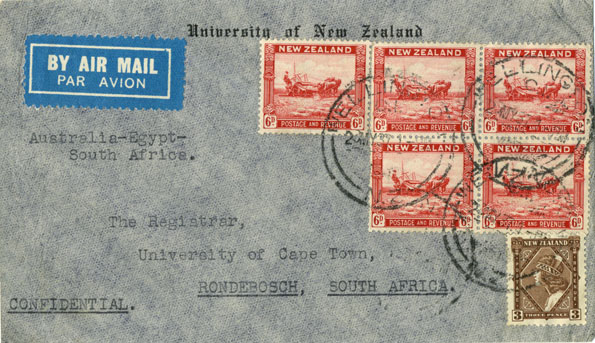
This cover is to South Africa and is postmarked in Wellington on 20 May 1937
and has the correct franking
of 2s 9d which was also the rate for Bechuanaland and South West Africa.
It has the approved routing instructions of
Australia – Egypt – South Africa.
The first airmail from New Zealand to Africa
had been in June 1932.
It was carried on the Wanganella from Auckland to Sydney 27-31 May
and then connected with IW 554 that arrived in Alexandria on 12 June
from where it would be transferred to the African service.
from South West Africa

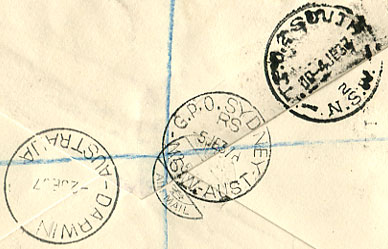
This cover is from South West Africa to New Zealand and was posted on 12 May 1937,
the first day of issue of the Coronation set.
As it has the complete set in both languages it is significantly overfranked.
It was first flown to Egypt where it joined the IA Eastern Route service
to Australia on 25 May.
The cover is registered and was backstamped at Darwin on 2 June.
The final leg to Sydney was by train from Cootamundra on 4 – 5 June and
it has a TPO (railway travelling post office) backstamp on 4 June and a
Sydney backstamp on 5 June.
It was then carried to New Zealand by sea, but was not backstamped on arrival there.
Internal flight only
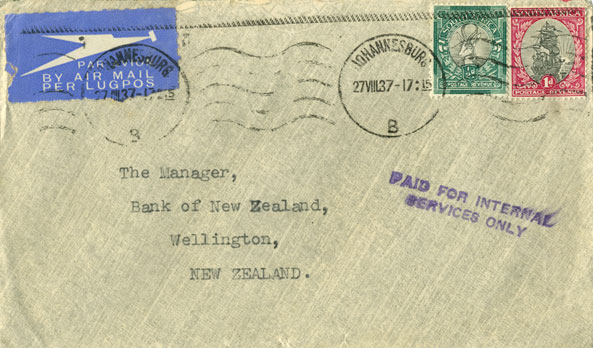
This cover is postmarked on 27 August 1937 which is after the first stage of the
Empire Air Mail Scheme (EAMS) had ben started from South Africa on 29
June 1937,
but before it had been extended to Australia and New Zealand on 26 July 1938.
It is franked with 1½d, the EAMS rate and so has sufficient
postage to be flown to the UK, but has a rubber cachet stating
Paid For Internal Services Only and so would be presumeably flown
from Johannesburg to Capetown and then sent to New Zealand by sea.
Southampton – Karachi by Flying Boat, October 1937
There were two services per week in each direction between Southampton and Brisbane.
From 3 October 1937, the Sunday service was flown all the way from Southampton to Karachi
by flying boat while the Thursday service continued to be flown by HP 42
landplanes between Alexandria and Karachi [3].
The route from Alexandria was Tiberias (Lake of Galilee),
Baghdad, Basra, Bahrein, Dubai, Gwador, Karachi.
In the opposite direction, from 29 September, the Wednesday service from Brisbane
was flown by flying boat from Karachi to Southampton while the Saturday service
was flown from Karachi to Alexandria by HP 42s [3].
The introduction of flying boats on the Karachi – Alexandria leg reduced
the travel time by one day.
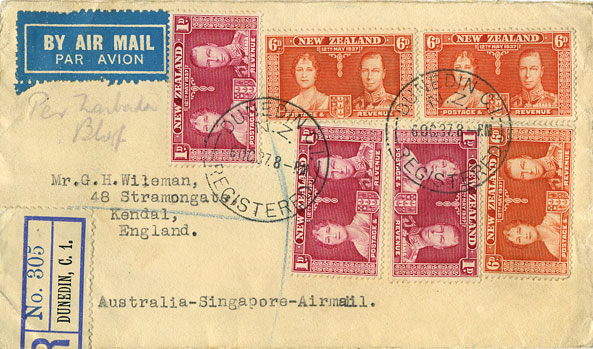
Flown October 1937
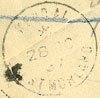
This registered cover is postmarked in Dunedin on 6 October 1937
and is backstamped Kendal, Westmorland in the north-west of England on 28 October
and so it will have joined the service IW 593 that left Brisbane
on Saturday 16 October and arrived in Southampton on 27 October.
As a registered cover, it is franked with 1s 9d which includes 3d registration fee.
It has Per Narbada Bluff in manuscript and that indicates how it was sent to Australia.
The Narbada was due to leave Bluff around 6 October bound for Calcutta [11].
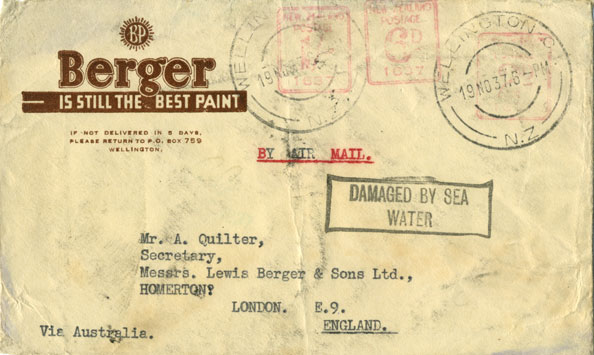
Cygnus crash
This cover is postmarked 19 November 1937 in Wellington and was carried
from Wellington to Sydney on the Maetsuycker on 20 December and joined
flight IW 604 that had left Brisbane on 25 November.
The S23 flying boat Cygnus left Karachi on 2 December 1937
and landed in Brindisi in Italy on 4 December.
It then crashed when taking off from Brindisi on 5 December.
A steward and a passenger were killed.
The cover is one of 8,000 from New Zealand
salvaged after spending several hours underwater.
The cachet DAMAGED BY SEA WATER was applied in London.
There is a faint
handstamp on the front (presumeably applied by the receiving
company) with the date 15 December.
Most covers had the stamps washed off, but as the cover has a
meter franking of three 6d values, the cover is complete if rather
crumpled.
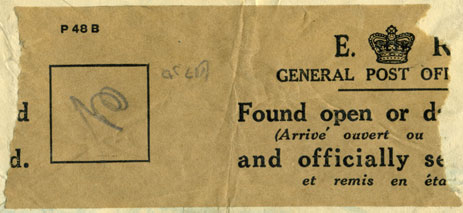
An official Post Office strip of brown gummed paper was attached
to secure the letter.
It has the royal insignia E R indicating Edward VIII although
he had abdicated a year earlier.
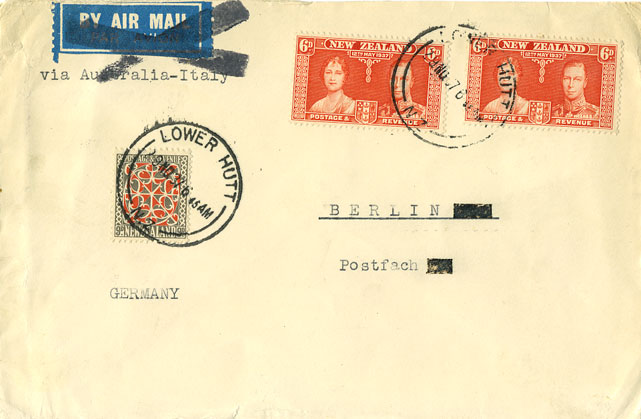
to Germany via Italy, November – December 1937
This cover is postmarked in Lower Hutt near Wellington on 29 November 1937
and is addressed to Berlin.
It has routing instructions Australia – Italy and
is franked with 1s 9d.
The next trans-Tasman sailing was not until 7 December when the Awatea
left Auckland for Sydney and so this cover would be flown on the flight
that left Brisbane on 11 December
and would have been off-loaded in Brindisi.
It was therefore flown from Australia on the same flight as the following cover to Germany.
The airmail etiquette has been
crossed out by a black handstamp.
That was done in Brindisi to indicate the end of the airmail service
as Brindisi to Berlin was by train.
This Brindisi handstamp is known used in 1935-38 [4].
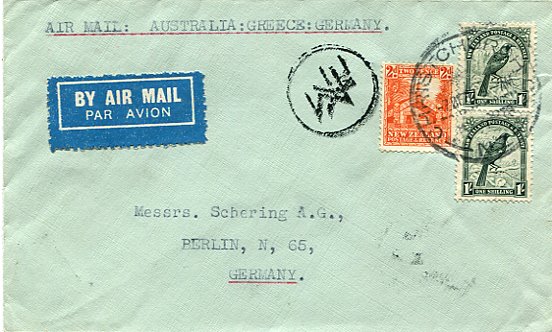
to Germany via Greece, December 1937
This cover is postmarked in Christchurch at 9am on 7 December 1937
and is addressed to Berlin.
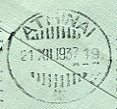
It has an Athens transit mark on 21 December,
routing instructions Australia : Greece : Germany and
is franked with 2s 2d which includes 1d for the internal New Zealand air mail [14].
It was flown from Christchurch to Blenheim by Union Airways and Blenheim to Wellington by Cook Strait Airways
on 7 December in order to make the connection in Wellington that afternoon
with the Awatea which arrived in Sydney on 10 December [11].
It then connected at Charleville on 11 December with IW 609 that arrived
in Athens on Tuesday 21 December
It would then be flown from Athens to Berlin on Wednesday 22 December [12].
This route cost more than the route via Brindisi
where the mail continued by rail.


An interesting feature of the cover is the Greek transit
mark on the front.
According to [10] it is a Greek currency control mark
and is made up of the three Greek characters Sigma, Upsilon, Epsilon standing for
National Exchange Service.
I am not convinced by this argument as why would
the Greek financial authorities be interested in covers
in transit?
There are different arrangements of the letters as can be
seen by comparing the mark with one from a cover from Australia to Germany via Greece that was sent in May 1937.
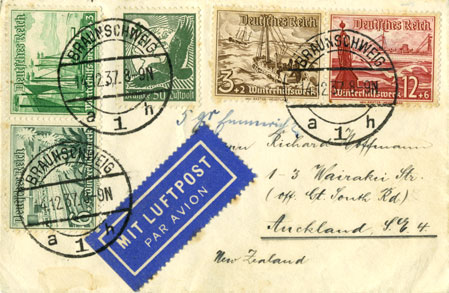
from Germany, December 1937
This cover was postmarked on 14 December, 1937 in Braunschweig and is addressed
to Auckland.
It would have been carried to Brindisi by rail where it is
likely to have joined flight IE 610 that left
Southampton on 16 December.
That flight left Brindisi on 19 December and the mail arrived in Sydney
on 29 December.
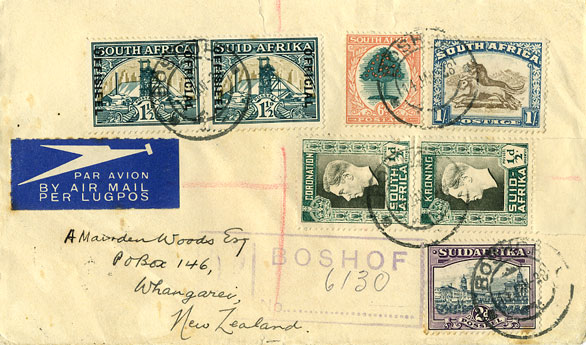
from South Africa, January 1938
This registered cover was postmarked in South Africa on 14 January 1938.
It is franked with 2s 0d made up of 1s 8d airmail postage and 4d registration fee.
It has a fine array of transit marks that allow its progress to be followed.
The first is an indistinct Kimberley transit mark.
It would have been flown to Cairo by the IA Africa service
and then joined IE 620
to Australia which left Alexandria on 21 January and arrived in
Brisbane on 1 February.
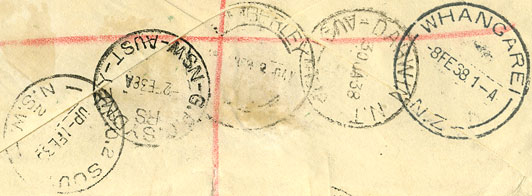
It has a Darwin transit mark on 30 January and would have been offloaded from the
Qantas service at Charleville on 1 February and flown by Butler Air Transport
to Cootamundra.
From Cootamundra, it went by overnight train to Sydney and has a T.P.O
(Travelling Post Office)
transit on 1 February and a Sydney RS (railway Station) transit on 2 February.
It then went on 4-7 February on the Awatea from Sydney to Wellington and
has a Whangarei receiving mark on 8 February.
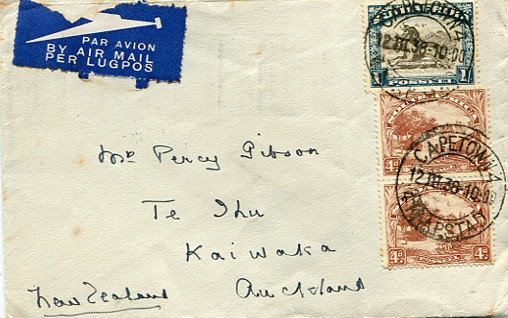
from South Africa, March 1938
Cover postmarked in Cape Town on 12 March 1938
and franked with 1s 8d.
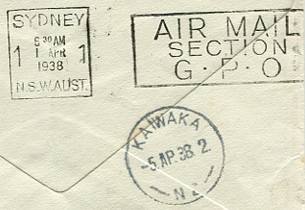
It has a Sydney backstamp on 1 April.
It would have been flown on DN 75 that left Durban on 17 March and arrived in Alexandria on
21 March.
It connected with IE 637 that left Alexandria on 23 March on and arrived in Charleville on 31 March
with the mail arriving in Sydney on 1 April.
It was then sent from Sydney on the Monterey on 1 – 4 April and
the cover has a backstamp in Kaiwaka, north of Auckland on 5 April.
Southampton – Singapore by Flying Boat, February 1938
From 17 February 1938, the Southampton – Singapore leg was by S23 flying boat and
23 February marked the beginning of the second stage of the
Empire Air Mail Scheme.
The air mail rate from UK to India and Malaya was now 1½d per ½ oz.
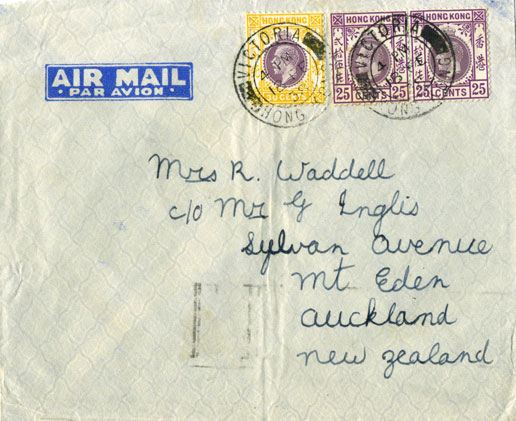
From Hong Kong, February 1938
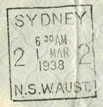
This cover is postmarked in Hong Kong on 18 February 1938.
The Hong Kong feeder route had changed its connection point
with the Imperial Airways Eastern Route from Penang to Bangkok
two months earlier.
The cover would have been flown by Imperial Airways
on 20 February from Hong Kong to Hanoi and then
on 21 February from Hanoi to Bangkok.
It connected at Bangkok with the Eastern Route service on 23 February.
That was the first service using S23 Flying Boats on the Karachi – Singapore
leg of the route.
The plane was the Coogee [3].
This service arrived in Brisbane on 28 February, but
the New Zealand mail was offloaded at Charleville and flown by Butler
Air Transport to Cootamundra on 28 February.
Finally, it was sent by overnight train to Sydney where it was
backstamped at 6.30 am on 1 March.
The Awatea left Sydney on 4 March and arrived in Wellington on 7 March.
It is correctly franked with 80c which was the airmail rate from Hong Kong to Australia
followed by surface to New Zealand.

Notice of reduced rate, 1938
This cover (postmarked May 1938)
has a cachet on the back, applied on arrival in London, advertising
the reduced rate from the UK to Africa, India and Malaya that had
been available since the Second Stage of the Empire Airmail Scheme to India
and Malaya had started on 23 February 1938.

EAMS relied on the introduction of flying boats
on the route and it was July before they were introduced on the complete route to
Australia.

UK to NZ double rate
The rate from UK to New Zealand was 1s 3d per ½oz.
This 1938 cover from the UK is franked with a 2s 6d GV Seahorse and
so was overweight.

It is postmarked on 17 April 1938 and backstamped at Cross Creek,
New Zealand on 11 May.
It therefore took rather a long time (25 days).
It would have been flown by IA from Southampton
on 21 April and arrive in Sydney on 2 May [3].
The final leg from Cootamundra to Sydney was still by train.
The next sailing from Sydney was the Wanganella on 7 May
which was due in Wellington on 11 May.
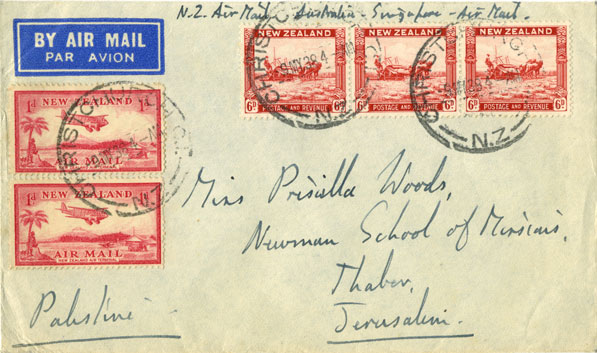
Palestine, May 1938
The rate from New Zealand
to Iraq and Palestine and Egypt was 1s 7d per ½oz [13].
This is the only case where the New Zealand rate differs
from the rate from Australia which was
1s 8d [2].
However, this 1938 cover from New Zealand to
Jerusalem, which is postmarked in Christchurch at 4 am on 9 May, has franking of 1s 8d as
it has the routing N.Z. Air Mail, Australia – Singapore Air Mail
and so includes 1d for the internal New Zealand air mail.
The next mailship was the Awatea that left Auckland in the evening of on 9 May
and the connecting air mail closed in Christchurch at 9 am on 9 May.
Use of the internal was therefore necessary to make the connection.
Southampton – Australia by Flying Boat, June /July 1938
The first airmail to be flown all the way to Australia by
Short S-23 Empire flying boat
left Southampton on 26 June and arrived at the new Qantas terminus
at Rose Bay, Sydney on 6 July 1938.
The first airmail by flying boat from Sydney
left on 5 July and arrived in Southampton on 14 July.
This meant that at last the London – Sydney service was
entirely by air.
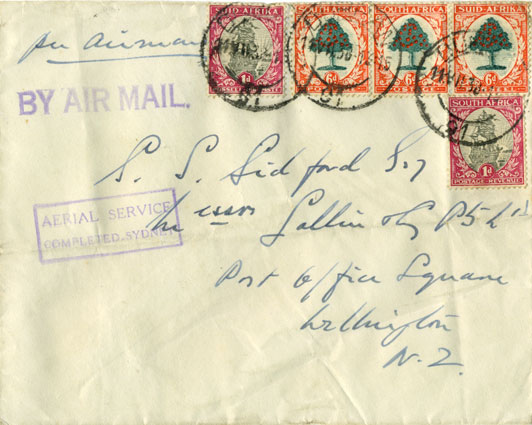
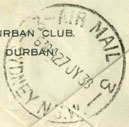
South Africa to New Zealand
This cover is postmarked in Durban, South Africa on 11 July and was backstamped on
arrival in Sydney on 27 July.
After being flown on the Imperial Airways African Service to Egypt, it
would have connected at Alexandria on 18 July with flight IE 671 which
arrived in Sydney on 26 July.
The Awatea left Sydney on 26 July bound for Auckland.
The airmail rate from South Africa to Australia and New Zealand was 1s 8d
and so the cover is correctly franked.
It has an unusual cachet Aerial Service Completed Sydney.
Legg reports a similar cachet on
a 1939 cover flown from Brisbane to Sydney and addressed to Auckland [7] while
van Beveren reports a 1940 cover flown from New Guinea to Sydney and
with routing instructions that it was to go by ordinary mail to Holland [8].
It is not clear how frequently this cachet was applied as it is not on
these two 1938
covers flown from New Guinea to Sydney and addressed to New Zealand and
no EAMS covers to New Zealand with the cachet have been reported.
Last flights to/from New Zealand at old rate
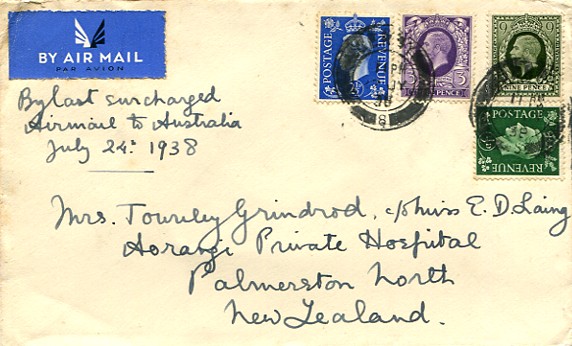
For the first month of this service, the postage rate remained at the previous high
rate and then the third stage of the
Empire Air Mail Scheme started with the service
that left Southampton on 28 July 1938.
This cover is postmarked in the UK on 22 July 1938 and is addressed to Palmerston North.
It would have been flown from Southampton on IE 673 on 24 July which was the last service at the old rate.
It arrived in Sydney on 2 August.
The Niagara left Sydney on 4 August and arrived in Auckland on 8 August.
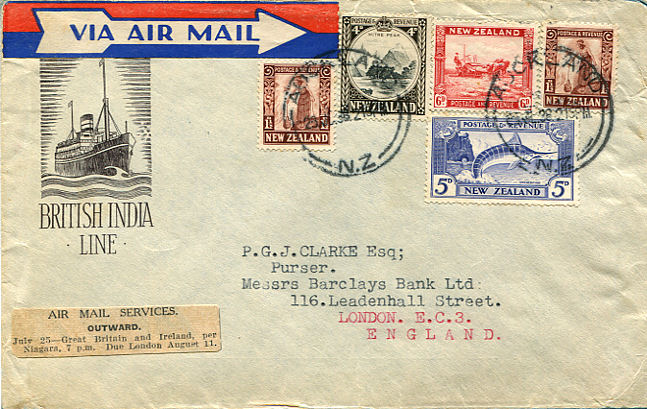
In the opposite direction, the first EAMS flight left Sydney on 2 August with the
rate now being 5d.
However the first EAMS acceptance from New Zealand was not until the flight that left
on 9 August.
The air mail rate between New Zealand and other Empire countries was
then 1½d per ½ oz.
This cover is postmarked in Auckland on 25 July and so was on the last despatch at the old rate.
It was carried from Auckland to Sydney on 25 – 29 July on the Niagara
and then flown from Sydney on IW 676 on 2 August,
arriving in Southampton on 11 August.
Hence this flight carried New Zealand mail at the old rate and Australian mail at the EAMS rate.


back next
All scans were made by the author.
[1] Airmails of New Zealand, volume 2 (1986) compiled by
Douglas A Walker, and
The New Zealand Airmail Catalogue, (2nd Edition, 1994)
by James Stapleton.
Both are published by the
Air Mail Society of New Zealand
[2] Aircraft Movements on Imperial Airways’ Eastern Route,
Vol 1, 1927 – 1937, Peter Wingent, Winchester 1999.
[3] Aircraft Movements on Imperial Airways’ Eastern Route,
Vol 2, 1937 – 1939, Peter Wingent, Winchester 2005.
[4] Jusqu’a Airmail Markings, I McQueen,
Darford, Kent, 1993.
[5] K C Sanford, Air Crash Mail of Imperial Airways and Predecessor
Airlines, published by Stuart Rossiter Trust Fund, 2003.
[6] W Legg, Australian T.P.O. Transit Marks, Air Mail News, vol 35,
pp 74 – 75, June 1992.
[7] W Legg, A Mystery Cachet, Air Mail News, vol 32,
p 11, March 1989.
[8] van Beveren, The ‘Aerial Service/Completed. Sydney’ cachet, Air Mail News, vol 32,
p 39, June 1989.
[9] T. Hetherington, A Further Unrecorded Air Mail Cachet?,
The Kiwi, vol 31, no 2, pp21&26, March 1981;
E.W Leppard, Routing Cachets, The Kiwi, vol 37, no 4, pp70-72, July 1988;
E.W Leppard, Routing Cachets, The Kiwi, vol 38, no 2, pp39-40, March 1989;
I. McQueen, The “Per Australia=London Airmail” Mark, The Kiwi, vol 50, no 3, pp39-40, May 2001.
[10] A.242. Not Greek “OAT” Markings, but Currency Control
Marks, Air Mail News, vol 44,
pp 84-88, August 2001.
[11] Evening Post Wellington 1916-1945, Papers Past,
available at: paperspast.natlib.govt.nz/cgi-bin/paperspast
[12] The D.L.H. Athens – Berlin Service, Peter Wingent, Imperial Airways Gazette,
pp 29-47, June 2005.
[13] New Zealand Overseas Airmail Postage Rates, R M Startup, Mowbray Collectables &
Air Mail Society of New Zealand, 2013.
[14] R Clark, Also Flown by New Zealand Internal Air Mail, Air Mail News, vol 60,
pp 27-34, August 2017.