
Pan American Airways started the southern route of their trans-Atlantic
service FAM 18 on 20 May 1939 and
their northern trans-Atlantic route on 24 June 1939.
The first flight of the regular Imperial Airways trans-Atlantic service left
Southampton on 5 August, 1939.
Mail was accepted on all three services for New Zealand.
Pan American Southern Route
The Pan American southern route from the USA was New York to Marseilles via Horta
in the Azores and Lisbon.
Mail for the UK was then flown to Paris by Air France
and from there to London.
Mail for New Zealand was flown to London and flown from there
on the Empire Airmail Scheme to Australia.
The service was weekly.
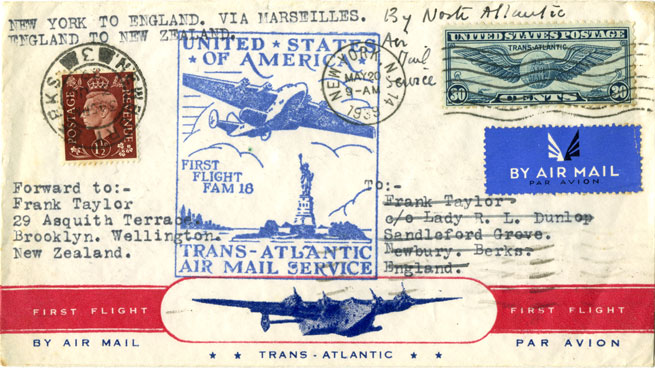
The example cover was not originally addressed to
New Zealand. It was sent to the UK from where it was redirected
to New Zealand.
A 1½d British stamp was added to cover the EAMS postage.
The postage rate to the UK and to Empire countries was 30c and a special US stamp
was issued on 16 May.
It was similar to the previous US airmail stamp with Trans-Atlantic added.
An example is shown on the cover.
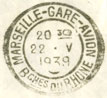
The cover is postmarked in New York on 20 May and backstamped in Marseilles on 22 May.
It was then flown from Marseilles to London by Air France,
but was not backstamped when it arrived there on 24 May.
It was then posted in Newbury on 3 June, but there were no further
backstamps.
It is likely that it was flown from Southampton on 4 June, arriving in
Sydney on 13 June.
Although the route of USA to New Zealand via Europe might appear
a long way round, it had the advantage of being by air all the
way except for the final leg from Australia to New Zealand.
The trans-Pacific airmail from the USA to New Zealand
was not set up until 1940.
The first airmail from London to USA on this route left on 31 May.
Pan American Northern Route
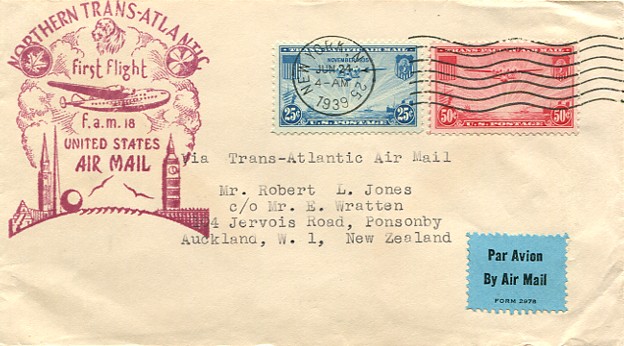
The Northern Route was only flown in the summer and
the route was New York – Shediac (Canada) – Botwood (Newfoundland)
– Foynes (Ireland) – Southampton.
It was fortnightly.
This cover was sent from New York on the first flight and is addressed to New Zealand.
The US Post Office applied a special cachet.
The required postage was only 30c and so the cover is significantly overfranked.
The first flight left New York at 8.21 am on 24 June 1939
and arrived at 3.40 pm that afternoon at Shediac in New Brunswick, Canada.
The next stop was Botwood in Newfoundland, but fog meant that the
Boeing B314 Yankee Clipper could not fly there from Shediac until 12.49 on 27 June
arriving in Botwood at 7.25pm.
The clipper left Botwood at 8.51pm and arrived in Foynes, Ireland at 1pm on 28 June.
It then left Foynes at 4.04 pm and arrived in Southampton at 7.30 pm.
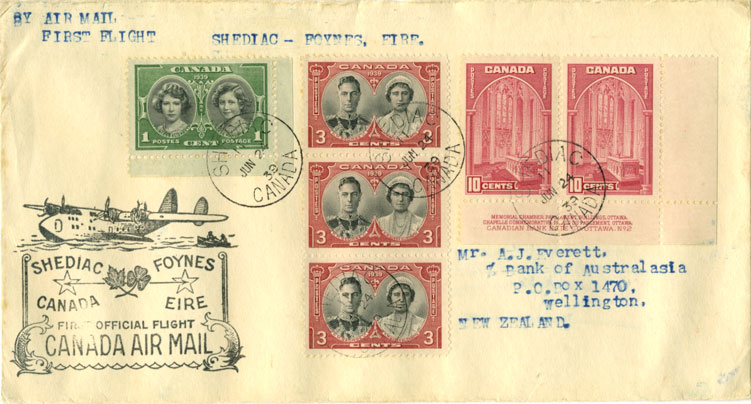
The second cover is postmarked at Shediac on 24 June and is also addressed
to New Zealand.
It has the routing
instructions Shediac – Foynes and
the Canadian Post Office cachet Shediac – Foynes,
but that cachet was also used for mail to Southampton.
Both covers would connect at Southampton with the Empire Air Mail Service to Australia
with the next flight leaving on 1 July and arriving in Sydney on 10 July [1].
There are no backstamps, but
Walker [2] reports a cover backstamped in New Zealand on 19 July.
The Wanganella left Sydney on 14 July and arrived in Auckland on 18 July.
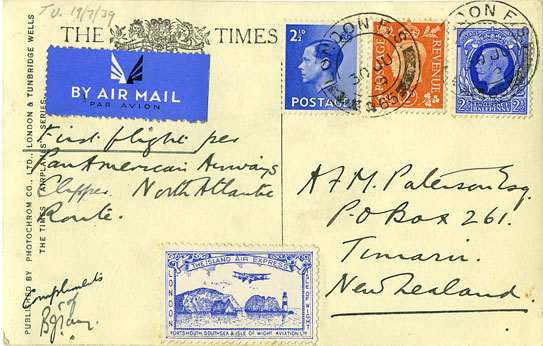
Return flight
The first return airmail left Southampton on 30 June 1939 arriving in New York on 1 July.
This postcard, which is addressed to New Zealand, has routing instructions to be
flown on the first service.
After arriving in New York, it would be flown to San Francisco and then
be sent to New Zealand by sea.
The postage rate for letters was 1s 3d, the same as being flown on the Eastern Route
to Australia.
As this is a postcard, the rate was only 7d.
The date of 19 July is in manuscript on the front.
It may have been added by Alex Paterson to indicate the date of arrival, but if that was the case
then it cannot have gone via USA.
The time for the trans Pacific steamship from San Francisco to Auckland
was 17 days and so it cannot have gone from New York to Timaru in 18 days.
However the date may have been wrongly added by a later owner as 19 July
is the date of arrival of mail sent from UK to New Zealand via Australia.
It was likely carried on the Niagara which left Vancouver on 5 July and arrived in Auckland on 24 July.
When WWII started in September, Pan Am terminated their service from
New York at Foynes
in Ireland and Imperial Airways ran a shuttle service between Foynes and Poole.
The service was only planned for the summer months and the last flight from New York
was on 30 September with the return from Foynes on 4 October.
Imperial Airways
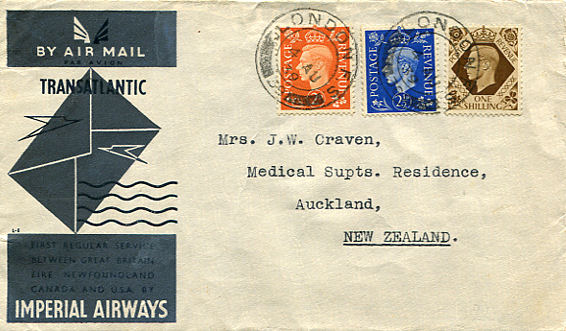
The first flight of the regular Imperial Airways trans-Atlantic service left
Southampton on the Caribou on 5 August, 1939 and arrived in New York on 6 August.
The route was Southampton – Foynes – Botwood – Montreal – New York.
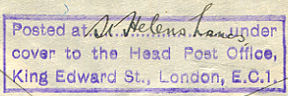
This cover to New Zealand was posted under cover to London to be sent on the first flight.
After being flown across the atlantic, it was likely carried by US transcontinental services to
California.
Walker reports a registered cover to New Zealand being backstamped in Temuka near Timaru
on 24 August [2].
The Monowai arrived in Auckland from Vancouver on 21 August.
As the Monowai had left Vancouver on 4 August, in order to connect, the mail
must have been flown on the FAM 14 service from San Francisco to Honolulu.
I have the scan of a registered air mail cover from the UK to Hawaii that is postmarked in London
on 4 August and has transit marks in New York on 7 August, San Francisco on 8 August and
Honolulu on 10 August which supports the view that the mail was flown to Hawaii.
From New Zealand
Mail could be sent from New Zealand to the USA by the QEA/IA route
from Australia to Marseilles followed by trans-Atlantic airmail at a cost of 3s 6d.
If the trans-Atlantic leg was by sea then the rate was 1s 9d.
When World War II started, Pan American moved their European terminus from Marseilles to neutral Lisbon.
In March 1940, Air France set up a Marseilles – Tangier – Lisbon service to connect with the transAtlantic Pan Am service.
A postcard flown from New Zealand all the way to the USA via Sydney, Marseilles and Lisbon is shown
here.


back next
All scans were made by the author.
Information on this page is taken from:
[1] Aircraft Movement on Imperial Airways’ Eastern Route, vol 2 1937-39
Peter Wingent, Winchester 2005.
[2] Airmails of New Zealand, volume 2 (1986) compiled by
Douglas A Walker,
Air Mail Society of New Zealand