
The ninepence value is the only stamp in the set that
was not recess printed by De La Rue.
The first plates were produced
by Waterlow for litho offset printing.
Single watermark
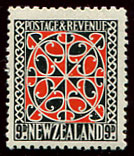
Smaller design
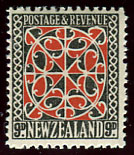
Multi wmk,
slate grey
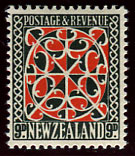
Single wmk
The 9d was first issued on 1 May 1935 on single
watermarked paper and perf 14×14½.
The colour is black and scarlet and there is no plate number.
The stamps were printed by Waterlow,
but all subsequent printings were made in New Zealand.
Multi-watermarked paper
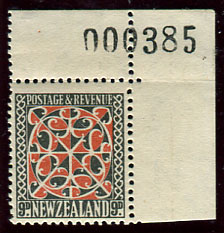
perf 14×14½
Stamps on multiple watermarked paper were issued in
June 1936 on sheets with the watermark sideways.
The perforation is 14×15.
This, and all subsequent printings, was by the
Government Printer in Wellington.
The border is often slate-grey rather than black.
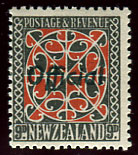
New plates with 120 impressions were produced by Coulls, Somerville
and Wilkie of Dunedin and stamps issued on 1 March 1938.
The watermark is upright and the perf is 14×14½.
Again, the border is often slate-grey rather than black.
Official stamps perf 14×14½ with the overprint in green were also
issued on 1 March 1938.
Smaller design
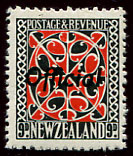
Coulls, Somerville and Wilkie later produced new plates of 240
impressions for surface printing in which the design is smaller.
The first issue in May 1941 was on single watermarked paper
while from September 1941, the stamps were on multi-watermarked paper.
In both cases, the perforation was 14×15.
The two sizes of design are easily distinguished.
As the stamps are the same size, there is a larger space between the
design and the perforations.
The registration between the two colours is much better
in the smaller design and the border is always black.
Official stamps with a black overprint were issued in
October 1943.
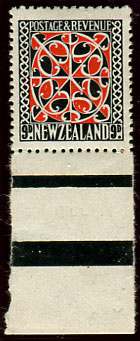
The printings in New Zealand had wide margins and to stop
the paper being used for illegal purposes, bars were printed in the
selvedge.
An example of the bottom margin of the smaller design on
multi-watermarked paper is shown.
Airmail use
The airmail postage rate to the UK was 1/6 until 1938.
As there was no 1/6 value, a common use of the 9d was as a pair
on airmail covers.

The 9d was replaced by the George VI definitive in 1947.


back next
The above information is taken from The Postage Stamps of
New Zealand Vol 1 and 2 published by the
Royal Philatelic Society of New Zealand in 1938 and 1950.
All scans were made by the author.