
The first acceptance of mail from New Zealand to be flown in Papua New Guinea
was in March 1933.
The fourth official trans-Tasman airmail flight of 1934 was made
by Charles Ulm and G.U. Allan
in the Faith in Australia on 2 July.
Again it was from Ninety Mile Beach, Kaitaia to Sydney.
After flying to Australia they made a flight to Papua new Guinea.
Carpenter Airlines began a regular air mail service
between Sydney and Papua New Guinea in May 1938.
1933 Acceptance from New Zealand for Wau
In March 1932, Guinea Airways started an airmail service between
Port Moresby in Papua and Salamaua.
In October 1932 the service was extended
from Salamua to Wau in New Guinea.
In January 1933, mail was accepted for this service from Australia.
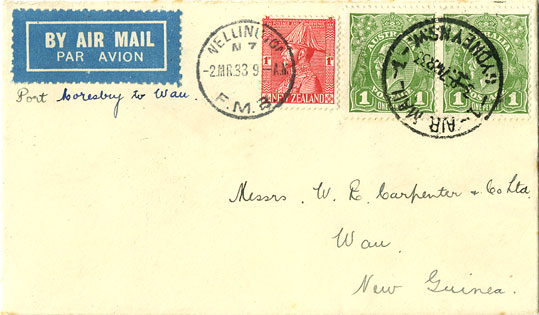
From 2 March, mail was accepted for the service from New Zealand, but
as no agreement had been made with the Papuan Government, the airmail surcharge of 2d
had to be paid in Australian stamps.
The mail went from Wellington to Sydney where it was postmarked on 7 March
and then by sea to Port Moresby.
Mail could be routed Port Moresby – Wau or Port Moresby – Salamaua.
This cover is one of 41 addressed to Wau.
The mail was not backstamped there, but the mail for Salamaua was backstamped
on 24 March.
1934 Flight, New Zealand – Australia and Australia – New Guinea
An interesting point about this flight was that it connected
with the first airmail from Australia to Papua New Guinea
also made by Ulm and Allan in the Faith in Australia.
10,145 letters were carried from New Zealand to Sydney,
of which 4,167 were
subsequently carried on the flight to New Guinea on July 24.
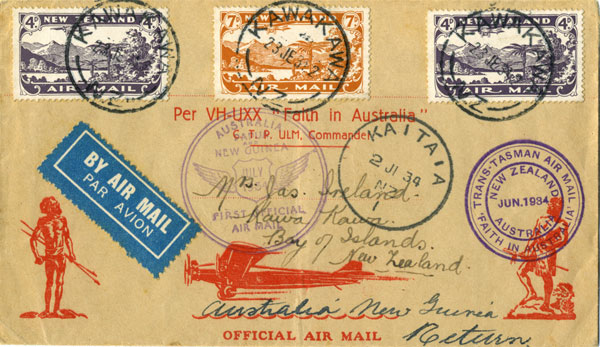
The example cover was flown from New Zealand to Sydney, from Sydney
to Lae, New Guinea and then back to Sydney before being returned to New Zealand
by sea.
The cover was posted in Kawa Kawa on 23 June.
The trans-Tasman flight from Kaitaia was originally scheduled for June which
is why the New Zealand cachet shows Jun.1934.
However, the flight was delayed until 2 July as shown by
the Kaitaia postmark and the Sydney backstamp.
The postage rate to New Guinea including the airmail fee was 1/1 while the
return surface postage rate was 2d.
This cover should therefore have been returned from New Guinea by surface
while the backstamps indicate that it was flown back to Sydney.
On to New Guinea
The flight from Australia to New Guinea was delayed.
It eventually left Melbourne on 24 July for Sydney where the
mail from New Zealand was picked up.
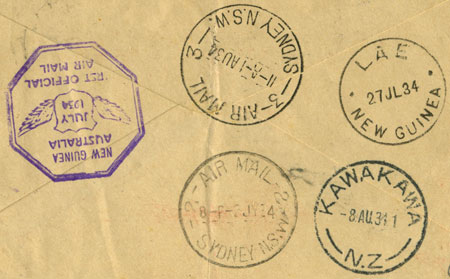
A cachet showing Australia Papua New Guinea First
Official Air Mail was applied at Sydney.
It is on the front of the cover.
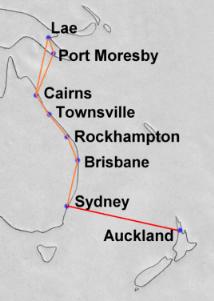
The route was then Brisbane,
Rockhampton, Townsville, Cairns with arrival in Port Moresby in Papua
on 26 July. Lae in New Guinea was reached on 27 July
and this is shown in the Lae backstamp.
The return journey from Lae was the first official air mail
from New Guinea to Australia and a New Guinea Australia cachet indicating this
was applied in Lae on the back of the cover.
The flight left Lae on 30 July for Cairns in Queensland missing
out Port Moresby which had been on the intended route.
It eventually arrived in Sydney on 1 August as shown by a
second Sydney backstamp.
The cover was then carried to New Zealand by sea and is
backstamped Kawa Kawa on 8 August.
New Zealand to Papua
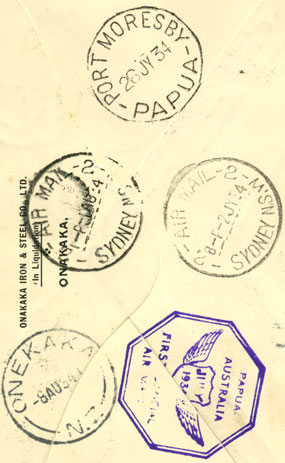
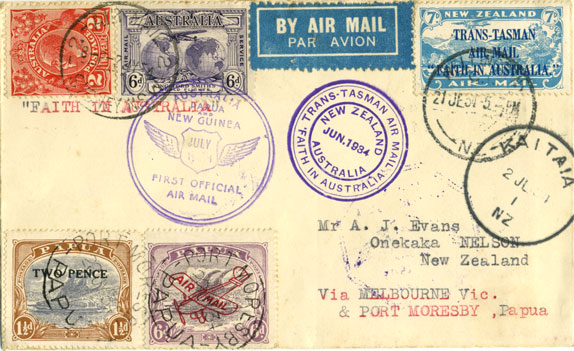
This cover was also flown trans Tasman on 2 July and then on to Papua New Guinea.
However, in this case the routing instructions are via Port Moresby in Papua.
Although the routing instructions are also via Melbourne,
it is unlikely that this instruction was followed.
The differences between the two covers are instructive.
They both have a Kaitaia postmark on 2 July and both the trans Tasman and the
Australia Papua New Guinea cachets on the front and the Sydney 2 July
transit mark on the back.
However, because the routing instructions are via Port Moresby, it has the
Papua Australia cachet on the back rather than the New Guinea Australia
cachet and a Port Moresby transit mark on 26 July instead of a Lae
transit mark on 27 July.
They then both have the Sydney transit mark on 1 August and a receiving mark
in New Zealand on 8 August.
The Port Moresby mail had been unloaded there and the original plan had been
that it would be loaded again when the plane returned from Lae.
However, due to bad weather, the decision was made that there would not
be a stop at Port Moresby on the return journey and so the Port Moresby mail
was reloaded and flown to Lae.
The airmail journey taken by the two covers was therefore the same.
The franking is 7d trans Tasman, 8d in Australian stamps which was
the airmail rate for Australia – Papua and 8d in Papuan stamps which
was the airmail rate for Papua – Australia.
Papua to New Zealand
The next cover was sent to New Zealand from Port Moresby in Papua
via Lae in New Guinea.
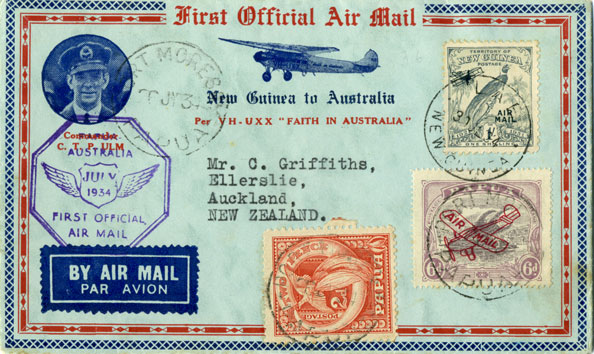
It has both Papua and New Guinea stamps.
A Papua Australia First Official Airmail
cachet was applied in Port Moresby.

The Papua stamps are postmarked Port Moresby on 26 July
and the cover was flown from there to Lae in New Guinea on 27 July.
The New Guinea stamp is postmarked 30 July, the date when
the flight left Lae.
This is in contrast to the first cover where the Lae backstamp
has the arrival date of 27 July.
The cover was flown to Sydney where it arrived on 1 August
and was backstamped.
It was then carried to New Zealand by sea.
The airmail rate from Papua to New Zealand was 8d and it was franked with 8d
in Papua stamps.
However, I am not sure why the
cover also has a 1/- New Guinea stamp.
A regular Australia – New Guinea airmail
service was set up in 1938.
Australia to New Guinea and then sea to NZ
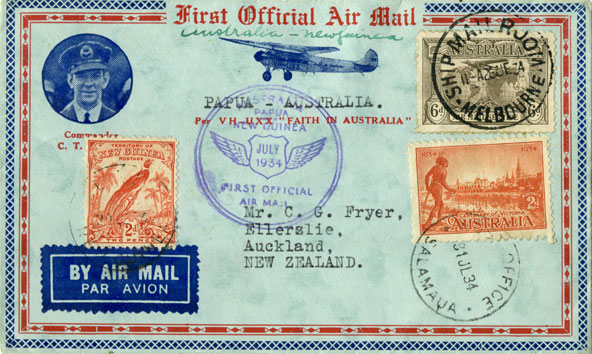
The next cover has routing instructions to be flown from Australia to New Guinea.
On arrival it was then sent to New Zealand by surface mail.
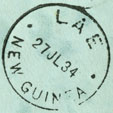
It is franked with 8d in Australian stamps to cover the outward
flight and a 2d New Guinea stamp to cover the return by surface mail.
Underpaid for New Guinea airmail
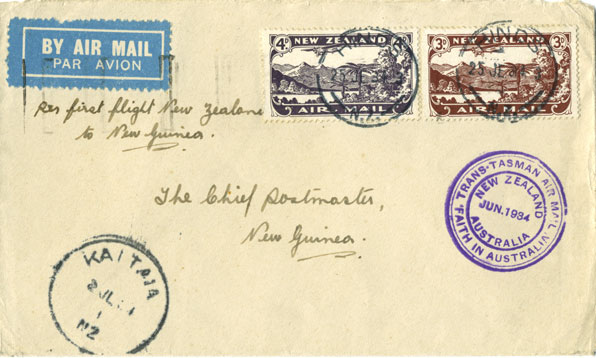
The next cover is addressed to New Guinea, but the 7d franking is only
enough for the trans-Tasman flight, not
for the onward flight to New Guinea which required
a total postage of 1/1.
The cover has the trans-Tasman cachet, but not the
Australia to New Guinea cachet.
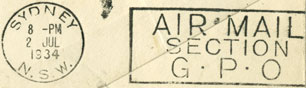
The Sydney backstamp is that applied to
local mail and so it is clear that the cover was not carried from
Sydney to New Guinea by air, but by surface mail.
Given that the flight was delayed for three weeks, it is very likely that this cover
would arrive in New Guinea before the airmail.
Commemorative stamps
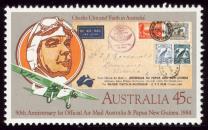
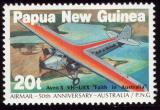
Both Australia and Papua New Guinea issued stamps in 1984
to commemorate the 50th Anniversary of the flight.
This was the last successful official Trans-Tasman airmail until the
regular service was set up in 1940.
Charles Ulm was killed on 3 December 1934 on a flight from the USA
to Hawaii.
Many photographs of Ulm and his associates on his many flights are in a
photographic archive
held by the National Library of Australia.
Papua and New Guinea, 1938
In May 1938, Carpenter Airlines began a regular air mail service
between Sydney and Papua New Guinea.
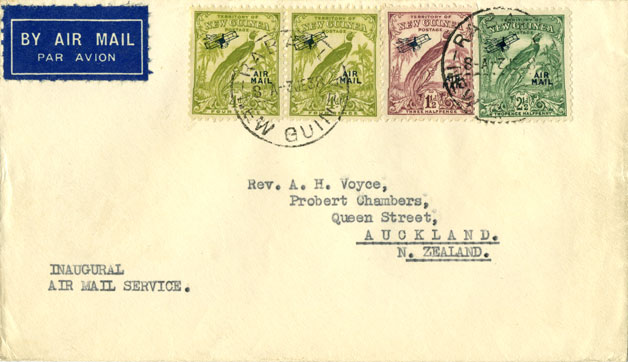
On 30 May, a DH 86 of Carpenter Airlines
flew from Sydney to Townsville and
on 31 May to Port Moresby in Papua followed by
Salamua in New Guinea.
On 1 June, the flight continued to Rabaul in New Guinea.
The rate was 4d per ½oz.
Mail was accepted from New Zealand for the inaugural flight
and addressed to New Zealand on the return flight.
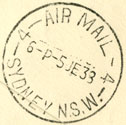
The cover was flown from Rabaul on the return journey starting
on Friday 3 June.
It arrived in Sydney on 5 June where it was backstamped.
It has stamps to the value of 1/-, sufficient for 1½oz.
Although there was a large mail to and from Australia, the
number of acceptances to and from New Zealand was quite small.
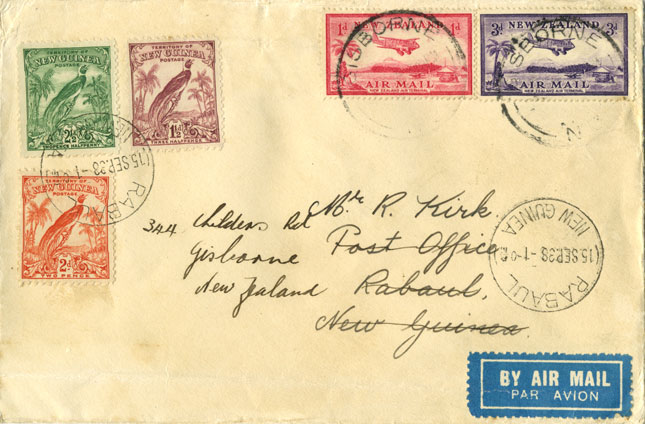
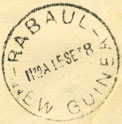
This next cover was flown from Sydney to Rabaul in September 1938.
It is postmarked in Gisborne and franked with 4d in New Zealand
airmail stamps.
There are two Rabaul transit marks on 15 September and
it is franked with 6d in New Guinea stamps for the return flight.
Although this cover is obviously philatelic in nature, I am not aware
of any special reason for a mid September flight.


back next
All scans were made by the author.
Information on this page is taken from:
Airmails of New Zealand, volume 2 (1986) compiled by
Douglas A Walker, and
The New Zealand Airmail Catalogue, (2nd Edition, 1994)
by James Stapleton.
Both are published by the
Air Mail Society of New Zealand