
A new revenue set of stamps was issued in 1880 although
many catalogues give the date as 1882 as that was when
they could first be used postally.
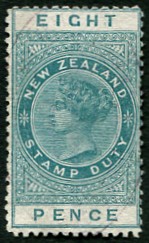
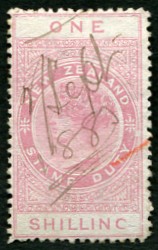
The dies were engraved by W.R.Bock and
the design remained unchanged for 51 years, not quite what we are used to
these days!
It was 1931 when they were replaced by the Arms design.
The first printings included the low values of 4d, 6d, 8d and
1/- while from 1882 the lowest denomination was 2/-.
The first issue was watermarked NZ, but from 1882 the watermark was
NZ and star and from 1903 the watermark was sideways.
The designs are similar although the frame to the Queen’s head
varies in shape with
the frames being similar to those of the
first side-face issue.
The frame of the low values was an oval similar to the 1874
1d postage stamp.
Up to 10/- the head was in a circular frame similar to the 1874 2d.
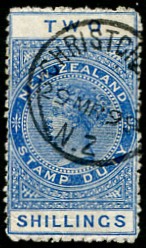
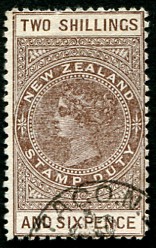
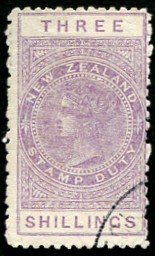

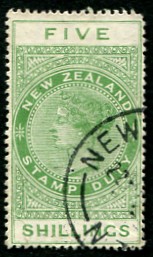
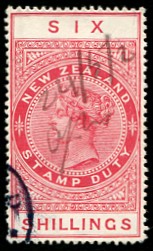
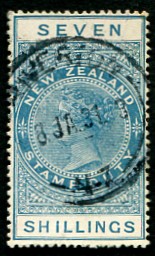

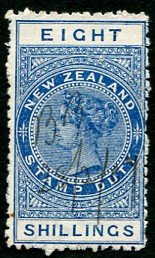
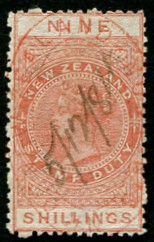

Circular frame to head
From 15/- to £2, the frame was circular, but the
inscription was in two parts similar to the 1874 3d.
As can be seen from the scans, revenue stamps often had holes
punched in them to ensure that they could not be re-used.
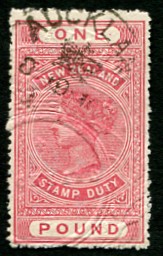
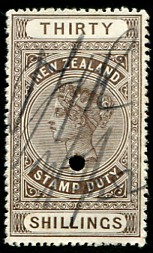
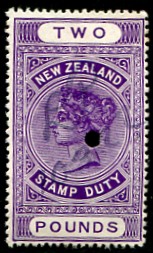
Frame split in two
From £2/10/- to £5, the head was in a rectangular frame
similar to the 1874 4d.
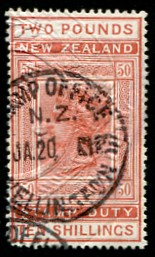
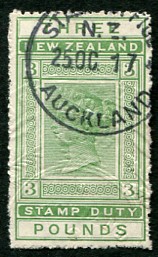
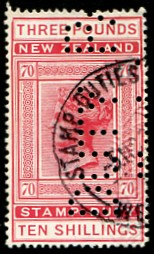

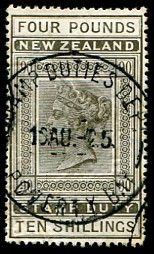
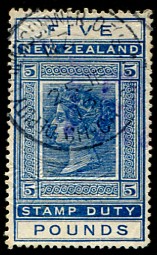
Rectangular frame
For the £6 to £10 pound values, the frame was a circle within a
hexagon similar to the 1874 6d.
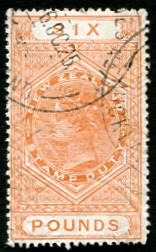
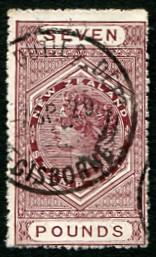
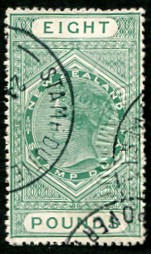
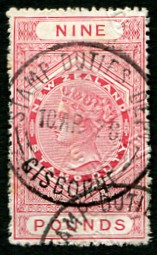
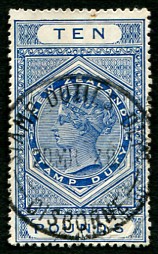
Hexagonal frame
For the 12/6 value and for values above £10, the frame was oval
similar to the 1874 one shilling.
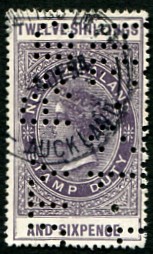
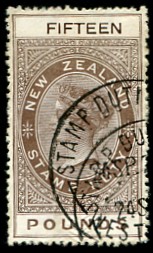
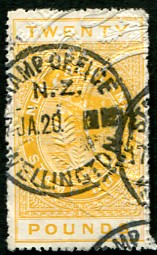
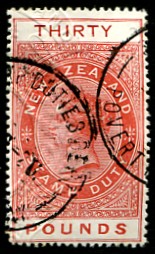
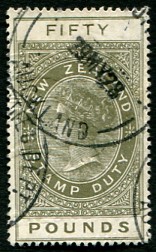

Oval frame
The 12/6 value, introduced in 1913, was the only additional value after
the initial issue. It is very highly catalogued (higher than any
other value) in mint and postally used condition.
The above example is a perfin with the perforations showing
DUTY PAID and the date 4 12 34.
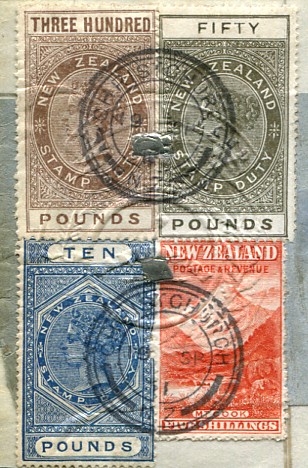
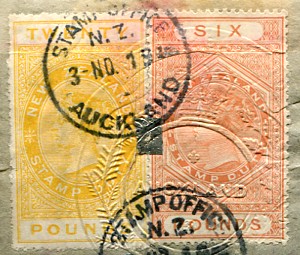
Metal foil ties
The revenue stamps were often used on legal documents and
joined by metal foil ties.
This is shown in the examples.
In one, a twenty pound and a six pound
stamp are tied together with a metal foil
while in the other there are 4 stamps: £300, £50, £10 and a QV pictorial 5/-.
Papers
The papers are the same as for the postage issues
with the changes occurring at the same time.
From 1913 the stamps were on chalk surfaced paper and the colours
are brighter.
However, the basic colour of all values remained the same during the 51 years.


back next
The above information is taken from The Postage Stamps of
New Zealand Vol 6, published by the
Royal Philatelic Society of New Zealand in 1977.
All scans were made by the author.