
After the glories of the
Chalon heads,
New Zealand’s second
postal issue was rather an anti-climax.
The stamps
Six stamps were issued, each with a portrait of
Queen Victoria, in the denominations 1d, 2d, 3d, 4d, 6d and 1/-.
A ½d newspaper stamp
had been issued the year before.

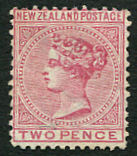
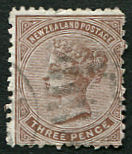

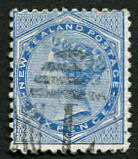
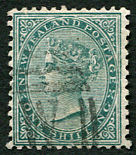
The plates were produced by De La Rue & Co and only one plate
was used for each value.
Each plate had 240 impressions, divided into
4 panes of 60.
The stamps were surface printed at the Government
Printing Office in Wellington and
issued on 2 January 1874.
The paper was watermarked NZ and star although a small printing of the 1d and 2d
was made in 1875 on large star watermark.
Initially, the stamps were mostly line perforated 12½ although some of
each value were perforated 10 x 12½.
From 1878, they were comb perforated 12 x 12½.
As the last printing of the 3d was in 1874, it does not appear with that perforation.
The stamps were replaced in 1882 by the
second side-face issue.
2/- and 5/-
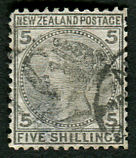
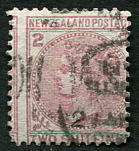
On 1n July 1878, 2/- and 5/- stamps were issued.
The dies were engraved by Bock and Cousins of Wellington and the
plates were
made at the Government Printing Office in Wellington where they
were printed.
They were in sheets of 120, organised as two panes of 60.
There was only one printing of about 47,000 stamps of each value.
They were printed on the same paper as the 1874 issue and the perforation
was 12 x 12½.
However the spacing of the impressions did not fit this perforation
head and so many of the stamps are badly centred as in the
illustrated 2/- example.
Most of the stamps were used fiscally and they were replaced in 1882 by the
new fiscal stamps.
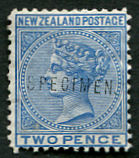
Overprinted Specimen
The stamps exist overprinted Specimen both in the original colours and,
with the 1d, 2d, 3d, 4d and 6d in other colours such as this example of the 2d in blue.

next
The above information is taken from The Postage Stamps of New Zealand Vol 1, published by the
Royal Philatelic Society of New Zealand in 1938.
All scans were made by the author.