
The steel plate for the 1d value was produced by the Royal Mint
in London.
As postal rates were increased in July 1931, a 2d value was needed.
W.R. Bock made the new die by etching in zinc
and a copper plate was made at the Government Printing
Office in Wellington.
In both cases the sheets were of 120 stamps on 12 rows of 10.
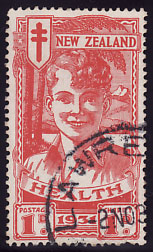
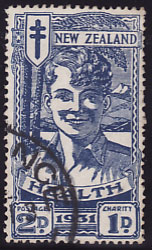
The 1931 design is of a smiling boy and was designed
by L.C. Mitchell.
The 1d surcharge is denoted Charity, it was changed to Health in the following year’s issue.
The stamps were surface printed at the Government Printing Office,
watermarked NZ and star and perforated 14½ x 14.
Due to the world-wide economic recession, sales were low.
As a result, they are now the most expensive of the
New Zealand health issues.
Dates:
- Issued Oct 31 1931,
- withdrawn 29 Feb 1932
Numbers sold:
- 1d: 74,802;
- 2d: 111,929
1930 Die Proof
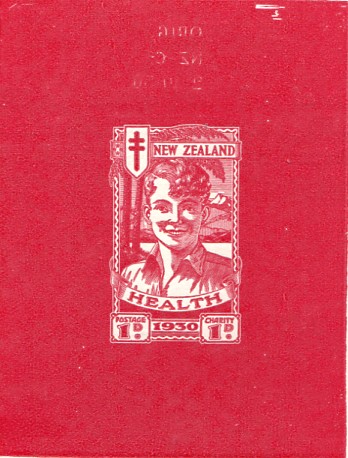
The Smiling Boy issue was originally intended for 1930 and the contract was won by Perkins Bacon
while a bid from the Royal Mint was not successful.
Dies were produced by both Perkins Bacon and by the Royal Mint and proofs exist from both sets of dies
with there being confusion in the literature as to which set of dies a particular proof belongs.
Te Papa, the National Museum of New Zealand, holds a 1930 Royal Mint die and it was used by the
New Zealand Government
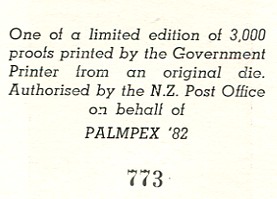
Printer to print 3000 numbered proofs for the National Exhibition Palmpex’82 [1].
An example (number 773) is shown on the left.
The information which comes with the Palmpex proof wrongly suggests that it is printed from a
Perkins Bacon die and this is repeated in the article by Stocker [2].
In the surround above the stamp, ORIG / NZ G / 2-10-30 (i.e. Original Die New Zealand Government
2 October 1930).
The Perkins Bacon dies were produced before the end of August and
have an unshaded sky, while in the Royal Mint die,
the sky is shaded as can be seen in the scan on the left [2].
A proof from the 1930 Royal Mint die was submitted as part of their successful
tender to produce the 1931 Smiling Boy issue

Postmarked 10 November 1931
This example of the 1d is postmarked in Invercargill on 10 November 1931
and also has a 4d airmail stamp which was issued that day.
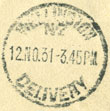
The cover was flown on the Invercargill to Wellington leg of the special
flight from Invercargill
to Auckland on 12 November and was backstamped on delivery in Wellington at 3.45pm on 12 November..
The required franking was 5d, 2d for normal postage and
3d for the flight.
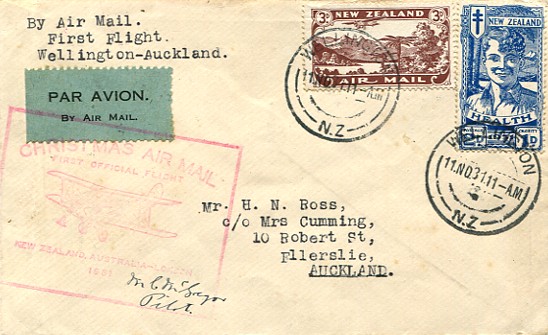
Postmarked 11 November 1931
This example of the 2d is postmarked in Wellington on 11 November 1931
and also has a 3d airmail stamp which was issued the previous day.
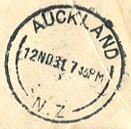
The cover was flown on the Wellington to Auckland leg of the special
flight from Invercargill
to Auckland on 12 November.
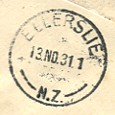
It is backstamped on arrival in Auckland on 12 November and then on the next
day on delivery in Ellersie, a suburb of Auckland.
Although this cover is only addressed to Auckland, it wrongly has the cachet that was applied
to covers destined for the All-Australian Christmas airmail
to the UK.
The cover is autographed by the pilot M C McGregor.
Seventyfifth anniversary of health camps, 1994
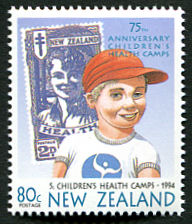
The health issue of 1994 commemorated the 75th anniversary of health camps
and showed several previous issues including the 1931 2d.
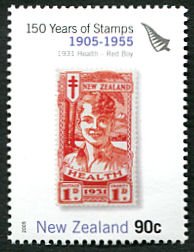
150 years of New Zealand stamps, 2005
The set of 5 commemorating the 1905-1955 stamps was issued on 6 April 2005 and the 90c stamp showed the 1931 1d stamp.


back next
The above information is taken from The Postage Stamps of
New Zealand Vol 1, published by the
Royal Philatelic Society of New Zealand in 1938.
[1] G Morriss, Health Stamps 1931, Stamp News Australasia, vol. 65, no 4, pp 32 & 45, April 2018.
[2] M Stocker, The ‘Smiling Boy’ Health Stamps of 1931, Tuhinga, Journal of the Te Papa Museum,
vol 24, pp 139-158, 2013.
All scans were made by the author.