
When the printings on star watermark paper resumed in August 1864,
the Government perforating machine had been installed.
The use of the NZ watermark paper therefore forms a neat
interlude between the imperforate issues and those on
star watermarked paper perforated 12½.
At the end of 1864, stamp production was moved from Auckland to Wellington,
the new capital of New Zealand.
Perforated issues with star watermark
a) Initial issues
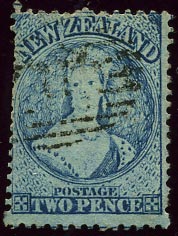
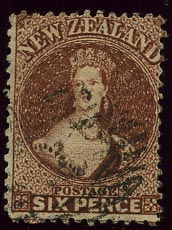
Only the 1d, 2d and 6d were issued perforated 12½ in 1864.
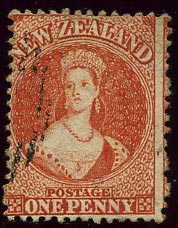
The first printings of the 1d were in carmine-vermilion.
Later printings were in carmine, vermilion, orange-vermilion
and dull orange.
By 1864, the 2d plate was worn and so the stamps appear
to be pale blue.
The 6d appeared in various shades of red-brown.
6d was the standard postal rate for
letters to the UK.
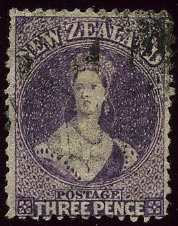
After its initial printing in 1863, the 3d was not
re-printed until 1865
and the first known dated perforated copies are not until 1867.
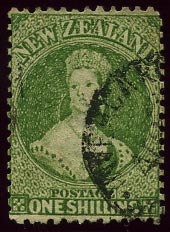
Perforated copies of the 1/- were issued in 1865.
The shades of the 3d are lilac and mauve with perforated copies of the
earlier shade of brown-purple being rare.
Shades of the 1/- varied from green to yellow green while
late printings were also in a pale yellow green.
b) Fourpence
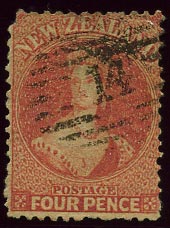
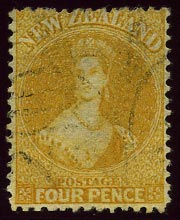
This value was issued on June 1, 1865. The original printing of
120,000 was in rose, but as this was thought to be too close
to the colour of the 1d, it was quickly changed to yellow.
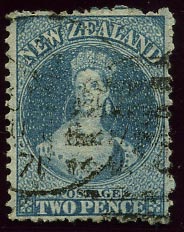
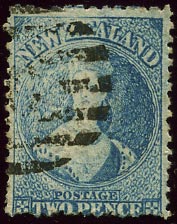
2d plate 2, normal and damaged
c) Twopence plate 2
As the 2d plate had become so worn,
a new plate was sent from London in April 1865 and
was first used in late 1865 or early 1866.
There was a wide range of shades ranging from deep to pale blue.
In late 1866, the surface of the lower part of the plate
became damaged.
Part of each affected stamp is clearly from a new
plate while other parts appear to be from a worn plate
as can been seen in the example.
Although badly damaged, the plate remained in use.
The damaged part of the plate was reprinted in 1913
and allows damaged stamps to be allocated to their position.
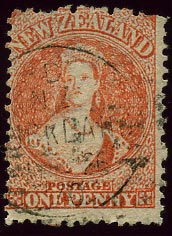
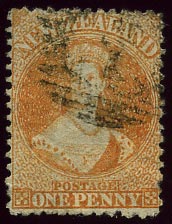
d) Later printings of one penny
The 1d plate became progressively worn and was usually in
an orange-vermillion shade.
The last printings were in orange although the orange
copy shown is not worn.
The perforating machines
The perforations gauged 12½ and the machine used initially
was a comb,
but in late 1866, this was replaced by a line machine.
In the original 1d, 2d and 1/- plates, the impressions were
positioned rather irregularly.
Also, they had very narrow margins between the impressions
while the later plates had wider margins.
According to The Postage Stamps of New Zealand, Vol 6,
M.C.Stanley demonstrated in an article in
The London Philatelist in 1967 that
two different comb heads were in use from 1864 to 1866 to deal with
the two different groups of plates.
However, it seems that they were not applied in a consistent fashion
and so it is not surprising that many of the issued stamps are badly
centred.
Pins also became bent or broken and so missing holes are not uncommon.


back next
The above information is taken from The Postage Stamps of
New Zealand Vol 1, published by the
Royal Philatelic Society of New Zealand in 1938.
All scans were made by the author.