
It was not until 1 April 1862 that the prepayment of postage became
obligatory.
Also, at that time, gold was discovered in Otago.
These two factors greatly increased demand and Davies
ran out of the star watermarked paper.
Printings were therefore made of all four values in 1862 on pelure
(i.e. very thin) paper and of the 2d in 1863 on thick soft paper.
Unwatermarked pelure paper 1862
The 1d, 2d, 6d and 1/- were printed on this
very thin unwatermarked paper with
the 2d and 6d being the more common.
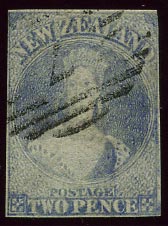
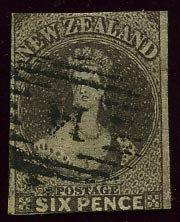
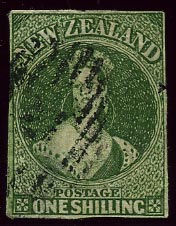
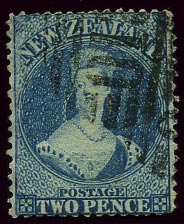
The colour of the 2d is of interest.
It is now a pale dull ultramarine, but was once much brighter
in colour.
It has faded badly and copies now typically have a blotchy
appearance as shown in the figure.
The 1/- is in a distinctive deep green colour.
2d on thick soft unwatermarked paper
Although fresh stocks of the star watermarked paper arrived in late
1862 along with the 3d plate,
Davies had to use another source of paper
again in 1863.
This time, a thick soft unwatermarked paper was used to print the 2d.
The colour is a deep blue and the stamps show the beginning of plate wear
to the right of the Queen’s head.
As well as being issued imperforate, copies exist perforated 13 at Dunedin.
This perforation is discussed in the next section.
Perforated 13 at Dunedin
When gold was discovered in Otago, the demand for stamps in
Dunedin increased dramatically.
In 1861, Dunedin handled 205,000 letters while Auckland
handled 233,000. By 1863, the Dunedin figure had risen to
1,354,000 compared to an Auckland figure of 607,000.
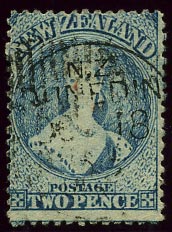
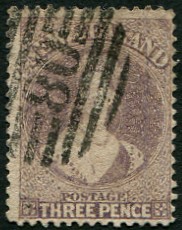
To speed up the separation of stamps, in 1863 the Dunedin
postmaster contracted
a local firm, Messrs Ferguson and Mitchell, to perforate stamps
on both star watermark and pelure paper.
The perforation machine was a line machine with a gauge of 13.
The first perforations of New Zealand stamps are therefore only
semi-official.
As they were paid per sheet, the operators perforated several sheets
at one go and so the perforations are usually misplaced.

Care must be taken in distinguishing these stamps from the
official and more common perf 12½ that appeared the following year.
The perforations must be a full perf 13 on all sides.
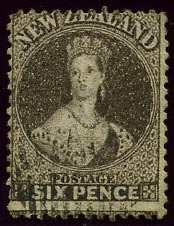
The 6d occurs in both black brown and red brown.
As the 6d black brown is much commoner perf 13 than in the
later perf 12½, it forms a useful benchmark.
NZ watermark
This watermark was introduced in 1864 for the 1d, 2d, 6d and 1/-
values.
The official perforating machine was introduced at this time, but
the 1d and 1/- on NZ paper were printed before the introduction
of the perforating machine and so are imperforate.
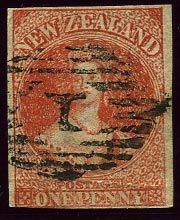
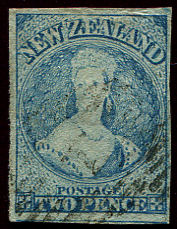
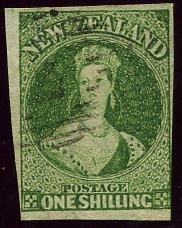
More than one printing was made of the 2d and it exists both
imperforate and perforated 12½ with relatively few being issued imperforate.
The 2d was very worn by this stage.
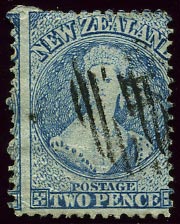
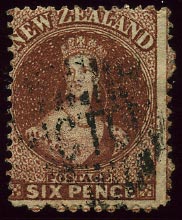
The 6d was produced later and is normally perforated 12½.
Davies commented adversely on this paper and a return was made to the
star watermark paper in late 1864.
The issues on star watermarked paper
issued before the brief use of
the NZ paper were imperforate while those issued afterwards were
perforated 12½.
The above information is taken from The Postage Stamps of
New Zealand Vol 1, published by the
Royal Philatelic Society of New Zealand in 1938.
All scans were made by the author.