
John Davies began his employment as the Postage Stamp Printer on the staff of the Postmaster
General’s Department in February 1862.
The previous printer, Richardson, had been a private contractor and
had been able to insist on his choice of paper.
The first Davies prints
As Davies was an employee he had to use the star watermark
paper that had been sent from London along with the plates in 1854.
His imperforate prints are therefore on the same paper as the original London
prints which has led to many wrong identifications by over-optimistic
collectors.
The numbers given below for 1862-64 include those
on pelure paper in 1862, on NZ watermarked paper in 1864
together with those perf 13 in Dunedin in 1863 and perf
12½ after August 1864.
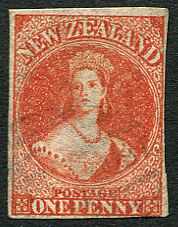

One penny
The 1d was originally in orange vermilion, then vermilion and from 1863
in carmine vermilion.
There was also a small printing in carmine which can be confused with
the London prints.
The numbers printed were: 148,080 in 1862, 326,640 in 1863 and 457,920
in 1864.
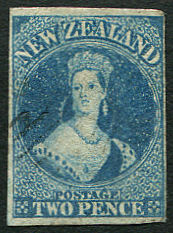
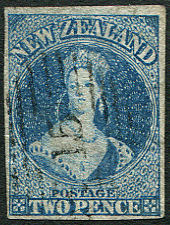
Two pence
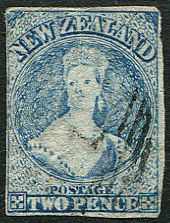
The two pence was initially in a deep blue followed
by slate blue.
From 1863, the blue plate began to wear and by 1864 it had
become very worn.
Around four and a half million copies of the 2d were issued
in 1862-64.

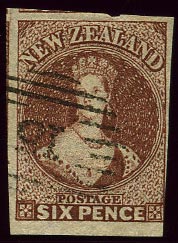
Six pence
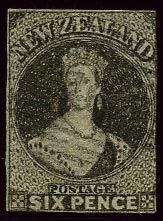
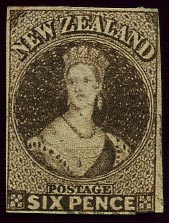
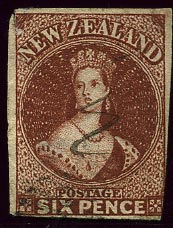
As 6d was the standard rate of postage to the UK,
it is the most common value after the 2d
and appeared in a wide range of shades.
The first printings were in black brown while
in the middle of 1863, the colour changed to brown,
in late 1863 to a full rich red brown and in 1864 to a paler red-brown.
A total of two million copies were printed in 1862-64.
One shilling
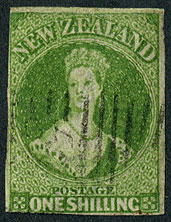
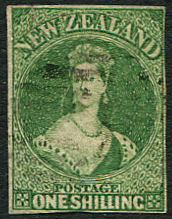
The 1s green occurs in several shades of green and yellow-green.
Only 47,760 copies of the 1/- value
were printed in 1862, 90,720 in 1863 and 143,280 in 1864.
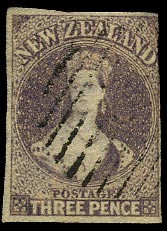
Three pence
The 3d value was issued on 1 January 1863.
The colour was brown-lilac.
120,000 copies were printed and
there was no further printing until 1865.


back next
The above information is taken from The Postage Stamps of
New Zealand Vol 1, published by the
Royal Philatelic Society of New Zealand in 1938.
All scans were made by the author.