
Mail could be sent to New Zealand by the London – Karachi air mail service
from 1929, although it was not until July 1930 that airmail could be
sent from New Zealand.
The cover shown below is one of only three known covers addressed to
New Zealand and flown on the
first flight leaving London on 30 March 1929.
To New Zealand on first service, 30 March 1929
The weekly Imperial Airways
London to Karachi air mail service
started on Saturday 30 March 1929, but
the Post Office had not announced that mail
would be accepted for Australia and New Zealand.
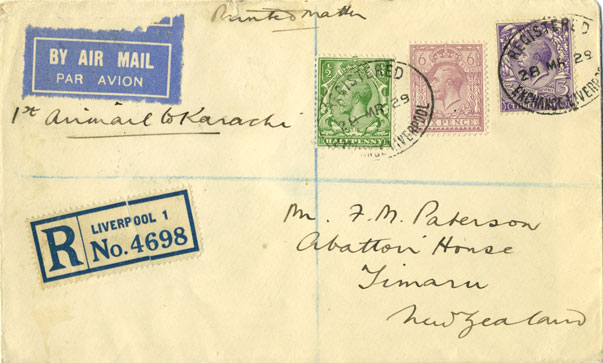
This registered cover is postmarked 28 March in Liverpool
and is addressed to F M Paterson in Timaru,
New Zealand.
It has the manuscript inscription Printed matter
and carries postage of 9½d made up of 6d airmail,
3d registration and ½d reduced surface rate.
Walker [2] states that covers to New Zealand
have not been previously recorded [3].
However, I have seen two almost identical items, also to Paterson, in auctions; one
had registration number 4696, the other 4697 while the shown item has number 4698.
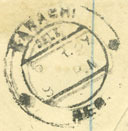
The Karachi REG backstamp
is indistinct.
The date appears to include the
characters 6 R 29 (and therefore could be 6 APR 29)
while the time is 9 PM.
It is known that the plane arrived in Karachi on 6 April.
From there mail was sent via Madras and the Dhanushkodi – Talaimannar ferry
to Colombo (Ceylon).
There it connected with the P&O mailboat Cathay on Saturday
13th April arriving one day early in Fremantle (Perth) on Monday 22nd April.
The mail was sent to Sydney by rail where it was delivered on 28 April [12].
From Sydney it likely
went to Wellington on the Maunganui from 3 – 7 May [13].
Two covers for Australia are known.
A registered cover from Basra to Adelaide is described in a 2005 auction
as having a 27 April Adelaide backstamp which would correspond to it making
the expected connection
at Colombo with the Cathay.
On the other hand, a cover is reported in [1] as arriving in Rochester, Victoria
on Monday 6 May which would correspond to the arrival of the mailboat
in Fremantle on Tuesday 30 April.
May 1929
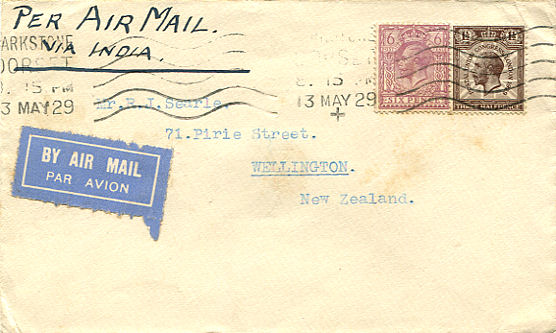
This cover is postmarked in Dorset on Monday 13 May 1929 and is addressed to New Zealand
with routing instructions Per Air Mail via India.
It is correctly franked with 7½d made up of 6d airmail plus 1½d surface and so
was intended to be flown from Britain to Karachi, but was sent before the first official
acceptance to New Zealand.
However, as it has no transit marks, there is no proof that it was flown to Karachi.
It was posted in plenty of time to connect with the weekly surface mail to Australia
and so sending it by air mail would have given no advantage.
If it was flown, it would have gone on IE 8 which left Croydon on 18 May and arrived in Karachi
on 25 May.
The route from Karachi to New Zealand would be the same as with the previous cover.
First Official Acceptance
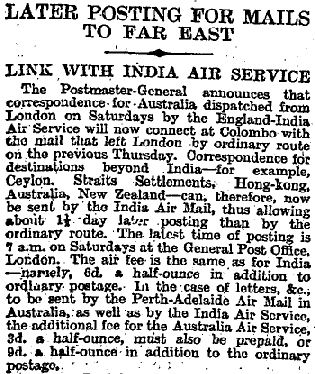

The first official acceptance of mail for Australia and New Zealand
using the London – Karachi air mail service is reported in The Times
of 30 August.
The mail left London on Saturday
31 August 1929 on IE 23, but the plane crashed while landing at Jask in Persia
on 6 September.
The pilot, Albert Woodbridge, one of the crew and the only
passenger were killed [4].
According to the report from The Times of 9 September, the mail was destroyed in the fire.
Albert Woodbridge is famous as the airman who wounded and shot down
von Richthofen, the Red Baron, in 1917.
The first successful official acceptance of airmail for New Zealand
via Karachi left London on IE 24 on 7 September, 1929.
Use of the London – Karachi airmail service, as part of the
route to Australia or New Zealand, made little improvement in the time.
The last posting each week for ordinary mail to Australia at the London GPO was
at 6pm on Thursday evening while, using the airmail service, mail could be
posted one and a half days later at 7 am on a Saturday.
Given the extra cost, it is not surprising that little use was made
of the service to Australia and it was withdrawn between May 1930
and 12 May 1932 [8].
The service to New Zealand was
never reinstated.
Use of the Karachi – London service from Australia and New Zealand
remained.
Legg shows the GPO airmail rates schedules to Australia for October 1929 to Spring 1931 and for
May 1933 [8].
The October 1929 schedule shows that the air fee for the London – Karachi service
had been reduced from 6d to 5d per ½oz and if the Perth – Adelaide service was used in
addition, the air fee was 8d.
The surface rate of 1½d had to be paid in addition.
The London – Karachi service is given the Air Route number 3 while
Perth – Adelaide has Air Route number 4.
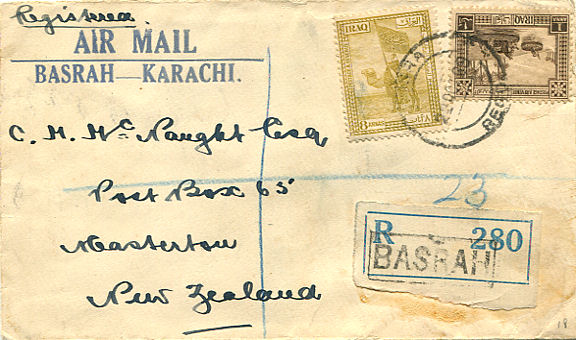
This cover addressed to New Zealand is postmarked in Basrah on 22 October 1929 and so would have been
flown on flight IE 30 which left Basra on 25 October and arrived in Karachi on 26 October.
However, although it is registered, it has no further postal markings.
From Australia via Karachi – London, December 1929
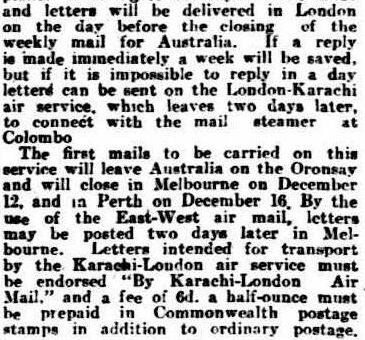

Although mail from Australia to the UK could be flown on the
Adelaide – Perth from its inauguration, it
was December 1929 before mail could also be flown on the Karachi – London air mail service.
The report is from the West Australian of 23 November 1929 [12].
Mail from New Zealand was not accepted until July 1930.
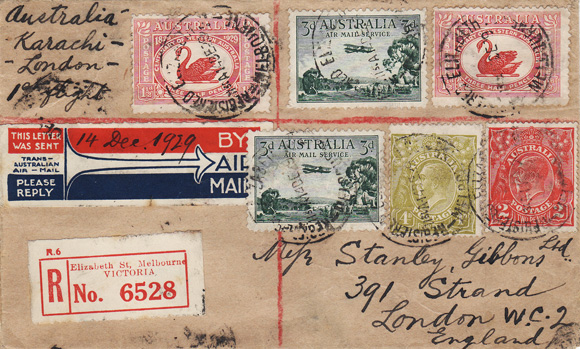
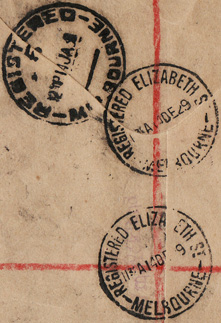
This cover is postmarked 14 December 1929 in Melbourne and
has the manuscript Australia – Karachi – London.
It was flown Adelaide – Perth and then
from Karachi on the first acceptance from Australia.
It would have been carried by overnight train on Saturday 14 December to Adelaide
and flown from there to Perth on 15 – 16 December where it connected
on Monday 16 December with the mail steamer Oronsay for Colombo.
It was then taken by surface to Karachi
from where it was flown on 30 December arriving
in London 1 day late on 9 January [3], 24 days after leaving Australia.
The surface mail on the Oronsay was due in London on 12 January.
It is franked with 1s 3d in stamps made up of
3d Adelaide – Perth airmail, 6d Karachi – London
airmail, 1½d surface postage plus a registration fee.
Prepayment of Overseas Airmail using New Zealand Stamps, July 1930
It was not until 1 July 1930 that New Zealand stamps were accepted
to pre-pay airmail postage on overseas routes.
As well as the Karachi – London route, mail was accepted for
Australian,
Canadian and
US airmail services.
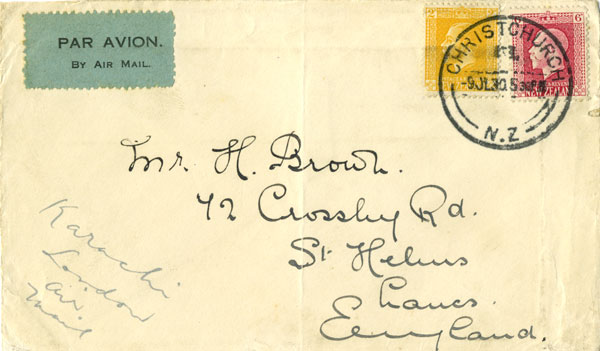
The first mail from
New Zealand via the Imperial Airways
Karachi – UK airmail route left New Zealand on 11 July.
(Mail from Australia
had been accepted on the Karachi – London route since December 1929.)
The rate from New Zealand was 7d per ½oz plus the normal surface postage rate of 1d.
The example cover is postmarked 9 July and went
by sea from Auckland to Sydney on the Ulimaroa on 11 – 15 July and then by rail to Perth
and was sent from Fremantle on the P&O mailboat Mongolia on 21 July.
It was off-loaded at Colombo on 31 July and sent by surface mail to Karachi
from where it was flown on flight IW 70 on 5 August, arriving in
London on 11 August [6].
The surface mail sent on the Mongolia was due in London on 16 August.
The Cairo – London part of the route had
changed in April 1930.
Mail was sent by rail from Cairo to Alexandria and
flown from there by flying boat to Salonica from where it was
sent by rail to Skopje (aka Skoplje and Uskub).
It was then flown from Skopje to London via Belgrade, Budapest,
Vienna, Nuremberg and Cologne.
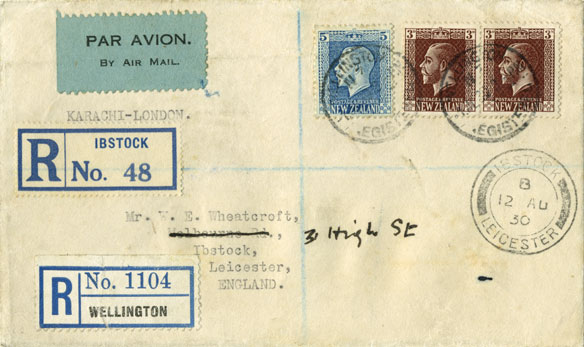
a) Registered
The next cover is registered and so
has stamps to the value of 11d being made up of the
postal rate of 8d plus 3d registration fee.
It is postmarked 1 July in Wellington
and has a receiving mark in Ibstock, Leicester dated
12 August 1930.
That ties in with the flight arriving in London on 11 August.
This cover is addressed to W E Wheatcroft, one of a small number of
enthusiasts at that time who regularly sent covers on inaugural flights.
There is an article about him in Air Mail News [7].
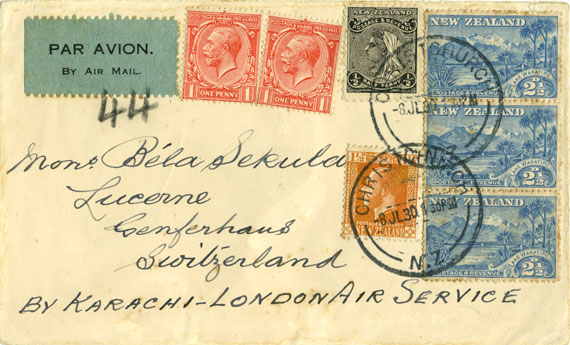
b) To Switzerland
This cover is postmarked in Christchurch on 8 July and is addressed to Switzerland.
It has a mixed franking of 9½d in New Zealand stamps plus 2d (unfranked) in
British stamps.
This is made up of 7d Karachi – London airmail, 2½d ordinary
postage to Switzerland while the 2d in British stamps
is the airmail fee from London to Basle.
An almost identical cover is shown in Walker [2].
It is interesting to note that if this cover had been
sent to UK by sea and flown to Switzerland prior to 1 July 1930,
it would have been necessary for it to have a
mixed franking of the surface
rate in New Zealand stamps and the London – Basle airmail fee in UK stamps.
However, that was now unnecessary
as New Zealand stamps could now
be used to prepay postage on overseas flights.
It is clear that the intention was for this cover to be flown to London and then
flown from there to Basle.
However, as the flight was through central Europe, it would have been
offloaded at Vienna or Nuremburg and sent on by rail to Lucerne.
Registered covers that were off-loaded with appropriate transit marks are discussed below.

c) Off-loaded in Gaza
This registered cover is postmarked on 1 July in Timaru and is addressed to
Alex Paterson, Poste Restante, Gaza,
Palestine.
It is clearly philatelic in nature, but the number of backstamps show that a major attempt
was made to locate him in Palestine.
The cover is franked with 11d which is the same as the earlier registered
cover to London and would be made up of 8d postage and 3d registration fee.
Although the routing instructions are via Karachi – London Air Mail Service,
the cover was off-loaded in Gaza.
The service that left Karachi on 5 August arrived in Gaza on 7 August
and the cover has a Gaza 7 August receiving mark on the back.
Then, in red ink,
there is Not called for in capital letters and Gaza has been scored out and
replaced with Jaffa.
There is a Jaffa receiving mark on the back dated 28 September and a further
Jaffa mark on the front dated 11 November with a further Not called for P. See Over
in red manuscript.
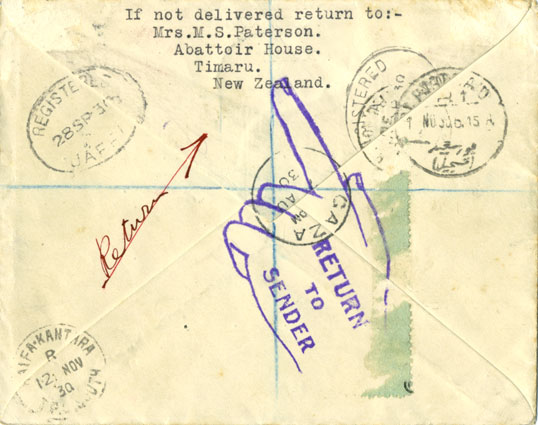
It then seems to have started its homeward journey.
There is a Haifa Kantara transit mark on 12 November
and a Port Said transit which appears to be 1 November, but is more likely to be 13
or 14 November.
It would then be sent from Port Said to New Zealand via Australia by sea and it
finally has a Wellington transit mark
on 24 December almost six months after it started its journey.
There are large Return to Sender cachets in purple with a hand and pointing finger
on both the front and back.
I think that they were applied in New Zealand.
The return address is to Mrs Paterson to add credibility to the notion
that Mr Paterson was in Palestine.
I have seen copies of similar covers from Alex Paterson addressed to Prague [10],
Athens, Estonia, Luxembourg, Copenhagen, Constantinople and Paris.
The Prague, Denmark and Constantinople covers are franked with 1s ½d made up of 7d
Karachi – London airmail, 2½d overseas surface plus 3d registration fee.
The Athens and Paris covers are not registered and so are franked with 9½d.
However, the Estonia and Luxembourg covers are only franked with 11d which would seem 1½d
short for a registered cover.
The Prague and Luxembourg backstamps are on 12 August and so they were
off-loaded in Vienna and Cologne (there is a Koln transit mark) respectively
on 11 August
and sent from there to their destination by surface.
The Kobenhavn Luftpost backstamp is on 12 August and so was likely flown there from Cologne.
The Constantinople backstamp is on 12 August with an Athens transit on 9 August.
The Tallin, Estonia backstamp is also on 12 August, but there is no transit mark.
The Paris backstamp is on 11 August, the same date as the London arrival and so it
may have been flown from there.
The Timaru Registration No. on the Estonia, Luxembourg, Gaza, Copenhagen, Prague and Constantinople
covers
are respectively 1363, 1368, 1369, 1373, 1399 and 1410.
That indicates that he sent quite a few letters to a range of destinations on this
dispatch.
d) Also flown Adelaide – Perth
Letters could be flown on a combination of the West Australian Airways
Adelaide to Perth service
and the Karachi – London service
at a further cost of 4d per ½oz. giving a combined
postage rate of 1s 0d.
Whereas mail flown only on the Karachi – London
service did not leave New Zealand until
11 July, mail that was also to be flown Adelaide – Perth left on 4 July.
Use of the Adelaide – Perth air mail service meant that
mail posted in Sydney on a Friday could catch up at Fremantle
with mail that had left Sydney on the previous
Wednesday.
The mail went by rail from Sydney to Adelaide and
the Adelaide – Perth air mail service left Adelaide on a Sunday to
connect on Monday with the mail steamer for Colombo [8].

This is one of 10 letters from the first acceptance of air mail
from New Zealand that was flown on both the Adelaide –
Perth and the Karachi – London service.
It has the correct franking of 1s 0d.
The postmark is 1 July 1930 in Wellington from where it was sent
to Sydney on 4 – 8 July on the SS Maunganui.
It was then sent from Sydney by rail to Adelaide,
flown Adelaide – Perth on
13 – 14 July, left Fremantle on the Barrabool on Monday 14 July for
Colombo where it
was due on Wednesday 23 July and
from where it was sent by surface to Karachi.
It was flown from Karachi by Imperial Airways on flight IW 69
on Tuesday 29 July.
and arrived in London on Monday 4 August [6].
The surface mail sent on the Barrabool was due in London on 9 August.
Delivery in Sutton Coldfield would be expected on 5 August.
The recipient is Francis Field, a prominent aerophilately dealer
and publisher, who often added a ½d stamp which was then postmarked
by favour by the local postmaster.
As that postmark is not until 7 August it was a couple of days before he
collected the mail, added the stamp and had it postmarked.
The important point is that it proves that it was carried on an
earlier flight from Karachi than the mail from New Zealand that
had not been flown on the Adelaide – Perth service as that mail did
not arrive in London until 11 August.
Later Flights: 1930

According to Walker [2], only 152 items were sent from New Zealand via the
combined Adelaide – Perth and Karachi – London
services in the first year which
averages at only about three on each flight.
Examples like this one are therefore uncommon.
It is always interesting to have proof that a service was actually used
by the public and that covers exist other than those flown on the first flight.
This cover is postmarked on 6 August 1930 and was sent on the Ulimoroa from
Wellington to Sydney on Friday 8 – Tuesday 12 August.
It was flown
Adelaide – Perth on 17-18 August, went by sea from Fremantle to Colombo on the
Cathay on
18th – 27th August and then went on the Karachi – London service IW 74 on
2 – 8 September.
There is a manuscript on the back stating that it was received on 9 September.
It is only franked by 11d in stamps rather than the required 1s 0d.
It is not surprising that there was confusion regarding the postage
which was 7d Karachi – London.
The Adelaide – Perth rate was 4d if addressed to the UK, but
3d for letters addressed to Perth.
That extra 1d might reasonably be assumed to cover the surface rate
while in fact a further 1d was required.
Increase in surface rate, 1 March 1931
An increase in the surface rate for Empire countries and the USA to 2d for the first ounce and 1d for each subsequent ounce
(previously 1d per ounce)
was announced on 25 February 1931 and came into affect on 1 March.
The registration fee was increased from 3d to 4d and the late fee from 1d to 2d.
That meant that the fee for the Karachi air mail to UK was now 9d for the first ½ oz.
The surface rate to non Empire countries remained at 2½d for the first oz and 1½d for each subsequent oz.
First experimental extension to Australia, April 1931
a) to New Zealand
In April – May 1931, Imperial Airways planned
two experimental
extensions of the London – Karachi airmail service
to Melbourne and return.
This was the first official air mail between
Great Britain and Australia.
The Imperial Airways service to Karachi had been extended to
Delhi in December 1929.
There were Qantas
services from Brisbane and an
Australian National Airways (ANA)
service from Brisbane to Melbourne.
The plan was to connect these services with Imperial Airways
flying from Delhi to Darwin and Qantas from Darwin to Brisbane.

The example registered letter is postmarked Birmingham
on 2 April 1931 and is addressed to New Zealand.
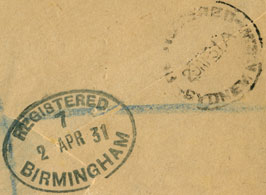
The postage rate for the flight was 1s 4d
per ½ oz. The letter has franking of 1s 7d
which includes 3d for the registration fee.
The flight left Croydon Airport (London)
on 4 April on the regular route to Delhi.
The mail arrived in Alexandria on 8 April,
Karachi on 12 April,
Delhi and Allahabad on 13 April, Calcutta and Akyab on 14 April,
Rangoon and Victoria Point on 15 April,
Alor Star and Singapore on 16 April, Samarang
on the 17th and Sourabaya on 18 April [6].
The DH 66 City of Cairo then crashed at Koepang (Kupang)
in Timor in the Dutch East Indies on 19 April.
Kingsford Smith, with G U Scotty
Allan as co-pilot, flew the Southern Cross from Sydney to
Koepang on 21-24 April.
They picked up the mail and flew it to Darwin on 25 April.
The mail was then flown to Brisbane by Qantas
on 27-28 April and by ANA
to Sydney on 29 April.
The New Zealand mail was forwarded from Sydney to Wellington by sea on the
Maunganui from 1-5 May [13].
b) from New Zealand
The return flight for London left Melbourne on 23 April.
The mail from New Zealand was sent from Wellington to Sydney on the Ulimaroa
on 17-21 April and joined the flight at Sydney on 24 April.
Only 229 ordinary and 106 registered letters were sent
from New Zealand.
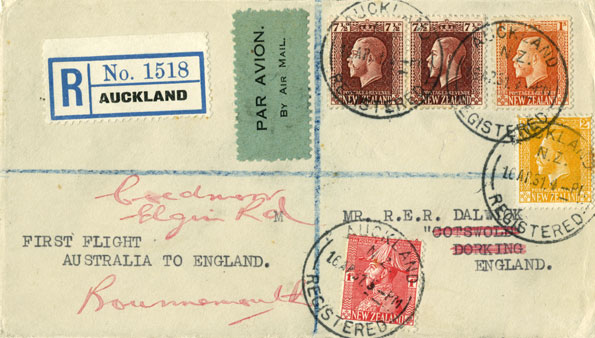
The example registered letter is
postmarked Auckland on 16 April and has franking of 2s 6d
made up as follows: 2d ordinary postage, 2s 0d air mail
to Great Britain, 4d registration fee.

The cover is backstamped 21 April in Sydney when a special cachet was
applied.
There is no London backstamp.
The New Zealand mail was carried by
ANA from Sydney to Brisbane
on 24 April and then by Qantas from Brisbane to Darwin,
on 25 – 26 April.
The plan had been
for the Imperial Airways DH 66 to fly the mails from
Darwin, but as it had crashed at Koepang and
Imperial Airways had no replacement aircraft,
Kingsford Smith and Allan, who had arrived in Darwin from Koepang
on the 25th, flew the mail from Darwin to Akyab in Burma on
27 April – 3 May.
At Akyab, on 3 May, the mail was
transferred to the Imperial Airways DH 66 City of Karachi
and flown to Delhi, arriving on 5 May.
From Delhi it joined the regular Imperial Airways
flight IW 109 to London where it eventually arrived on 14 May.
Second experimental extension to Australia, April – May 1931
a) to New Zealand
The second experimental airmail left London on 25 April and
was flown on the regular Eastern Route to Delhi.
The DH 66 Hercules City of Karachi had
arrived in Delhi on 5 May from Akyab with the mail from the
return flight of the first experimental airmail.
The mail was exchanged and the City of Karachi immediately
returned that day (via Allabad) to Calcutta.
It was then flown to Akyab on 6 May.
The mail was then flown from Akyab to Darwin from
6 to 11 May by Kingsford Smith and Scotty Allan in the
Southern Cross.
From Darwin it was flown to Brisbane
on 12-13 May by Qantas and then by ANA
to Sydney on 14 May with
P G Taylor as pilot.

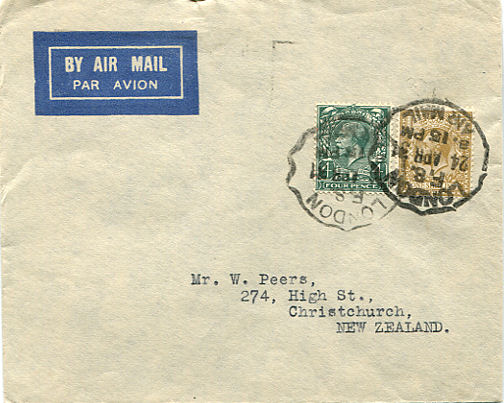
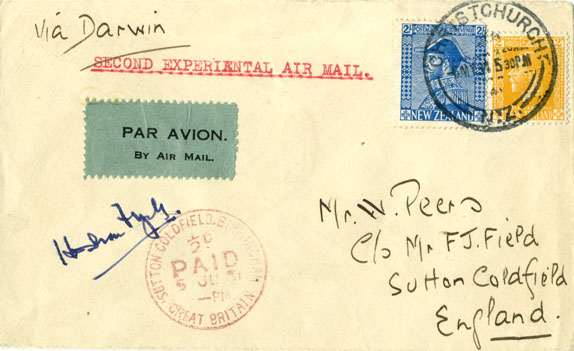
This cover was postmarked in London on 24 April and is addressed to Christchurch.
It has a Sydney backstamp on 14 May and a Christchurch backstamp on 19 May.
The mail was delivered in Wellington on 18 May [2] and so must have made
a very good connection with the Maunganui which sailed from Sydney to Wellington
on 14-18 May [13].
The Monowai left Sydney for Auckland on 15 May, but did not arrive
in Auckland until 19 May.
b) from New Zealand
There were 266 acceptances from New Zealand for the second
return flight and they were carried from Auckland to Sydney on
the Maunganui on 8-12 May 1931.
This cover is postmarked Christchurch on 6 May.
As with the first return flight, the postage rate was 2s 2d made up of
2d ordinary postage and 2s 0d airmail fee.
The flight left Melbourne on 15 May and the New Zealand mail joined
at Sydney on the 16th.
The Melbourne – Sydney – Brisbane leg was flown by ANA in
with Jim Mollison as pilot.
Qantas flew the leg from Brisbane to Darwin on May 17-18.
The pilot was Hudson Fysh,
Managing Director and co-founder of Qantas.
This was the last time he flew a scheduled service
and the cover has his autograph.
By this time, Imperial Airways had
purchased a replacement DH 66 and it flew the leg from Darwin
to Delhi (May 19 – 26).
The mail connected with the scheduled flight from Delhi on May 27
and was flown to Cairo where it arrived on 30 May.
The flight from Alexandria on May 31 was only the second on a
new route.
It was by Short Kent flying boat to Genoa via
Crete, Athens, Corfu and Naples.
However, the flight was delayed for two days in Corfu [6] and so it
was June 3 before it arrived in Genoa.
The mail was sent by overnight rail from Genoa to Basle
and then flown to London where it arrived on 4 June [6, 9].
That corresponds with the Sutton Coldfield
½d paid mark of 5 June on the above cover.
First New Zealand airmail stamps, November 1931
Flown Karachi – London
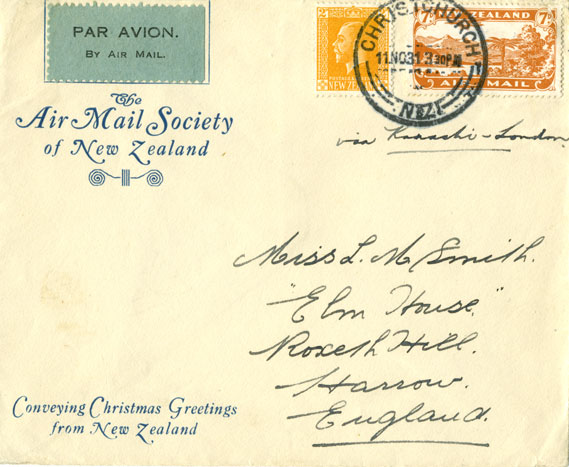
The next cover contains the first use of the 7d value of the
special airmail stamps
issued on 10 November 1931 on the Karachi – London route.
It is routed Karachi-London and
postmarked 11 November, 1931 in Christchurch.
The surface postal rate had been increased to 2d in March 1931
and so the total postage rate was now 9d.
The special Christmas Greetings envelope was produced by the
Air Mail Society of New Zealand for use in conjuction with the
All-Australian Christmas flight to the UK
whose mail left New Zealand on the same day, namely 13 November.
On 13 November, mail for Sydney left Auckland on the Ulimaroa
and Wellington on the Marama.
Both arrived on 17 November.
The mail was then carried by train to Perth and then from Fremantle on the Mooltan to Colombo
on 23 November – 2 December.
Colombo (in modern Sri Lanka)
to Karachi was by ferry and rail.
The mail was then carried on service IW 140 from Karachi to London on 10-17 December [9].
There had been a major change in the Karachi – London air mail
service in October 1931.
The route from Baghdad was now to Tiberias and from there by car to
Haifa.
From Haifa, the mail was flown to Brindisi via Castelrosso, Athens and Corfu.
From Brindisi, it was sent by rail to Paris and then flown to London.

Also flown Adelaide – Perth
The next cover was also sent from Christchurch to the same person, but
is routed Adelaide – Perth in addition to
Karachi-London.
It was flown Adelaide to Perth on 21-22 November and then was carried to Colombo
on the Mooltan, leaving Fremantle on Monday 23 November.
Use of the Adelaide – Perth airmail did not therefore speed up its journey
as it was carried on the same service from Fremantle as the previous cover.
It arrived in London on 17 December.
In addition to the 9d postage on the first cover, it contains the 4d airmail stamp
to cover the Adelaide – Perth postage.
Some airmail stamps were sold by mistake in
Highfield on 9 November
and most were used on covers routed for the Karachi London service although they were actually sent on the
All-Australian Christmas flight to the UK .
Also flown Christchurch – Auckland and Adelaide – Perth
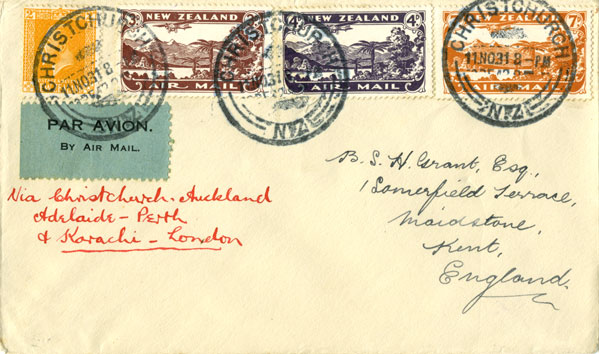
This cover has routing instructions for it to be flown on three different flights:
Christchurch – Auckland on the special
New Zealand internal Christmas flight of 12 November;
Adelaide – Perth on 21-22 November
and Karachi – London on 10 – 17 December 1931.
It is correctly franked with the complete set of airmail stamps:
the 3d pays for the internal New Zealand flight, the 4d for Adelaide – Perth and the 7d
for Karachi – London.
In addition, the 2d GV covers the surface rate.
It arrived in London on the same service as the previous two covers.
Commercial flight, postmarked 14 November 1931
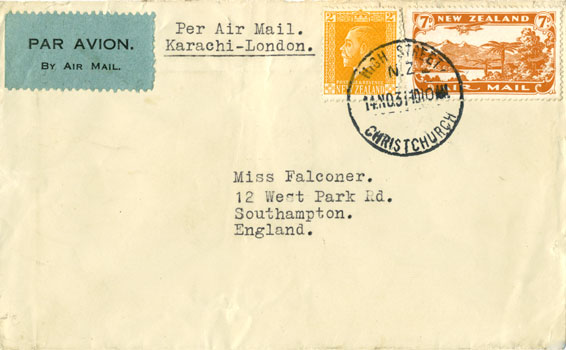
Many early flight covers are philatelic in nature and sent on first flights.
It is therefore always interesting to see covers sent on second flights.
This cover is postmarked in Christchurch on 14 November, 1931 and would
go from Wellington to Sydney on the Maunganui on 20-24 November [13].
It then left Sydney by train on 25 November and carried from Fremantle to Colombo on the Otranto on
30 November – 9 December.
It would be flown on flight IW 141 that left
Karachi on 16 December and arrived in London on 23 December;
just in time for Christmas.

Flown on internal December 1931 Christmas flight, Adelaide – Perth and Karachi – London
To publicise the advantages of air mail, the New Zealand Air League
organised a network of airmail services on Christmas Eve 1931.
This cover is postmarked in Christchurch on 23 December and is addressed
to the UK.
It was sent by the regular steamer from Lyttelton to Wellington on the night
of December 23
and then flown from Wellington to Auckland on December 24.
It is franked with 5d to cover the Christmas airmail service, 4d for Adeliade – Perth and 7d for Karachi – London.
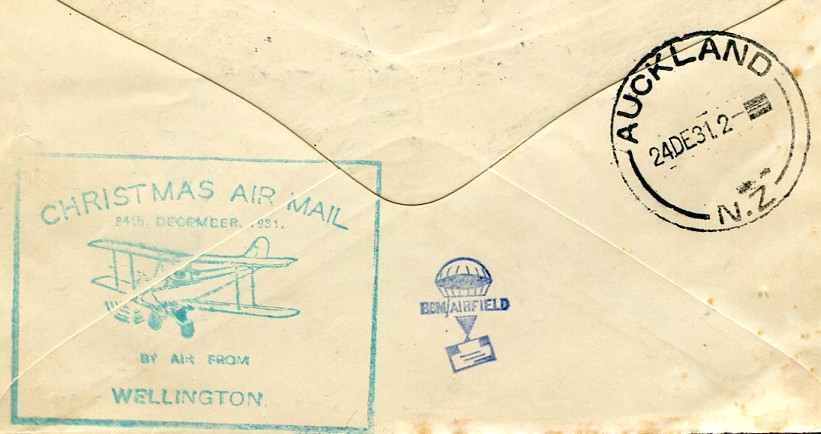
The mail left Auckland for Sydney on the Aorangi on 28 December,
arriving on 31 December.
The mail was flown from Adelaide to Perth on 2-3 January 1932 and then went by sea from Fremantle to Colombo
on the Cathay on 4 – 14 January.
Colombo to Karachi was by ferry and rail.
The mail was then carried on service IW 146 from Karachi to London on 20-26 Jan [6].
Flight to UK January 1932
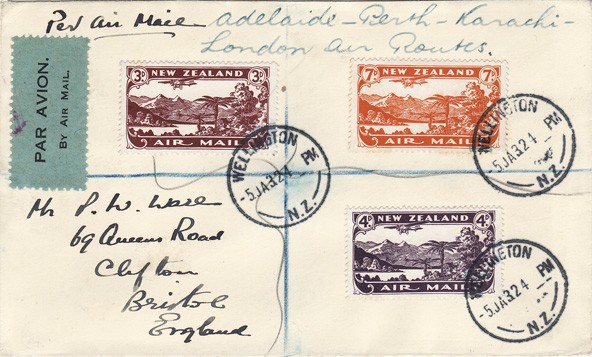
The next cover was flown Adelaide – Perth and Karachi – London.
It is postmarked Wellington on 5 January 1932.
It is franked with a complete set of the 1931 airmail set.
The postage was 2d surface plus 4d Adelaide – Perth and 7d Karachi – London
and so it is overfranked by 1d.
It would be carried from Auckland to Sydney on the Ulimaroa on 8-12 January.
Sydney – Adelaide was by rail and it is likely to have been flown Adelaide – Perth on 16-17,
then Fremantle to Colombo on the Comorin on 18 – 27 January
and sent on the Karachi – London service IW 148 on 3 – 11 February.
The cover appears to be philatelic in nature and I have seen
another example to the same address with a postmark on the same date.
However, I am not aware of anything special about this particular flight.
Flights to Europe, 1932
The rate to non Empire countries was 2½d surface rate for the first oz together with the
airmail fee of 7d for the first ½ oz.

b) To Holland
The next cover is addressed to Holland and is franked with a 2½d stamp
in addition to the 7d airmail.
That was the surface rate to non-Empire countries.
It is postmarked in Auckland on 23 April 1932 and would have
been carried from Auckland to Sydney on the Zealandia on
29 April – 3 May and from Fremantle to Colombo on the Ormonde on 9 – 18 May.
It would have been flown on
flight IW 164 that left Karachi on 25 May.
It would be flown to London arriving on 31 May and then
sent from there to Holland.
There had been a further change in the route of flights that left Karachi from
20 April 1932 in that they made
a stop at Limassol (Cyprus) and Rhodes.
That continued until the flight that left on 28 September.
However, according to Wingent [6], the flights of 24 and 31 May were both
routed via Cairo.
c) To Greece
Mail could be sent from New Zealand to intermediate destinations on the
Karachi – London route.
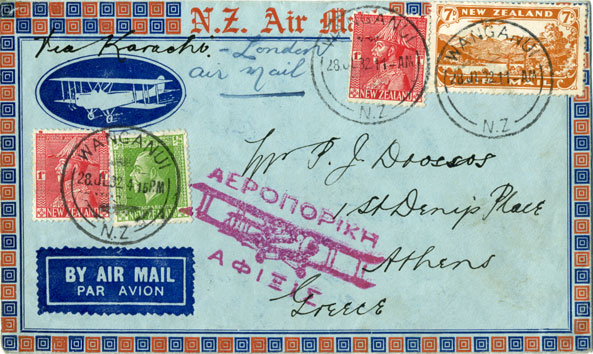
This cover, postmarked in Wanganui on 28 July 1932, was sent to Greece.
It is franked with 7d for the airmail leg from Karachi to Greece
plus 2½d surface rate.
The Maunganui left Auckland on 29 July and arrived in Sydney on 2 August.
The cover would be carried on the Maloja between Fremantle and Colombo on 8-17 August
and connect with the Karachi – London service that was due in London on 30 August.
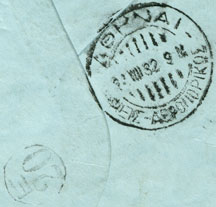
The cover has an interesting Greek arrival cachet and a smudged arrival datestamp
that appears to be 28 August.
That is the arrival date in Athens of flight IW 177 that left Karachi on
24 August [6].
There is also an E20 in a circle on the back, but I am not sure
what that indicates.
The recipient is Drossos, a well known Greek aerophilatelic dealer,
but there does not seem to be any special philatelic reason for the flight.
The first New Zealand acceptances for Africa were just before this date:
the first acceptance from Auckland was flown from Karachi on 27 July
and the first acceptance from Wellington
on 11 August 1932.
Reduction in surface rate, 1 June 1932
On 1 June 1932, the surface rate to Empire countries and the USA was reduced to 1d per oz.
The registration fee was reduced back to 3d and the late fee to 1d.
That meant that the rate to the UK via Karachi air mail was once again 8d for the first ½ oz.
Change of route, October 1932
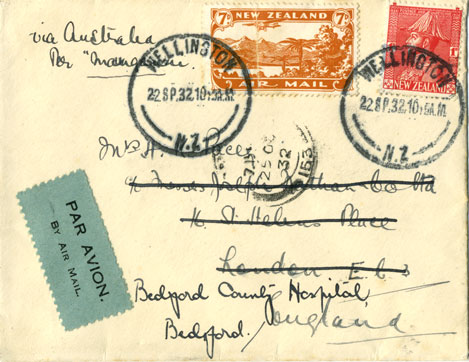
For the flight leaving London on 1 October 1932,
the route was changed from the Persian to the Arabian side of the Persian Gulf
and Handley Page HP 42 airliners were introduced on the route to Karachi.
Another change was that Rhodes and Limassol were dropped from the route
from Athens and replaced by Castelrosso.
Also, the car journey from Haifa to Tiberias was no longer necessary
as the Kent flying boats now flew to Lake Tiberias (Sea of Galilee)
where passengers were transferred to the HP 42 airliners.
The first flight from Karachi on the new route left on 5 October
and arrived in London on 12 October.
This cover is postmarked in Wellington on 22 September and, as
it was redirected, has a London postmark on 25 October.
It was therefore flown on IW 185, the third flight on the new route from Karachi
which left on 19 October and arrived in London on 25 October.
It would go on the Maunganui that left Auckland on 23 September and arrived in Sydney
on 27 September.
It then went on the Cathay from Fremantle to Colombo on 3 – 12 October and
was scheduled to connect with IW 185 at Karachi on 19 October.
The surface rate had been reduced back to 1d in the middle of 1932
and so the cover is correctly franked with 7d for Karachi – London and 1d surface.
Change of Route, January 1933
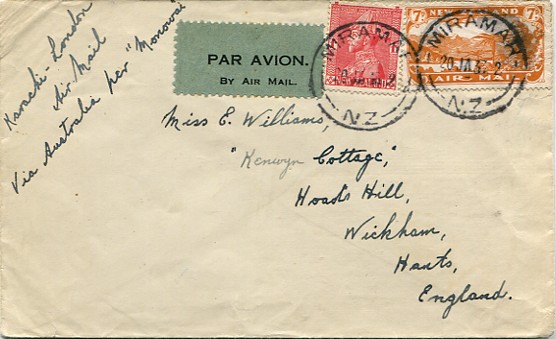
To UK, Jan 1933
There was a further change to the Karachi – London route in January 1933,
when the route from Baghdad to Athens reverted to being via
Gaza, Cairo, Alexandria and Crete.
The first flight on the new route left Karachi on 19 January 1933 and arrived in London on 27 January.
There was a further minor change on 15 February with the overnight stop now being in Baghdad rather than Basra.
This cover is postmarked on 20 January 1933.
It would be sent on the Monowai which sailed from Auckland to Sydney on 26 – 29 January.
After being sent from Sydney to Perth by rail, it
would then go on the Moldavia from Fremantle to Colombo on 6 – 15 February.
That mail connected in Karachi with IW 203 that left Karachi on 22 February
and arrived in London on 1 March.
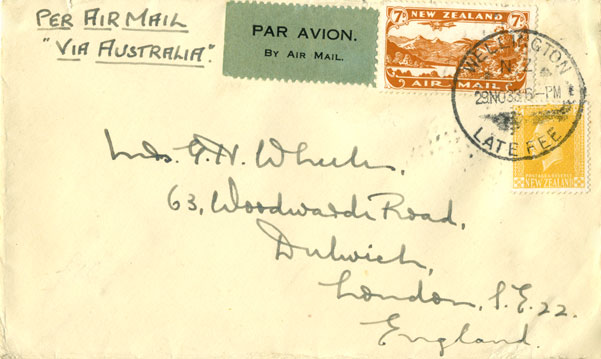
To UK, November 1933: Late fee
Acceptance of letters for a sailing of the trans-Tasman steamer
closed several hours before the boat sailed.
However, letters were still accepted on payment of a special late fee.
The cover is postmarked Wellington at 6pm on 29 November 1933 with a
special LATE FEE cancellation.
The cover is routed Per Air Mail Via Australia.
The Monowai left Auckland on 30 November and was due in Sydney on 3 December.
It would connect at Fremantle with the Strathnaver for
Colombo on 11-20 December and at Karachi on 27 December on service IW 247
that arrived in London on 2 January 1934.
The surface rate at that time was 1d and so the postage is made up
of 7d Karachi-London airmail, 1d surface mail and 1d late fee.
Adelaide – Perth, Karachi – Italy, addressed to Denmark, January – March 1934
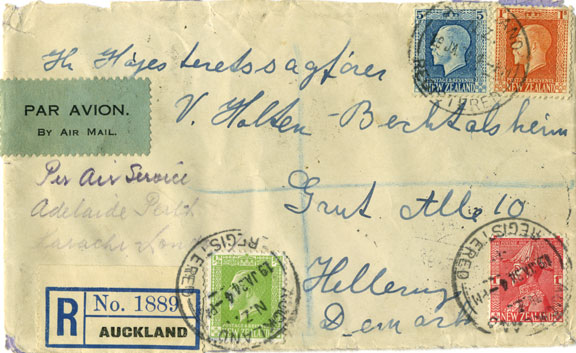
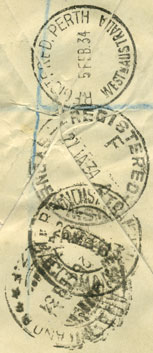
This registered cover is postmarked in Auckland on 19 January 1934
and is addressed to Denmark.
It has routing instructions Adelaide – Perth
and Karachi – London.
The franking is 1s 6½d.
Costs would include 4d Adelaide – Perth, 7d Karachi – London,
2½d surface rate to a foreign country, 3d registration fee and so the cover is
overfranked by 2d.
It is backstamped in Sydney on Saturday 27 January.
It was not flown from Adelaide to Perth until the following week on 3-4 February
and is backstamped in Perth on Monday 5 February when it connected with the P & O
steamer Mongolia that sailed to Colombo on 5-14 February.
One again, flying Adelaide – Perth did not speed up the service.
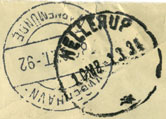
It was then flown from Karachi on 22 February.
That flight arrived in Brindisi on 26 February and the cover
has two indistinct backstamps on 26 February.
One appears to be Brindisi and the other Milano.
The IA Karachi service arrived in London on 28 February, but it appears that
this cover did not follow the routing instructions, but went directly from Italy to
Copenhagen.
The dates on the Danish backstamps are not clear, but appear to be 28.2.34
in Kopenhavn and 1.3.34 in Hellerup.
via Calcutta, 1933?
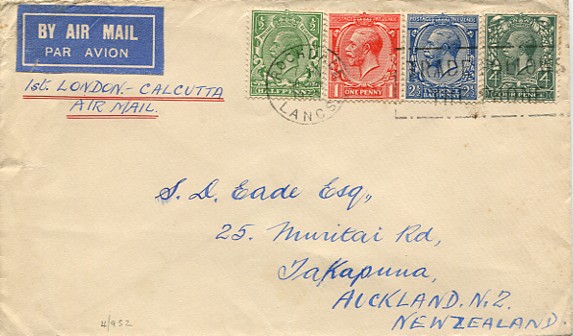
From July 1933, the London – Delhi service was extended to Calcutta.
The first flight left London on 1 July and arrived in Calcutta on 8 July.
Although use of the Karachi air mail service from New Zealand to Britain remained, the service
to New Zealand was withdrawn in May 1930 as it was slower than surface mail via the USA
and it was never reinstated.
However, air mail collectors often ‘tried their luck’ with first flights and sent them
to unusual destinations.
This cover is postmarked in Rochdale, Lancashire on 30 June and is
addressed to Auckland with routing instructions 1st London-Calcutta Air Mail.
It has the correct franking of 8d.
However, it does not have the usual Karachi – Calcutta first flight cachet that was applied to
the mail on arrival in Calcutta and so there is no proof that it was actually flown on the service.
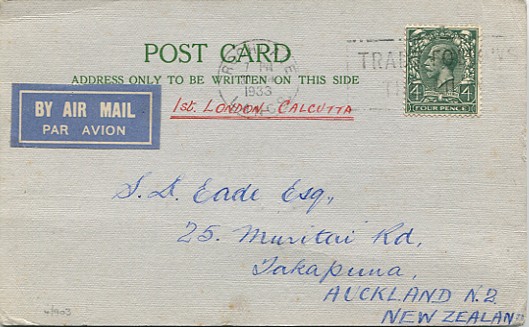
A postcard was also sent by the same sender to the same address and, once again,
there is no first flight cachet.
It is correctly franked with the correct postcard rate of 4d.
Support for the idea that it would be flown is in the GPO Air Mail leaflet
for May 1933 which has the footnote:
Correspondence can be sent by air mail, if the sender so desires, to countries not
directly served by the air services shown in this leaflet upon payment of the air postage,
as shown above, to the country through which the letter is to be forwarded. … Correspondence
sent by this means must be superscribed to indicate the poster’s intention, e.g., “By
Indian air service to Karachi.”
Flying from Karachi to Calcutta would have added a delay to any mail to New Zealand.
If it was flown then the route from Calcutta would likely be to Colombo via Madras
and on by sea to Freemantle in Australia.
Trans-Tasman + Karachi – London, 1934
a) First flight, February
The next cover is routed Adelaide – Perth
and Karachi – London as well as being carried on the
first trans-Tasman flight
on 17 February 1934.
It has the correct franking of 1s 6d.
The trans-Tasman rate of 7d covered onward surface delivery
to the UK. The extra rate for the Perth-Adelaide airmail service
was 4d while the Karachi-London airmail service was 7d.
It was postmarked in Wellington on 19 January which is two days after the issue
of the special trans Tasman stamp.
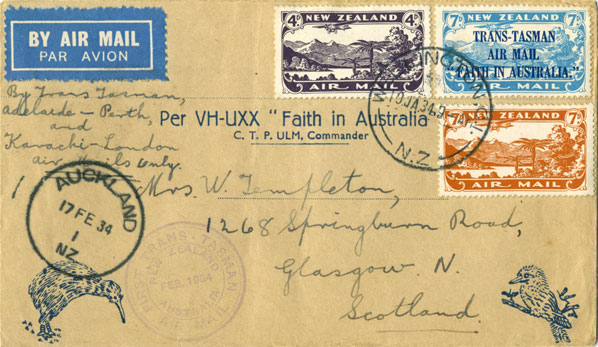
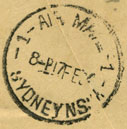
The backstamp shows that it had arrived in Sydney on
Saturday 17 February.
From 6 September 1930, the Adelaide – Perth service left on a Saturday
rather than Sunday as before [8].
This cover would therefore not be flown from Adelaide until
the following Saturday (24 February) arriving in Perth
on 25 February and connecting with the Ballarat from Fremantle to Colombo on 26 February – 7 March.
It was then flown on the IA flight that left Karachi on
15 March and arrived in London on 22 March [6].
That corresponds with a manuscript on the back of the cover
stating that it was received in Glasgow on 23 March.
So it was 34 days in transit after leaving New Zealand.
A cover to
the same address
sent via US airmail around the same time
was only 30 days in transit.
On this occasion, the Adelaide – Perth air mail service
did not speed up the mail, trans-Tasman.
covers addressed to the UK
and routed only on the Karachi – London service, also
arrived in London on 22 March.
Walker [2] states that the arrival date is unknown.
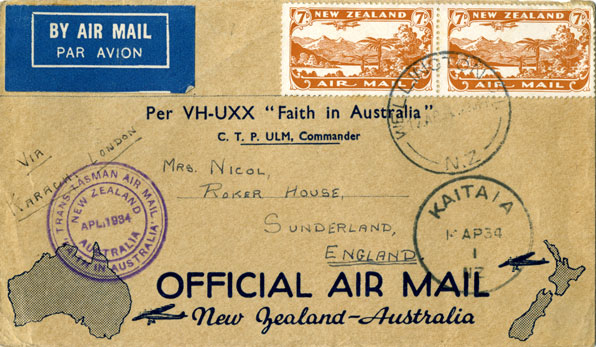
b) April 1934
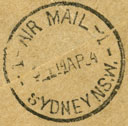
This next cover was flown on
Ulm’s second trans-Tasman flight on 14 April.
It is addressed to England.
From Sydney it was taken to Karachi by surface and
then flown on the Karachi – London airmail service
from 9 – 17 May which required the second 7d stamp [6].
The route from Fremantle was by sea to Colombo
and from there by surface to Karachi.
According to [5], after October 1932, an air mail service
by Tata Sons Ltd was available for the Madras – Karachi leg
of the route from Colombo, but I have not seen any mention of
it being used to expedite mail to/from Australia and New Zealand.
In December 1934, the Empire Air Service
was extended to Australia and that
then became the standard
airmail route from New Zealand although, of course, the New Zealand
to Australia leg was still by sea.
The service of surface to Karachi and air from there was no longer available.


back next
All scans were made by the author.
[1] London to Australia via Karachi, 1929, Bill Legg,
Air Mail News, vol 47, pp 254-6, February 2005.
[2] Airmails of New Zealand, volume 2 (1986) compiled by
Douglas A Walker,
Air Mail Society of New Zealand
[3] Airmail to New Zealand via Karachi, March 1929,
Robert G Clark,
The Kiwi, vol 54, no 3, pp54-55, May 2005.
[4] K C Sanford, Air Crash Mail of Imperial Airways and Predecessor
Airlines, published by Stuart Rossiter Trust Fund, 2003.
[5] The Route from Ceylon to Karachi in 1935,
Air Mail News, vol 45, pp 245-6, February 2003.
[6] Aircraft Movements on Imperial Airways’ Eastern Route,
Vol 1, 1927 – 1937, Peter Wingent, Winchester 1999.
[7] Uncle Will and his Airmail Friends, Stan Wheatcroft,
Air Mail News, vol 48, pp 29-40, May 2005.
[8] W.H. Legg, Aspects of the London-Karachi and the Perth-Adelaide
Routes,
Air Mail News, vol 44, pp 106-116, August 2001 and pp 178-183,
November 2001.
[9] The Postal History of British Air Mails,
E B Proud, 1991.
[10] L Giles, Q72, BAeF Bulletin, no 116, p 10, April-May 1994.
[11] Postage Rates, The Mail Coach, vol 21, no 6, pp 251-253, August 1985.
[12] Australian Newspapers 1803-1954,
Trove, National Library of Australia
[13] Evening Post Wellington 1916-1945, Papers Past,
available at: paperspast.natlib.govt.nz