
KLM planned an experimental airmail from Amsterdam to Melbourne
and back in April/May 1931.
This prompted Imperial Airways to plan
two experimental
flights from London to Australia and return.
Regular KLM service to Batavia
Since 25 September 1930, KLM
(Koninklijke Luchtvaart Maatschappij or
Royal Dutch Airlines)
had operated the longest
regular airmail route in the world
from Amsterdam to Batavia (modern Jakarta) in Java
in the Dutch East Indies (modern Indonesia) [1,3].
The KLM route from Karachi to Batavia was similar to that used in the
experimental Imperial Airways
flight except that Alor Star – Batavia was via Medan
rather than Singapore.
The regular KLM route was used for air mail between Malaya
and London.
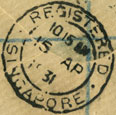
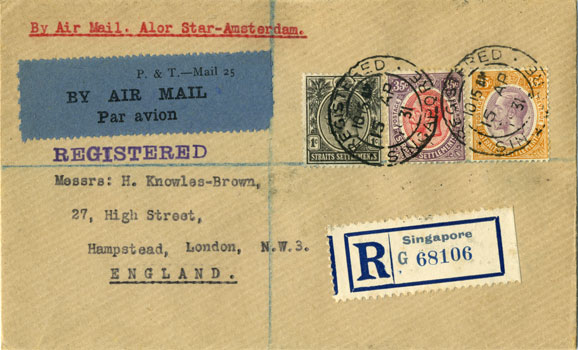
This registered cover was posted in Singapore on 15 April 1931
and then carried by surface to Alor Star where it joined
the regular KLM flight to Amsterdam.
It has franking of 71 cents while a cover
flown five weeks later from Alor Star on the
second Imperial Airways experimental
flight needed only 48 cents postage.
Even after Imperial Airways opened their route to
Singapore in 1933,
the KLM route continued to be used for London
airmail, despite being more expensive, as it was significantly faster.
UK to Australia/NZ via Amsterdam, 1931
To give a through service from Amsterdam to Australia, KLM
added an experimental flight from Batavia to Melbourne.
The through flight left Amsterdam on 30 April and arrived in Batavia on
9 May.
The Batavia to Melbourne leg was 11 – 19 May.
Mail from London was accepted and was flown to Amsterdam on 29 April.
The rate to both Australia and New Zealand was 2s 6d.
Mail for New Zealand was unloaded at Sydney on 18 May and sent on by sea.
I have seen a scan of a cover to New Zealand that was backstamped in Christchurch
on 4 June.
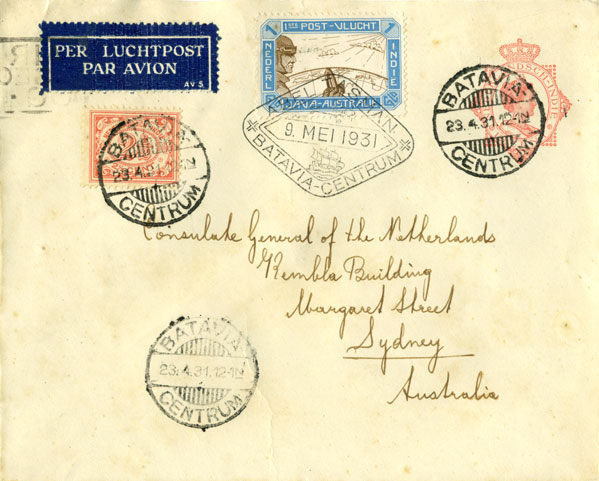
The example cover was carried from Batavia to Sydney.
A special 1 Guilden stamp was issued in both the Netherlands and the Dutch
East Indies to pay the airmail postage for this flight.
It is shown on the cover
cancelled with the special Batavia cachet dated 9 May.
The cover was backstamped at Sydney on 18 May.
The KLM flight entered Australia at
Wyndham rather than at Darwin.
The plane was a Fokker FVII trimotor (like the
Southern Cross) named
Abel Tasman and that name is shown in the cachet.
The pilot and co-pilot were J. Pattist and P. Moll
who was to take first place for KLM in the handicap section of the
MacRobertson Air Race in 1934.
Australia to UK via Amsterdam, 1931
The return flight left Melbourne on 22 May and arrived in Batavia
on 27 May and Amsterdam on 6 June.
No mail from New Zealand was sent on this flight.
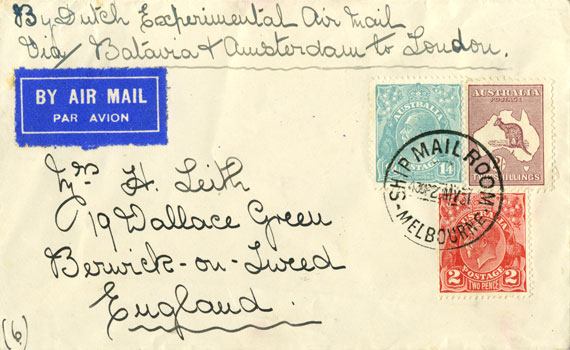
The example cover was carried from Melbourne to the UK.
The postage rate was 3s 6d.

The postmark on the cover is
Shipmail Room, Melbourne on
22 May.
As Melbourne is where the flight started, the cover was not carried by
ship.
The likely explanation is that the shipmail room was where external
mails were handled and they would normally involve transport by sea.
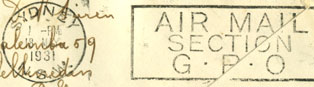
A special purple cachet was applied in Melbourne.
New Aircraft, 1933
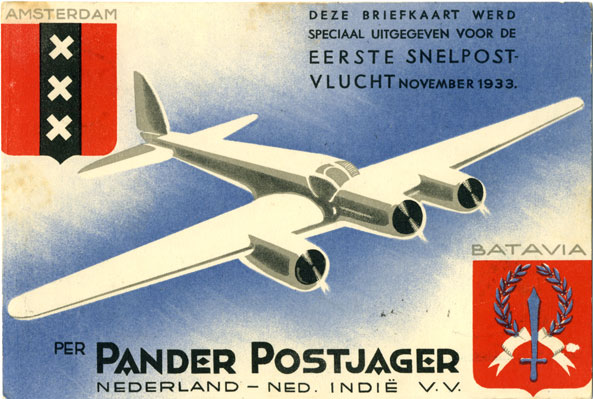
Early KLM aircraft were built by Fokker, but in 1933
they decided to order US aircraft from Douglas, first the
DC 2 and then the famous DC 3 Dakota.
Two Dutch firms, Fokker and Pander designed new
aircraft to meet this challenge: the Pander Postjager
and the Fokker FXX [2].
The trimotor Pander Postjager (Mail Rusher) was designed
purely to carry mail
and is shown on this first flight postcard.
The plan was to carry 1933 Christmas mail both to
and from the Dutch East Indies.
The Postjager left
Amsterdam on 9 December 1933 bound for Bandoeng in Java.
However, it had to land in Taranto, Italy due
to engine failure.
As it was to be some time before a replacement engine could
arrive, the mail was flown from Brindisi
to Cairo by Imperial Airways.
The new Fokker FXX was to make a Christmas flight to Java
leaving on 18 December
and so it was planned that it would pick up the Postjager‘s
mail.
However, its engine failed before take off and so it was
replaced by an older Fokker FXVIII named the Pelikaan.
It picked up the Postjager‘s mail
and arrived in Bandoeng on 22 December.
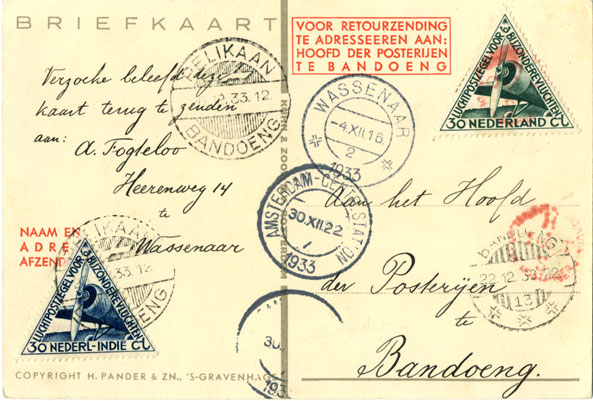
The postcard is backstamped at Bandoeng on 22 December.
The plan had been for the Postjager
to return with the Christmas mail.
Instead, the Pelikaan flew the return mail leaving
Bandoeng on 26 December and arrived back in Amsterdam on
30 December setting a new record time for the route.
The card was also flown on the return journey.
It has the special Pelikaan Bandoeng postmark
of 26 December and the 30 December Amsterdam arrival mark.
Special Netherlands and Dutch East Indies triangular airmail
stamps were issued for these flights.
Both are on the shown postcard.
Only one of each of the Pander Postjager and the
Fokker FXX were ever built.
The end of the Postjager was in the
MacRobertson Air Race in October 1934 where it crashed at Allahabad.
MacRobertson Air Race, 1934

The next through airmail by KLM to Australia
was in October 1934 when their entry in the
MacRobertson Air Race
was a Douglas DC 2
carrying passengers and an official mail.
They took less than four days from England to Melbourne and came
second in the Speed Race, but chose instead to take the first prize
in the Handicap Race.
The official cover shown was issued by KLM and was
postmarked on 15 October in the Netherlands
and has an official cachet in red.
The plane flew to England on 19 October ready for the race
on 20 October.
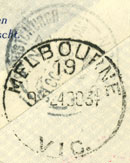
The cover was backstamped at Melbourne on 24 October and
is one of only about 50 addressed to New Zealand.
It was carried there from Australia by surface mail and
was backstamped Christchurch on 31 October.
Regular Amsterdam – Sydney Service, 1938

KLM had wished to set up a regular Amsterdam – Australia
service for several years, but it was not until June 1938 that
they got the go-ahead.
The agreement was largely because Imperial Airways / Qantas
required new landing rights in the Dutch East Indies due to their
introduction of flying boats.

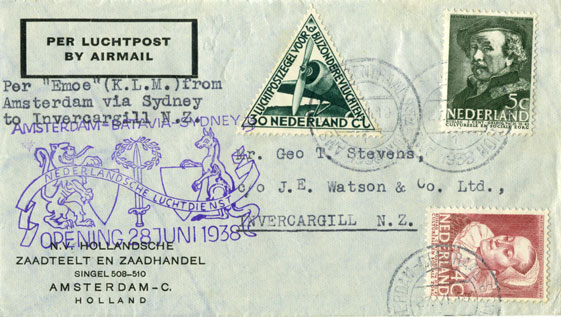
The first regular air mail for Australia left Schipol Airport
on 28 June and was flown on the established route to Batavia by
DC 3.
The route from Amsterdam was via Leipzig, Budapest, Athens,
Alexandria, Lydda, Baghdad, Basra, Jask, Karachi, Jodhpur,
Allahabad, Calcutta, Rangoon, Bangkok, Penang, Medan, Singapore,
Palembang, Batavia.
The Batavia – Sydney section was operated by KNILM
using a Lockheed Super Electra.
The air mail then left Batavia on 3 July and arrived in Sydney
on 5 July where it was backstamped.
Mail for New Zealand was accepted on this flight and
the shown cover was carried by trans-Tasman
steamer from Sydney to New Zealand.
The cover has an advertisement on the back for an air demonstration
on 2 July at Schipol airport.
Saigon – Batavia (- NZ), August 1938
In August 1938 KNILM started a regular service between Saigon
and Batavia via Singapore.
The first flight from Batavia to Saigon was on 30 August and
the first return flight was on 31 August.
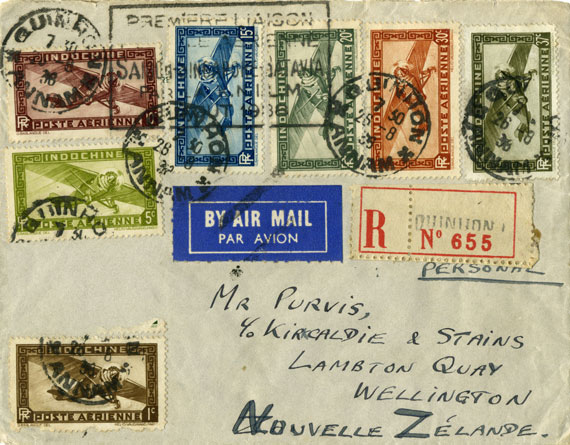
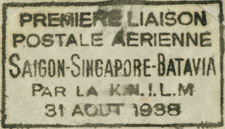
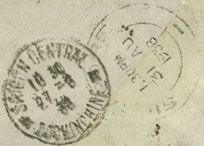
This cover has a postmark dated 26 August, a Saigon backstamp
dated 27 August and a Singapore arrival mark dated 31 August.
It was flown on the first flight from Saigon to
Batavia and is addressed to New Zealand.
It is not clear whether it was also flown from Batavia to Sydney.
According to the timetable
the flight left Saigon at 7.30 am on a Wednesday and arrived in Batavia
later that day at 17.10.
This connected with the KNILM flight to Sydney which left Batavia at 13.00 on
a Thursday.


back next
All scans were made by the author.
Information on this page is taken from:
Airmails of New Zealand, volume 2 (1986) compiled by
Douglas A Walker, and
The New Zealand Airmail Catalogue, (2nd Edition, 1994)
by James Stapleton.
Both are published by the
Air Mail Society of New Zealand
[1] The Dutch Connection, B Legg, Air Mail News, vol 34,
pp 144-151, December 1991.
[2] An Aerial Christmas Saga, F G Kones, Air Mail News, vol 35,
pp 134-142, December 1992.
[3] Arrangements for Airmail In and Through Malaya, 1930-31, K Elliot, The
Malayan Philatelist, vol 38, pp 20-21, January-March 1997.