
The Singapore – Brisbane stage of the Empire Air Service was opened
in December 1934 providing the first regular airmail service
between Australia and the UK.
Qantas Empire Airways (QEA) was formed by Qantas and
Imperial Airways to fly the route between Singapore
and Brisbane.
The first airmail left Brisbane on 10 December and arrived in Singapore on 15
December and in the UK on 24 December.
Acceptances from New Zealand for First Flight
Mail for this flight from New Zealand was sent from Auckland to Sydney on the SS Monterey
by sea on 30 November – 3 December and the mail closed in Auckland on 30 November.
The routing for this flight was Via Australia-Singapore-England.
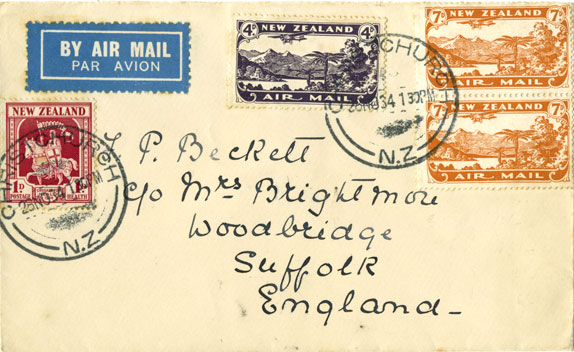
The cover on the left was posted in Christchurch on 28 November and
therefore has the correct date for the new service although it
has no routing instructions.
The postal rate for the new service was 1s 6d and the cover
has stamps to the value of 1s 7d. The most likely explanation
for the extra 1d Health is that it is
a late fee.
There is no backstamp, but that is normal.
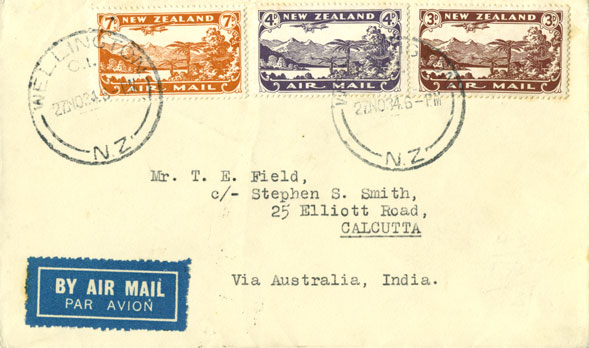
The next cover is postmarked in Wellington on 27 November (where the mail closed
on 29 November [5]) and is addressed to India.
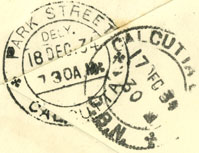
It arrived in Calcutta on 17 December and is backstamped on 17 December
and again on 18 December.
It has the correct franking of 1s 2d.

Although the rate to the UK was 1s 6d, the rate to intermediate (non British Empire)
destinations was often higher.
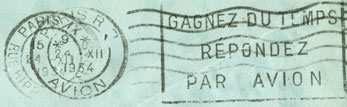
This cover is addressed to France and has the necessary franking
of 1s 9d.
This cover is postmarked in Auckland on 30 November which
is the day that the mail closed.
The mail arrived in Paris by rail from Brindisi
on 24 December
and the cover has two Paris backstamps, both on 24 December.
The UK mail was flown later that day from
Paris to Croydon.
The envelope was produced for an
earlier flight and has a
picture of Charles Ulm although he did not take part in
this flight.
A poignant note is struck by the fact that
Ulm disappeared without trace when flying from the USA to Hawaii
three days after this cover was posted.
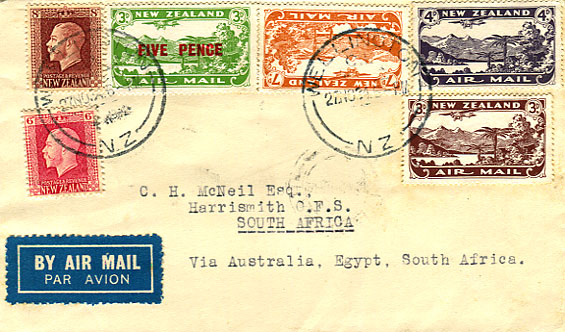
Mail could connect with the IA Africa service in Egypt.
The mail arrived in Cairo on 21 December where it was backstamped on 22 December.
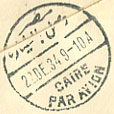
It was flown from there on 22 December on an HP 42 to Khartoum, on 23 December
to Juba and on 24 December to Kisumu (Kenya).
From there it was flown on 24 December in an AW Atalanta to Nairobi, on 25
December to Mbeya (Tanganyika), on 26 December to Salisbury (Southern Rhodesia),
on 27 December to Johannesburg and on 28 December to Cape Town [1].
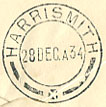
This cover is addressed to Harrismith O.F.S. (Orange Free State)
and was off-loaded at Johannesburg on 27 December and taken to Harrismith
the next day where it was backstamped on 28 January.
The cover is franked with the correct rate to South Africa of 2s 9d
and carries the complete set of 1931 airmail stamps.
The route

Darwin to Karachi

The route from Sydney was
by rail to Cootamundra on the night of 9-10 December
and then on 10 December by Butler Air Transport
to Charleville in a DH 84 Dragon where
the mail was transferred later that day to the
Qantas Empire Airways flight from Brisbane.
Two planes were used by Qantas Empire Airways on the
inaugural flight from Brisbane to Darwin on 10 -12 December,
a DH 61 and a DH 50.
A link with the past was G U (Scotty) Allan
who was the pilot of the DH 50.
He had been Kingsford Smith’s co-pilot from Darwin to Akyab in
the first official Australia – Great Britain
experimental flight in 1931.
QEA had intended to use a DH 86A Express,
but due to two recent
crashes, these planes had been grounded.
As they could not use their DH 86A aircraft,
the Darwin – Singapore section was flown by Imperial Airways
in an Armstrong Whitworth AW 15 Atalanta on 13 – 14 December.
The route from Singapore to Karachi on 15 – 18
December was similar to the experimental flight of 1931,
but with the inclusion of Bangkok.
Walker [1] states that there was a stop at Penang, but the timetables
shown in Wingent [2] indicate that although a stop in Penang had been
introduced in April 1934, it was dropped later that year and
then re-instated in October 1935.
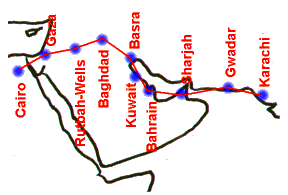
From Karachi, the flight was along the Arabian side of
the Persian Gulf to Basra and then on to Cairo which
was reached on 21 December.
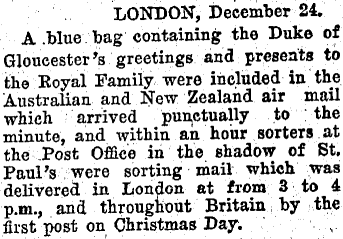
From Cairo, the mail was taken to Alexandria and on 22 December
flown in a Short S17 Kent flying boat to Athens and then
Brindisi in Southern Italy.
The mail was then taken by rail to Paris on 22 -24
December and then flown from Paris
to Croydon Airport near London on 24 December.
A report on the arrival in the Evening Post of Wellington of 26 December is shown [5].
Intermediate stages
Mail could now be flown all the way from Australia to
a range of destinations.
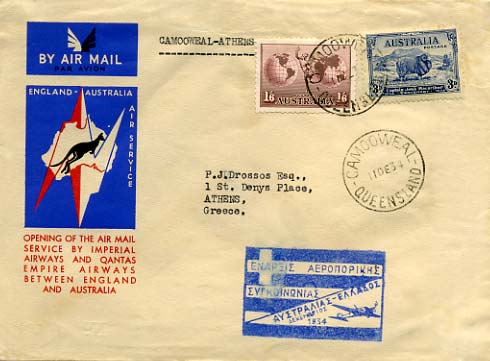
The shown cover was flown from Camooweal in Queensland to Athens
and has the correct franking to Greece of 1s 9d.
In Athens, a special blue cachet was applied.
For mail from New Zealand, this cachet is only known in purple
or black.
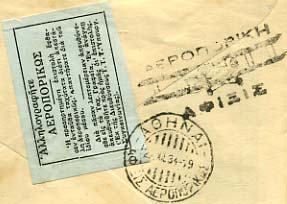
The mail arrived in Athens on 22 December and
large airmail labels were attached to the back.
A backstamp showing a biplane was also applied.
The cover is addresed to
P J Drossos, a well known Greek
aerophilatelist who was responsible for many airmail covers during this period.
First Flight: to Australia and then to New Zealand by Sea
From UK
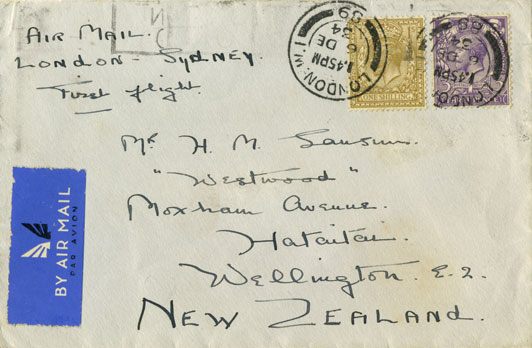
The first regular airmail from the UK to Australia left on December 8
and arrived in Sydney on December 21.
Letters for New Zealand were sent on by sea.
The cost was 1s 3d per ½ oz, i.e. 3d less than it cost to send
a letter from New Zealand.
Due to the heavy mail on the inaugural flight, this service was
duplicated.
According to Wingent [2], the mail for Australia and New
Zealand went by the normal service to Karachi (i.e. by rail
from Paris to Brindisi) while mail for Karachi was flown all
the way by the HP 42 airliner Hengist.
Apparently Hengist did not arrive in Karachi until
14 December while Athena (an AW Atalanta)
left Karachi on 13 December.
Athena flew the mail to Darwin arriving on December 18.
Qantas then flew the mail to Brisbane with the
Sydney and New Zealand mail being off-loaded at Charleville
on 21 December.
Butler Air Transport had the contract to fly the mail
from Charleville via Narromine to Cootamundra from where it
was to be sent to Sydney by rail.
As there had been delays, the mail was flown directly to Sydney
from Narromine in an Avro 10 that had been chartered
from New England Airways.
Stapleton states that all mail was backstamped on arrival
in Sydney.
However, although the above cover is postmarked London on
December 6 and has the correct routing instructions, it
does not have a backstamp.
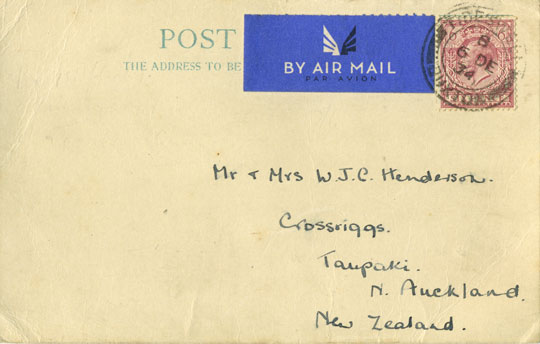
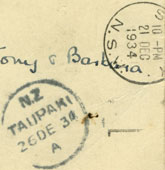
The next example is a postcard for which the airmail rate was 6d.
It was backstamped in Sydney at 10 pm on 21 December and on
arrival in Taupaki (Auckland)
in New Zealand on 26 December.
A report of the arrival in New Zealand published in the Evening Post of Wellington
is shown below.

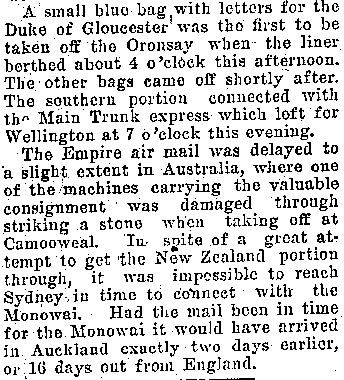
Walker [1] reports that the mail was forwarded to New Zealand on the SS Monowai
while the Evening Post reports that the mail missed that connection
and arrived in Auckland on the Oronsay on 26 December [5].
As the mail was sent south that evening on the Main Trunk express, it
would arrive in Wellington on the morning of 27 December.
The Christchurch mail arrived on 28 December [1].
Acceptance from South Africa for New Zealand
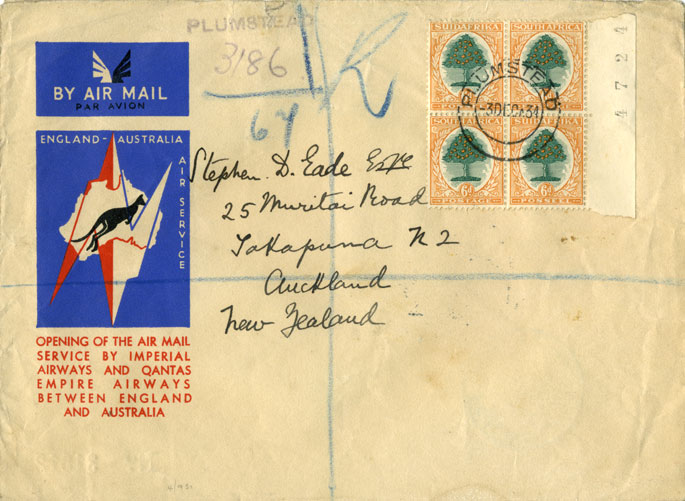
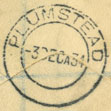
This cover is postmarked Plumstead in South Africa on 3 December.
Plumstead is near Cape Town and so the cover was first taken there by surface mail.
The airmail left Cape Town on 4 December on an Imperial Airways
Armstrong Whitworth AW15 and was flown to Kisumu in Kenya where it
was transferred to an HP 42 for the flight to Cairo where it arrived
on 10 December.
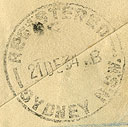
At Cairo it connected with the Eastern Route service to Australia
and the cover is backstamped in Sydney on 21 December.
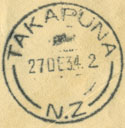
The cover was then backstamped on arrival in Takapuna on 27 December.
At the time, the route from Cape Town to Australia was the longest air mail
route in the world.
The airmail rate from South Africa to Australia or New Zealand was 1s 8d.
The cover is franked with 2s 0d which includes 4d registration fee.
Acceptance from Hong Kong for New Zealand
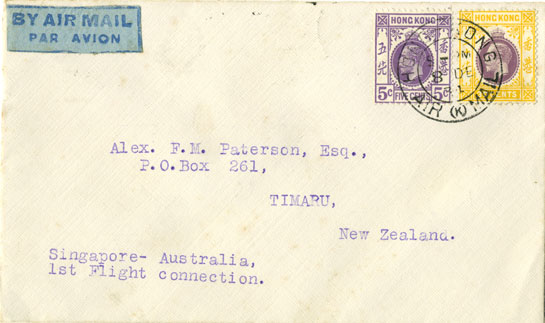
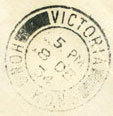
This next cover is postmarked in Hong Kong on 8 December.
Although the postmark includes the words Air Mail, the
Hong Kong Imperial Airways flight
connection did not start until March 1936.
It was therefore carried to Singapore by sea where
it joined the first regular flight to Australia which left
Singapore on 16 December.
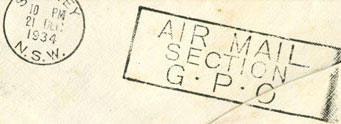
The cover is franked with 35c which was postage rate per quarter oz.
It has the usual Sydney backstamp on 21 December.
Preliminary to the first flight

This cover has Dutch East Indies stamps handstamped ARETHUSA in purple
together with a 2d Australian stamp postmarked in Brisbane on 22 December 1934.
It also has the typewritten routing instruction PER “ARETHUSA”.
The Armstrong Whitworth AW 15 Atalanta class Arethusa flew
the Darwin – Sharjah leg of the first regular Australia – UK flight on 13 – 19 December.
It had arrived in Singapore on 2 December [2]
and flew to Darwin on a positioning flight via the Dutch East Indies on 8 – 10 December.
That suggests the following scenario.
Some by favour mail was picked up in the Dutch East Indies
during the Arethusa‘s positioning flight on 9 December.
This mail was offloaded at Darwin and then
flown, again by favour, from
Darwin to Brisbane on 19-21 December on the first regular UK – Australia flight.
The Australian stamp was added on arrival in Brisbane where the cover was posted normally.


back next
All scans were made by the author.
[1] Airmails of New Zealand, volume 2 (1986) compiled by
Douglas A Walker, and
The New Zealand Airmail Catalogue, (2nd Edition, 1994)
by James Stapleton.
Both are published by the
Air Mail Society of New Zealand
[2] Aircraft Movements on Imperial Airways’ Eastern Route,
Vol 1, 1927 – 1937, Peter Wingent, Winchester 1999.
[3] Aircraft Movements on Imperial Airways’ Eastern Route,
Vol 2, 1937 – 1939, Peter Wingent, Winchester 2005.
[4] The Cheapest Airmail Rate in the World?, Air Mail News, vol 51,
pp 7 – 13, May 2008.
[5] Evening Post Wellington 1916-1945, Papers Past,
available at: paperspast.natlib.govt.nz/cgi-bin/paperspast