
The first official airmail between New Zealand and Australia took
place on 17 February, 1934.
The Avro 10, Faith in Australia, left Muriwai Beach, Auckland at 6 am
and arrived in Sydney 14 hours 10 minutes later.
Charles Ulm was the pilot, Scotty Allan the navigator/co-pilot
and R.T. Boulton was the engineer.
The postage rate was 7d made up of 1d surface rate plus 6d airmail
of which 4d went to Ulm.
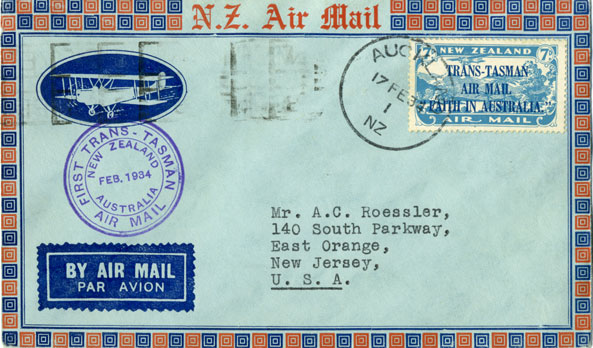
An airmail of 39,255 items was flown and a special cachet
was applied.
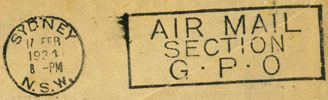
Covers were backstamped on arrival in Sydney.
A special printing of the
7d airmail stamp in sky blue
was issued for the flight.
It was overprinted with the slogan:
Trans-Tasman Air Mail “Faith in Australia” on three lines.
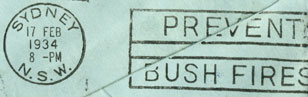
The cover is addressed to the USA with
the onward journey from Australia by sea.
There are faint cancellation bars
over the aircraft in the
top left which could be a Jusqu’a cancellation to indicate that
there was to be no further carriage by air after Sydney.
Special covers
A large number of special covers were produced for the flight.
The great majority were printed in dark blue on manilla envelopes
and an estimated 35,000 of these were flown.
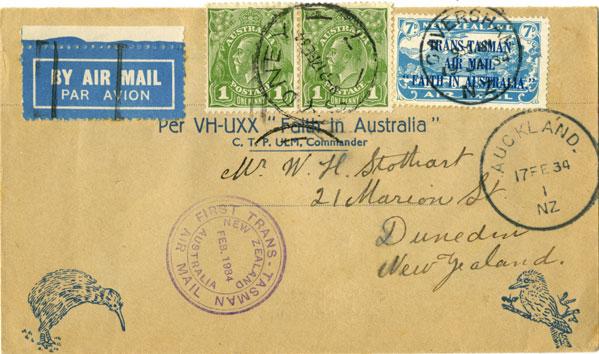
This example is one of the 12,860 boomerang covers and carries
two 1d Australian stamps to pay for the return from Sydney to
New Zealand by sea.

The special airmail stamp
has the ‘break in the left hand stroke of the N in IN‘
flaw in the overprint that occurred in the fourth row of each sheet.
The cover has a different backstamp from the first example.
Again there are vertical bars cancelling the air mail etiquette.
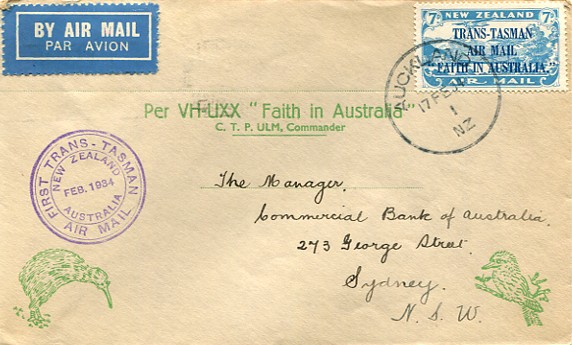
As well as the usual envelopes on dark blue and manilla, around 75 covers with the same design, but printed in light green were flown.
The envelopes are described by Walker as being white, but the example shown is a very pale buff, not white.
The shown cover is addressed to Australia.
In addition, around 150 covers in dark blue, but printed on these paler envelopes were also flown.
In addition, special covers were produced by the Wakefield oil company
whose Castrol products were used by Ulm in all his flights.
These covers were signed by Ulm and, according to the literature, were numbered
in the lower left corner.
As far as I can gather, the covers addressed to Australia are numbered while
those, like this one, addressed to London are not.

This example is addressed to the UK and has an extra 7d stamp
as it was also flown on the Karachi – London service on 15 – 22 March.
Connections to other airmail services
The next cover is addressed to Perth and has a 4d stamp to
pay the airmail postage from
Adelaide to Perth as well as the 7d trans Tasman airmail.
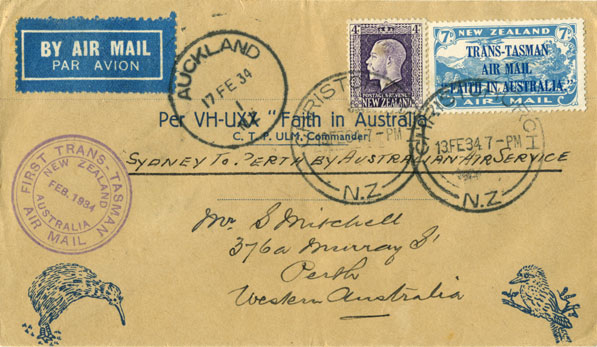
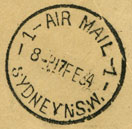

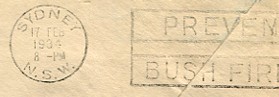
It has a different Sydney backstamp and
the Perth backstamp shows that it did not arrive there
until 25 February, 8 days after arrival in Sydney!
The reason is that from 6 September 1930, the Adelaide – Perth service
left on a Saturday rather than Sunday as before [1].
This cover would therefore not be flown from Adelaide until
the following Saturday (24 February) arriving in Perth
on 25 February
The next cover is routed
Adelaide – Perth and
Karachi – London
and so was carried on three separate airmail services.
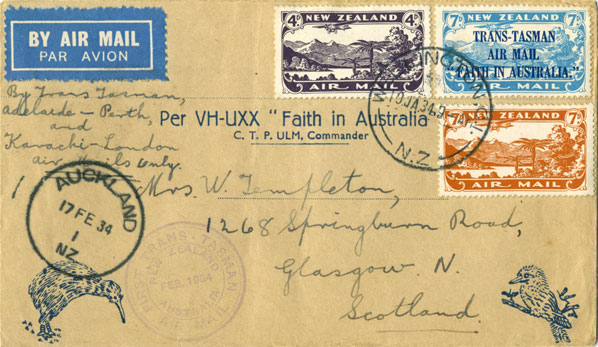
In addition to the Trans – Tasman 7d, it has a 7d stamp
for the Karachi – London air mail and a 4d for the
Adelaide – Perth airmail service.
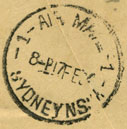
After being flown Adelaide – Perth
on 24 – 25 February, it connected with the S.S. Ballarat from Fremantle on 26 February.
It was then flown on the IA flight that left Karachi on
15 March and arrived in London on 22 March [2].
This cover has a manuscript on the back stating that it
was received in Glasgow on 23 March and so was 34 days in transit
after leaving New Zealand. (As it is postmarked Wellington
on 19 January, the total elapsed time is much longer.)
A cover to
the same address
sent via US airmail around the same time
was only 30 days in transit.
Plus surface to UK
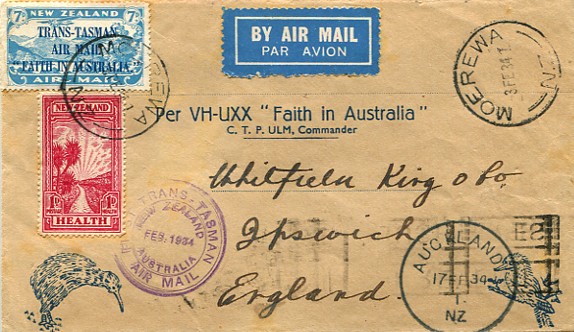

This cover is addressed to the UK.
It is postmarked in Moerewa on 3 Februray and again in Auckland on 17 February and
backstamped in Sydney later on 17 February.
It is franked with 8d with the extra 1d being unnecessary.
After arriving in Sydney, it would have been sent to Perth by train and
connect with the S.S. Ballarat from Fremantle on 26 February.
It reached London on 24 March.
The extra 1d stamp is the 1933 Health stamp.
Plus surface to Italy
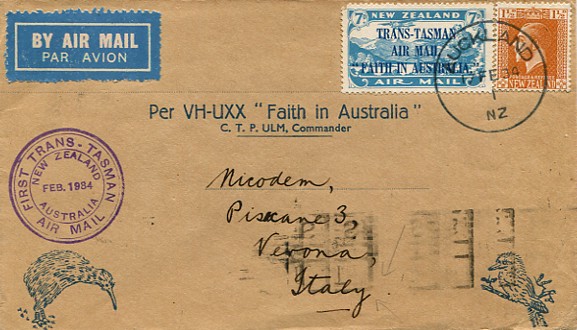
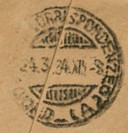
This cover to Italy is postmarked in Auckland on 17 February and
has the normal Sydney backstamp later on 17 February.
It is franked with 8½d made up of 2½d surface to
a non Empire country and 6d airmail.
After arriving in Sydney, it would have been sent to Perth by train and
connect with the S.S. Ballarat from Fremantle on 26 February.
It is backstamped in Italy on 24 March which is the same day as the ordinary mail
from the S.S. Ballarat reached London.
The plane
The Faith in Australia had previously been owned by
Australian
National Airways which was liquidated in 1933.
Charles Ulm bought the Avro Ten Southern Moon from them.
As he planned a round the world trip, the
plane was modified so that it could make long
distance journeys and was renamed Faith in Australia.
The preparation
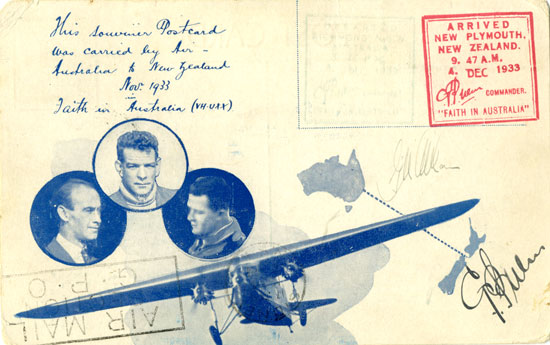
Flown Australia to New Zealand
Ulm, Allan and Boulton flew the Faith in Australia
from Sydney to Bell Block airport, New Plymouth on 3 – 4 December 1933 carrying
a small unofficial mail,
mostly postcards.
Cachets were applied in the top right corner of the cards giving the time
the plane left Richmond (5.27 P.M. on 3 December) and the arrival time
in New Plymouth (9.47 A.M. on 4 December).
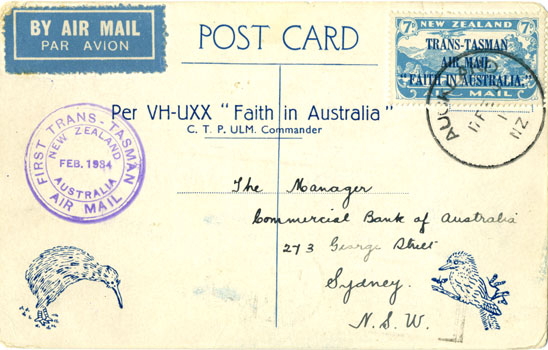
Also flown on return flight
100 of the cards were overprinted in blue with the design used on the special envelopes described above.
They had the special 7d stamp added and posted so that they were flown normally on the return flight of 17 February.
Both sides of a card, flown both ways and signed by Ulm and Allan,
are shown.
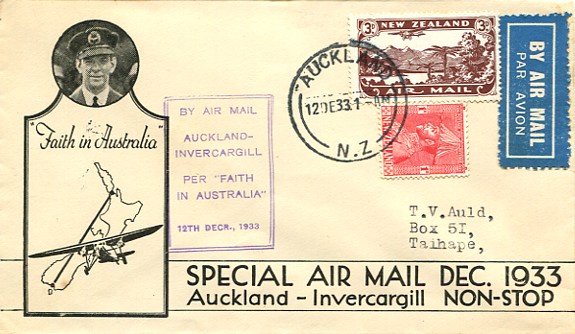
Auckland – Invercargill
Their aim on arrival in New Zealand was to persuade
the Postal Department to authorise an official airmail on
the return journey to Australia.
To raise funds and to generate publicity, they made a “barnstorming”
tour of New Zealand with the Faith in Australia which
included a
non-stop airmail flight from Auckland to
Invercargill on December 12.
Anniversary

The 50th Anniversary of this flight was commemorated by
an Australian issue in 1984.
It shows Ulm, the
Faith in Australia and a signed cover similar to the one shown above.
Three further official trans-Tasman airmail flights were made from
New Zealand in 1934,
but after the failed attempt in 1935 there were no further trans-Tasman
official airmail flights
until 1940.


back next
All scans were made by the author.
Information on this page is taken from:
Airmails of New Zealand, volume 2 (1986) compiled by
Douglas A Walker, and
The New Zealand Airmail Catalogue, (2nd Edition, 1994)
by James Stapleton.
Both are published by the
Air Mail Society of New Zealand
[1] W.H. Legg, Aspects of the London-Karachi and the Perth-Adelaide
Routes,
Air Mail News, vol 44, pp 106-116, August 2001 and pp 178-183,
November 2001.
[2] Aircraft Movements on Imperial Airways’ Eastern Route,
Vol 1, 1927 – 1937, Peter Wingent, Winchester 1999.