
Three plates were produced by De La Rue
with the stamps in 10 rows of 12.
During 1940/41, printing and/or perforating was by Waterlow.
The design shows Captain Cook landing in New Zealand
at what is now the town of Gisborne.
Plate 1
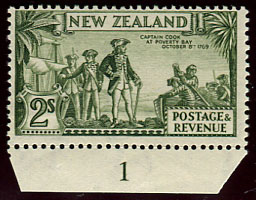
The initial issue on 1 May 1935 was on paper with a single watermark.
The stamps were perforated 13-14×13½,
i.e. the top and bottom perforations on each stamp were perf
13 for half the length and perf 14 for the other half.
A very small number of sheets were fed through the preforation machine in the opposite direction and so
are perforated 14-13×13½.
A significant number of the known examples with the rare perforation were used on Pan American covers
with a black cachet that were sent on the first flight to the USA on 2 January 1938.
In late 1935, the stamp was issued perf 13½x14.
In August 1936, the stamp was issued on multi watermarked paper
perforated 13-14×13½.
In March 1939 there was an
issue perf 13½x14.
A specialised monograph showing the large number of flaws, retouches and re-entries
in this plate was published in 1951 [1].
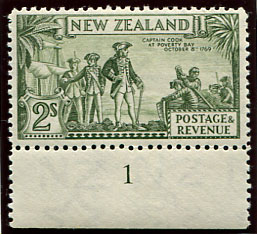
Blitz perforations
Plate 1 was handed to Waterlow in 1940 where stamps
were printed and
line perforated 12½.
They were issued in July 1941.
The plate was returned to De La Rue in September 1941
and 20,000 sheets were printed by them on coarse paper in December 1941 and sent to
Waterlow where they were line perforated 12½
They were issued in 1942.

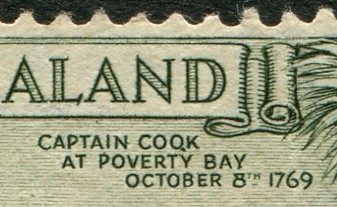
The best known flaw in New Zealand philately is the ‘Captain Coqk’ flaw where a coloured mark makes the second ‘O’ in
‘COOK’ look like a ‘Q’.
The example shown here is perf 12½, but the flaw exists in position R1/4 on all printings from plate 1.
Coarse paper
Stamps appeared on coarse paper perf 13¾x13½ in October 1942.
They were from plate 1 and from new plates 2 and 3.
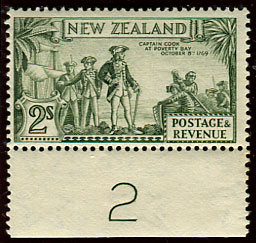
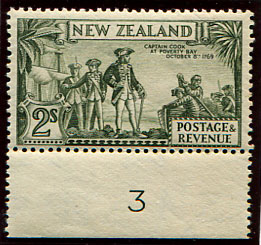
Distinguishing the plates
The three plates can be distinguished
by the horizontal lines in the rigging to the left of the
Marine’s head.
-
Plate 1: each individual impression was retouched
and the horizontal lines are strong. - Plate 2: less retouching and so fewer horizontal lines.
- Plate 3: very few horizontal lines.
Details are shown below.
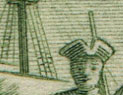
Plate 1
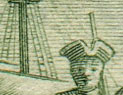
Plate 2
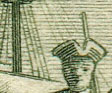
Plate 3
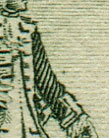
In stamps from plates 2 and 3, there is a small dot to the right
of Captain Cook’s arm.
According to Vol 2 of the RPSNZ Handbook, the dot
was removed from all the impressions in plate 1 although it re-appears in re-entries.
Deterioration of plate 3
Extra lines of colour developed progressively in plate 3.
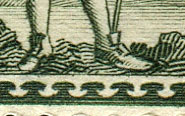

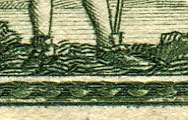
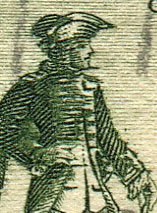
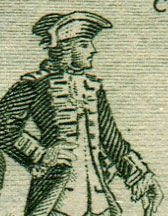
The deterioration is seen most clearly in the ornaments at
the bottom of the stamp.
Initially the ornaments are separate, later they joined up and
finally in some impressions there was only a blurred mess.
We also show a late stage in the deterioration to the figure
of Captain Cook with an early impression for comparison.
The horizontal line extending from Captain Cook’s chin is
especially prominent.
Forgery
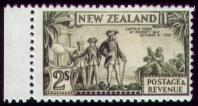
With modern reproduction and printing methods, forgeries
could become a major problem.
So that I could examine how good it was, I bought on eBay a so-called
Maryland forgery and it is shown on the left.
It has the word FORGERY printed faintly on the
back and so there is no intention to defraud.
The question is could a novice be taken in by the stamp.
The design is certainly a faithful reproduction, but then so
are pictures in catalogues.
The colour is not quite right and it is perf 11 which does not
exist for this stamp.
The main give-away is the unwatermarked white paper and the fact
that it is obviously not recess printed.
Quite frankly, I was disappointed in its quality.
However, there could be major
problems with reproductions of proof material of surface printed
stamps as they are often imperforate, on unwatermarked paper
or card and in different colours from the issued stamps.


back next
All scans were made by the author.
The above information is taken from The Postage Stamps of
New Zealand Vol 1, 2 and 4 published by the
Royal Philatelic Society of New Zealand in 1938, 1950 and 1964.
[1] Collins, R.J.G, The 2s Pictorial of 1935-1942 Plate 1,
Verne, Collins & Co., 1951.