
Pan American Airways planned a regular trans-Pacific airmail service between
Auckland and San Francisco, a distance of 6,900 miles.
A survey flight was made in March 1937 by
Pan Am’s chief pilot: Ed Musick.
The first official New Zealand air mail to the United States
left Auckland on 2 January 1938.
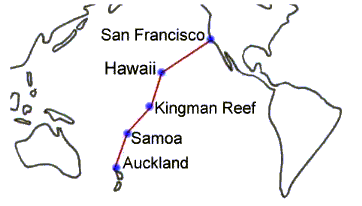
The route was Auckland – Pago Pago (American Samoa) – Kingman Reef – Honolulu (Hawaii)
by the Sikorsky S-42B flying boat, Samoan Clipper
with the pilot again being Ed Musick.
At Honolulu, the service connected with the weekly Pan American FAM 14 service to San Francisco.
The S-42B had arrived in Auckland on 26 December, but
no official airmail was carried on the flight from America.
The next day the Short S23 Empire flying boat Centaurus
arrived in Auckland from Sydney on a survey flight.
The first newspaper report confirming the flight and postage rates was not until 24 Dec.
(Rates were 6d to American Samoa, 3s 0d to Hawaii, 4s 6d to USA with postcards
half price.
Mail for UK would be sent by sea across the Atlantic at no extra charge.)
The plan was for the clipper to leave Auckland at 4 a.m. on Wednesday 29 December
with the mail closing in Auckland at 8 p.m. on 28 December [9].
The ‘Evening Post’ on 24 December reported: “As there is a limited time in which to get letters
to Auckland, the internal air-mail services … will be found of advantage.”
However, it was not until 27 December that ‘The New Zealand Herald’ announced: “Letters posted in any
part of New Zealand other than Auckland will be required to carry the New Zealand air mail fee”.
That added 1d to the postage rate [9].
15,000 letters had been received by the evening of 28 December when, due to bad weather, a decision was made at 10 p.m.
to postpone the flight until 4 a.m. on 30 December
with the closing time for the mail being extended to the evening of 29 December.
5,000 more items were posted on 29 December for the flight.
There were then further postponements and the flight finally left at 3a.m. on 2 January with a total
of 25,000 items.
It arrived in
Pago Pago on 1 January (having crossed the International Date Line), in
Kingman Reef (an uninhabited atoll where a schooner waited with supplies) on 2 January
and Honolulu on 3 January.
There the mail was transferred to a
Martin 130 flying boat on the Pan Am FAM 14
Manila – San Francisco
route and arrived in San Francisco on 6 January.
Postmarked on 24 December
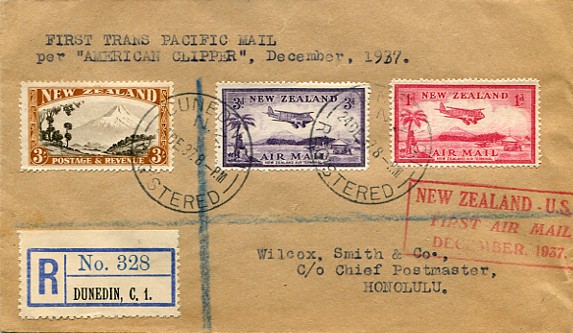
The decision that mail should be carried and the publication of the air mail rates was not made until 24 December.
Some dealers were very quick to send covers as shown by this registered cover to Honolulu by Wilcox, Smith & Co.
postmarked in Dunedin at 8 p.m. on 24 December.
It is franked with 3s 4d made up of 3s 0d Auckland to Honolulu, 3d registration fee and 1d internal air fee for Dunedin to Auckland.
A cachet was applied to the mail. It was normally in red as with this cover, but mail from Wellington usually had the cover in purple
and that is also known on some mail from Timaru and Auckland.
Covers also exist from Auckland with a Pan American black cachet.
All mail was backstamped on arrival in Pago Pago, Honolulu or San Francisco with
this cover backstamped 2 p.m. on 3 January on arrival in Honolulu.
Postmarked on 27 and 28 December
The initial closing date for the mail was 8 p.m. in Auckland, 2 p.m. in Wellington and 9 a.m. in Christchurch on 28 December.
All post offices were closed over the Christmas period on 25, 26 and 27 December and so it was difficult for members of the public
to purchase the necessary airmail stamps until 28 December.
To USA
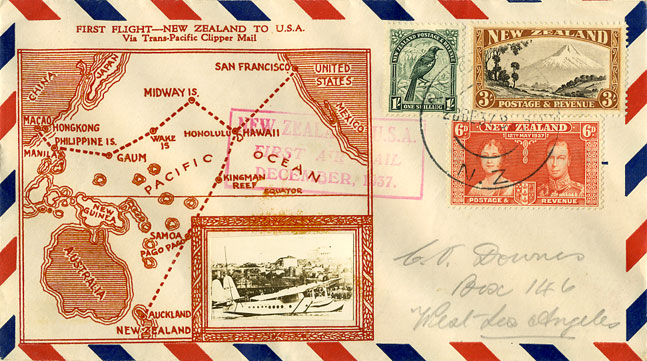
This cover to Los Angeles is postmarked in Auckland at 8 p.m. on 28 December and
has a map showing the Pan American
trans-Pacific routes as well as a photograph of the
Sikorsky S-42B flying boat.
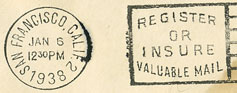
The red cachet shows the expected departure date of December 1937 rather than the actual date of January 1938.
A backstamp was applied on arrival in San Francisco on 6 January.
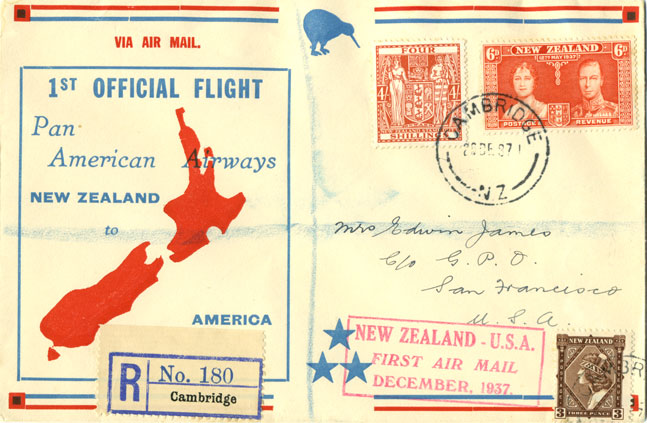

This registered cover carries an extra 3d stamp for the registration fee.
It is on a specially printed cover that
Pan Am produced for the flight and is postmarked in Cambridge (80 miles south of Auckland) on 28 December.
There are two San Francisco backstamps, one applied on January 6 when it
arrived in the registered section of the post office and the second
on January 7 when it was transferred to the main office to await
collection.
Purple cachet
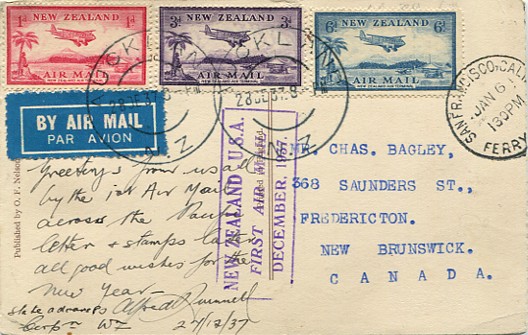
Most items with purple cachets have Wellington datestamps, but this postcard to Canada is postmarked in Auckland on 28 December.

Franked with 2s 5d and so it appears to be overpaid by 2d presumably in the mistaken impression
that a 2d surface rate to Canada was required in addition to the postcard air mail rate of 2s 3d.
Unusually, as well as the normal San Francisco transit mark at 12.30pm on 6 January,
it has a second San Francisco transit at 1.30pm.
Only part of that transit mark appears and it includes the word Ferry.
That is of interest as early mail from New Zealand that was flown from San Francisco
had the cachet Ferry Station as the mail was sent by ferry from the clipper terminal to the
main airport.

To Samoa
The first leg of the 1938 Auckland to US flight
was to American Samoa. The rate was 6d.
The example cover is addressed to Apia in Western Samoa.
It was flown to Pago Pago in American Samoa
and carried from there to Apia by sea.
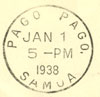
The clipper crossed the international date line.
Although the letter left
Auckland on 2 January 1938, it arrived in Pago Pago on 1 January.
This is shown on the backstamp.
I have seen a registered cover with a further backstamp in Apia on 6 January.
Black cachet
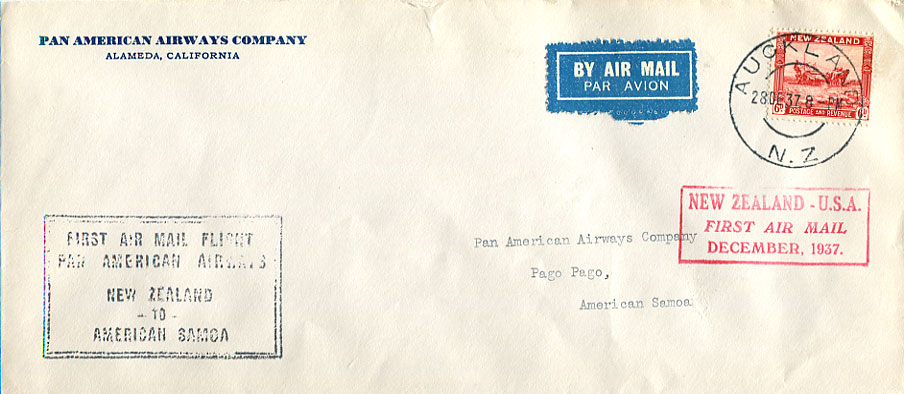
Pan American applied a private cachet in black to their own long covers.
There are three different cachets: to American Samoa,
to Hawaii and to United States of America.
These cachets are not mentioned by Walker [1] or in the second edition of Stapleton [3].
Auction descriptions often use this omission to suggest that the cachets are rare.
However, the reason for the omission is that
they were part of the Pan American Archive and
did not appear on the market until after Pan American went
bankrupt in the 1990’s [4].
They are described by Krupnick [2] and in the 3rd edition of Stapleton [6],
but I have not seen an estimate of how many exist.
The covers were all postmarked in Auckland, at 8 p.m. on either 28 or 29 December.
This following cover, postmarked on 28 December, has the Samoa black cachet, as well as the normal red cachet, and is addressed to
Pago Pago.
The next cover, also postmarked on 28 December, has the Hawaii black cachet and is addressed to
Honolulu.

New Zealand internal air mail
Regular New Zealand air mail services between the South and North Islands had been set up
in 1936.
At a cost of an extra 1d, they could be used to make tight connections with overseas sailings at Wellington or Auckland.
As notice for the trans-Pacific air mail was very short, it was decided that mail from outside the Auckland
area must be flown by the internal service and so had to carry an extra penny postage.
This was the only occasion when use of the internal air mail service was compulsory [9].
Wellington to UK
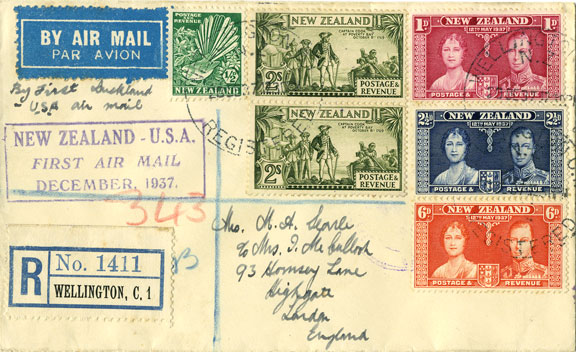
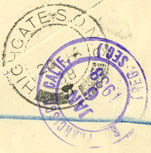
This registered cover is postmarked on 27 December in Wellington and so required an extra 1d air mail fee to pay for
the inland air mail from Wellington to Auckland.
It is franked with 4s 10d which includes a 3d registration fee in addition to the 1d air mail fee.
As with many covers with a Wellington postmark, it has a purple cachet.
It is addressed to London and so was sent from New York to Britain by sea, but that was included in the air mail
fee to the USA of 4s 6d.
As well as the usual San Francisco transit mark on 6 January, it has a receiving mark in Highgate, London on
20 January.

Wellington to Samoa
This postcard to Samoa is postmarked in Wellington at the Wellington mail closing time of 2 p.m. on 28 December.
It is franked with 4d which includes the inland airmail fee from Wellington to Auckland
in addition to the postcard rate to Samoa of 3d [1].
It has a purple cachet often seen on Wellington mail.
According to Walker [1], covers with a purple cachet “although not rare, … are
extremely scarce”.
Krupnick [2] suggests that they are more common with
about 10% of the cachets being purple.
Lower Hutt (nr Wellington) to Hawaii
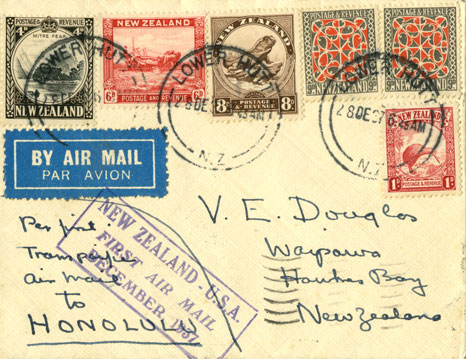
This cover is postmarked in Lower Hutt which is near Wellington early in the morning of 28 December and
was flown to Hawaii and then returned to New Zealand by sea.

The cover has stamps to the value of 3s 1d made up of
3s 0d to Hawaii with
1d for the inland air fee from Wellington to Auckland.
The cachet would be applied in Wellington which is why it is in purple.
It has a Honolulu backstamp at 2 p.m. on 3 January.
Postage due as not paid for internal air mail
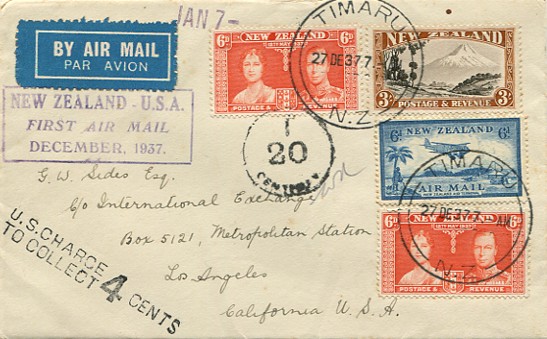
All mail from outside the Auckland area had to be sent by the New Zealand inland air mail to connect with the Pan American flight
from Auckland.
This cover, postmarked in Timaru at 7a.m. on 27 December, would have been sent from Timaru to Christchurch by train
before being flown from Christchurch to Auckland.
Most examples of a purple cachet have postmarks from
Wellington or its surrounding area while this one is unusual as it is postmarked in Timaru.
It is franked with 4s 6d and so has a T 20 centimes and a US Charge to Collect 4 Cents handstamp because
it is not franked with the required extra 1d for the Christchurch – Auckland internal air mail.
As the mandatory use of the internal air mail was not announced in the newspapers until 27 December, there was no way that the sender
could have known that the extra 1d was essential rather than being an option.
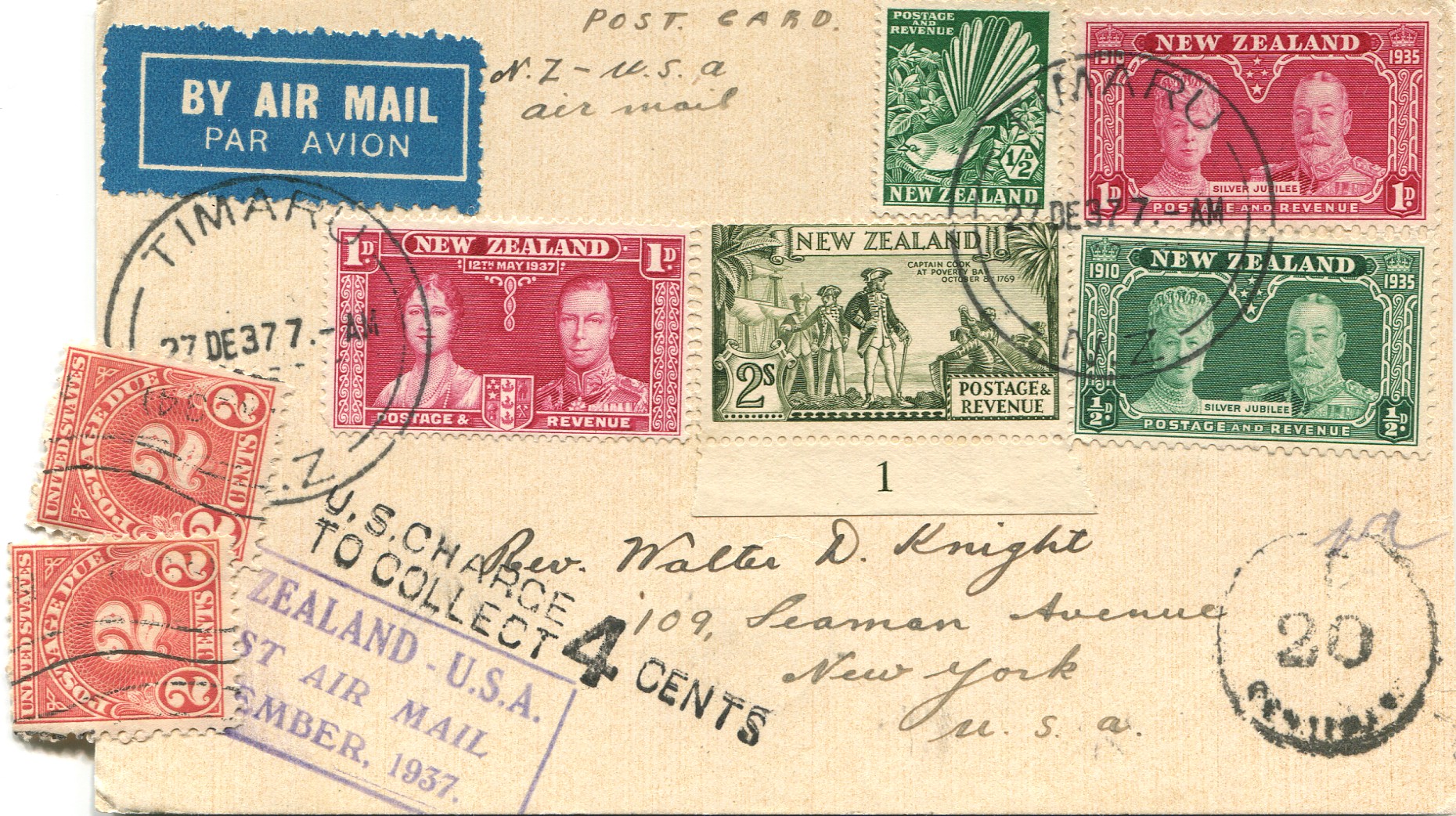
This postcard to New York is also postmarked in Timaru at 7a.m. on 27 December and has the same
T 20 centimes and a US Charge to Collect 4 Cents handstamps.
In addition it is franked with two USA postage due 2c stamps.
It is franked at the post card rate to the USA of 2s 3d, but did not have the extra 1d for internal air mail.
The 2s second pictorial is a plate single.
I have the scan of a cover postmarked in Dunedin on 25 December and franked with 4s 6d that does
not have postage due markings.
Postmarked after Initial Deadline on 29 December
Late on 28 December, it was announced that the flight was to be postponed and would now take place on the morning
of 30 December, but further delays were announced on 29 and 30 December and the flight finally left on 2 January.
The following mail was posted after the initial deadline.
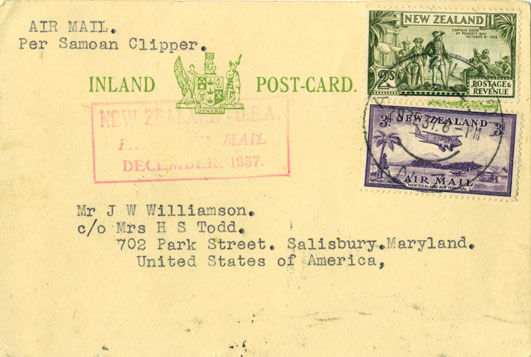
To USA

This postcard to the USA is postmarked in Auckland at 8 p.m. on 29 December.
It is franked with 2s 3d as the rate for postcards was half the letter rate.
The great majority of late covers are from Auckland or nearby towns.

To Hawaii
This cover is postmarked on 29 December and is addressed to Hilo in Hawaii.
The cover has stamps to the value of 3s 6d although the rate
to Hawaii was only 3s 0d.

The journey from Samoa to Kingman Reef was
on 2 January and from Kingman Reef to Hawaii on 3 January.
The date of arrival in Honolulu is shown on the backstamp.
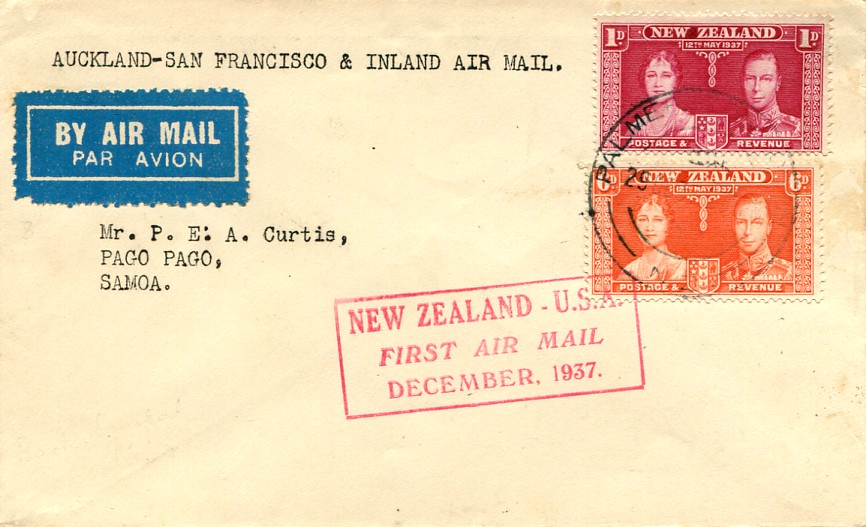
Internal air mail & to Samoa
This cover to Pago Pago is postmarked in Palmerston North on 29 December.
Although Palmerston North is on the North Island between Wellington and Auckland, the cover still had to be franked with
the 1d internal air fee in addition to the air mail rate to Samoa of 6d.
It has routing instructions: Auckland – San Francisco & Inland Air Mail and
would have been flown from Palmerston North to Auckland on 29 December by Union Airways.
Black cachet
Pan American made use of the delay to produce some more covers with their black cachet.
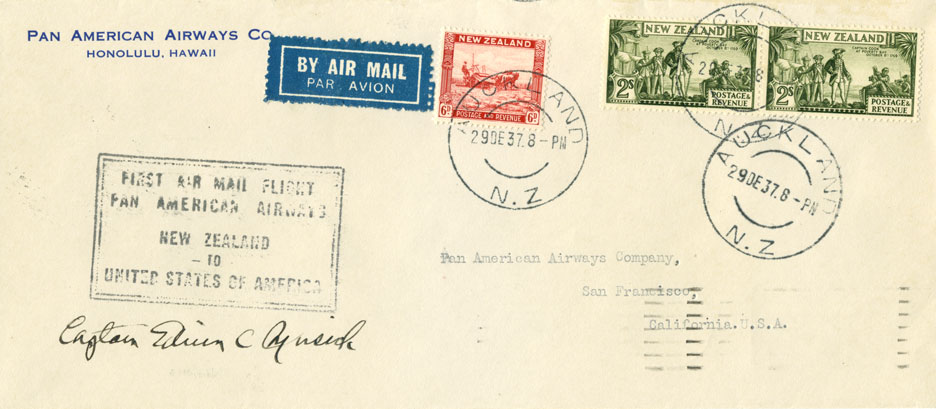
The following cover to San Francisco is postmarked on 29 December and is signed by
Captain Edwin C Musick who captained the Samoan Clipper
on this flight from New Zealand to Hawaii.
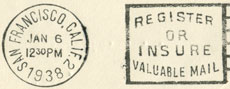
The cover was backstamped on arrival in San Francisco.
Another unusual feature of these covers is that they are often franked with a pair of 2s second pictorial
stamps that are invariably perforated 14-13×13½ which is the rare variation of the 13-14×13½
perforation and which only exists on single watermarked paper [8].
Postmarked on 31 December
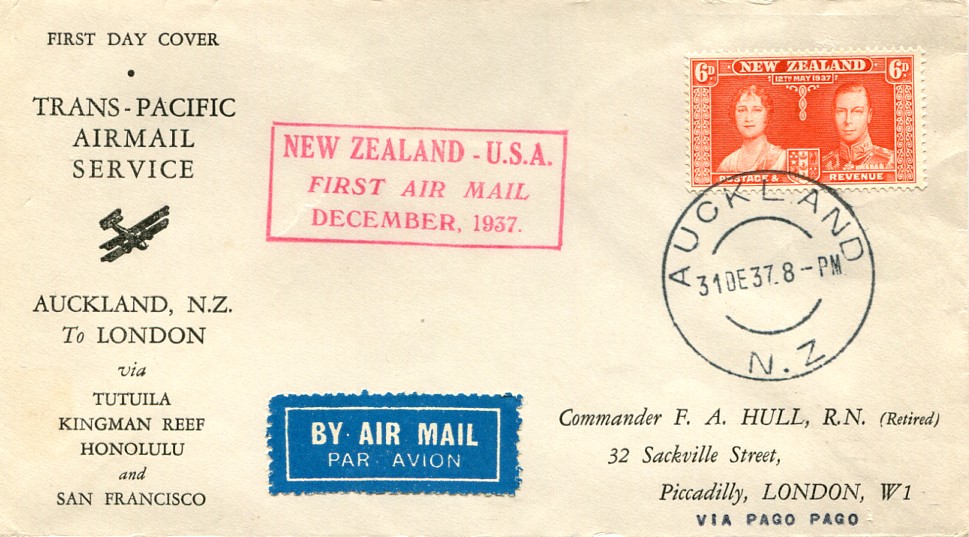
To Samoa
This cover is addressed to London, but only the leg to American Samoa was by air
and so it only required franking of 6d.
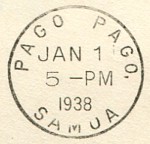
It has the normal Pago Pago arrival mark at 5 p.m. on 1 January 1938.
It was postmarked in Auckland at the final closing time of 8 p.m. on 31 December and so was posted very late for the flight.
It is proof that mail was still being accepted up until the evening of 31 December.

Late Posting From Christchurch
This cover is postmarked at the final closing time in Christchurch of 9 a.m. on 31 December.
It is addressed to Britain and so should be franked with 4s 7d and, as it has postage of 5s 0d, is overfranked by 5d.
Very little late mail was sent from the South Island because, as the departure dates were extended one day at a time, it was normally
too late to post a cover from places such as Christchurch by the time potential senders found out that another day’s posting was possible.
It would have been flown from Christchurch to Auckland on 31 December before being flown to San Francisco and from there to New York
before being sent across the Atlantic by sea.
Disaster on return flight
Captain Ed Musick, and all the crew, were tragically killed a fortnight later
(11 January 1938) on the return flight to New Zealand.
The S42B had developed an oil leak after leaving Pago Pago in
American Samoa.
They attempted to return to Pago Pago and
dumped fuel to lessen their load so that they could land.
Unfortunately, the fuel ignited and the Samoan Clipper
blew up.
An article, including newspaper clippings, has been published in Air Mail News [5].
That terminated the proposed regular service and it was not restarted
until 1940.


back next
All scans were made by the author.
Information on this page is taken from:
[1] Airmails of New Zealand, volume 2 (1986) compiled by
Douglas A Walker,
published by the
Air Mail Society of New Zealand
[2] Pan American Pacific Pioneers, J E Krupnick, PH Publishing, 1997.
[3] The New Zealand Airmail Catalogue, (2nd Edition, 1994),
James Stapleton,
published by the
Air Mail Society of New Zealand.
[4] L Giles, The Kiwi, vol 53, p28, March 2004.
[5] J van Beveren, The Loss of the Samoan Clipper in 1938,
Air Mail News, vol 47, pp 123-127, August 2004.
[6] The New Zealand Airmail Catalogue, (3rd Edition edited by Mike Shand, 2009),
James Stapleton,
published by the
Air Mail Society of New Zealand.
[7] G Schmidt, The Mail Coach, vol 29, p 211-215, June 1993.
[8] R Odenweller, A Rarity Made More Common, The Kiwi, vol 64, p152-153, September 2015.
[9] R Clark, Trans-Pacific Airmail from New Zealand to the United States, January 1938, The Kiwi, vol 66, p98-102, May 2017.