

Several flaws exist, some of them major.
They remained until the issue was withdrawn.
All plates consisted of 240 stamps in four panes.
Penny


There are minor flaws on the plates and the presence of adverts on the back
has made their positioning relatively straightforward.
Two major flaws exist on stamps from the 1d plate 7 which appear to be the result of
damage to the plate.
They are so well known that they have been given names:
the chisel and screwdriver flaws.
The chisel flaw is shown on the left and the screwdriver flaw on
the right.
They are both clearly visible.
Chisel flaw
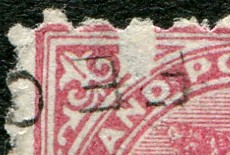

The stamp with the chisel flaw is in the top left
hand pane at position R4/6.
The stamp contains two flaws shown
in the enlargements.
There is a large rectangular break in the top frame and
a break in the lower right frame.
Screwdriver flaw
This flaw appears to be the result of a sharp pointed instrument
(such as a screwdriver) being dropped on the plate.
The damage is diagonal and
actually covers four stamps in the bottom left
pane at positions R8/3, R8/4, R9/2 and R9/3.
Details are shown below.

R9/2: Screwdriver flaw

R9/3: Line through
ornament

R8/3: Line through N

R8/4: scratch to right of E
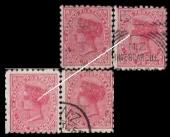
of stamps with the four flaws.
The damage starts with the screwdriver flaw in R9/2.
This is then continued as a
line through the ornament at the top left in R9/3 and then
as a line though the second N of PENNY in R8/3
and finally ends at the top right on R8/4 where there is a
faint diagonal scratch to the E of NEW.
Twopence


From 1892, four stamps in the top left pane of plate 5 show a large
number of breaks in the shading.
These flaws, at positions R9/2, R9/3, R10/2 and R10/3
are usually referred to as the substituted electros
although why anyone should want to add such poor impressions to
the plate beats me.
The most significant part of the damage is that each
of the four stamps has breaks in the Queen’s cheek and
in the shown stamp (position R9/2) the breaks form a division sign
÷.


back next
The above information is taken from The Postage Stamps of
New Zealand Vol 4, published by the
Royal Philatelic Society of New Zealand in 1964.
All scans were made by the author.