
The first health stamp was issued in 1929 and there was
an annual issue up until 2016.
For the 1929, 1930 and 1931 issues, the 1d surcharge was denoted Charity.
From 1932 onwards this was changed to Health.
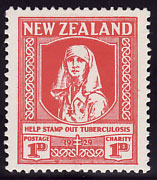
The 1929 plate was produced by etching and
contained 80 stamps in 8 horizontal rows of 10.
The stamps were printed at the Government Printing Office,
watermarked NZ and star and comb perforated 14.
Stanley Davis was responsible for the vignette while L C Mitchell was responsible for the frame.
The stamp is inscribed
Help stamp out tuberculosis.
This was the first time that the cost of a New Zealand postage stamp
was greater than its postal value. This required a special clause
to be added to the 1929 Finance Act.
The extra charge went towards supporting health camps.
Sheet Layout
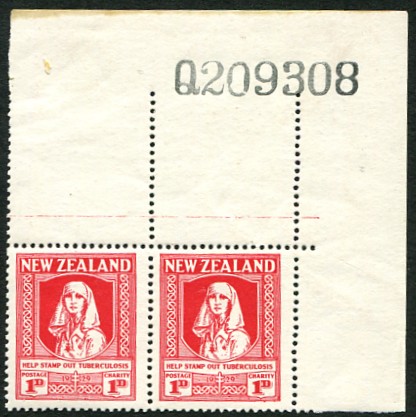
There were no plate numbers on the sheets.
There were wide margins at both the top and bottom of the sheets.
As the comb perforation was done from bottom to top, the top margins have a vertical perforation.
Initially, there were no buffer bars, but
it was noted that the plate was wearing at the top and so
buffer bars were added at the top.
Examples are shown both with and without buffer bars.
On sheets without buffer bars, a thin red horizontal line appears at the top of the sheets and likely marks the edge of the printing plate.
The paper used for the printing was the same as that used for the GV definitives and was suitable for 240
small sized stamps.
When divided in two, it was suitable for two sheets of 80 of the larger Health stamps.
As the paper was divided in two, only half the printed sheets
have sheet numbers at top right.
The examples shown here have sheet numbers and are therefore from the right hand half sheet.
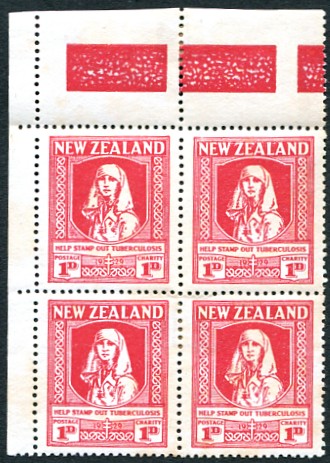
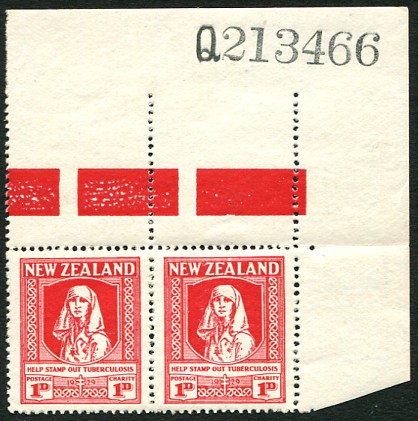
Right hand half sheet
The paper had letter watermarks in the margins.
To ensure that the letter watermarks did not appear on the printed stamps, the sheet of stamps printed on the right hand
half have the sheet number and are skewed to the left.
That means that the sheets have a wide margin on the right and a narrow margin on the left
as shown in the examples.
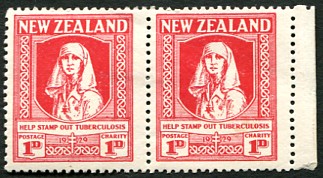
Left hand half sheet
Sheets of stamps printed on the left hand half sheet are skewed to the right and so have a wide margin on the left and
a narrow margin on the right as can be seen in the example.
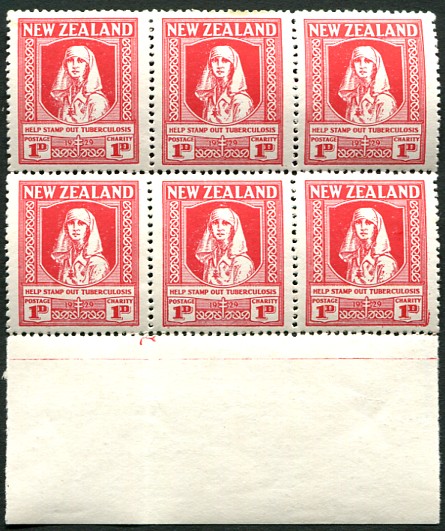
Bottom Margin
As can be seen in the example on the left, the sheets had a wide margin at the bottom and also
showed a similar red horizontal line to that at the top of the sheets without buffer bars.
An irregular bent line appears below the stamp at position R8/5.
It appears in the example and so the bottom block is from columns 5, 6 and 7.
In addition, the bottom right frame lines are extensively doubled on the stamp in position R8/7 and
that is the case on the stamp at the bottom right.
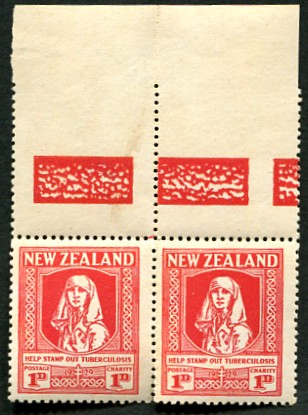
Misplaced Buffer Bars
12,500 sheets numbered Q206540 to Q219039 were ordered in late November and a further 12,500 sheets numbered Q219040 to Q231539 were ordered on 5th December.
In his plating study, Hancox shows a complete sheet numbered Q215311 with buffer bars and so is from the November order as are the
sheet number examples shown on this page.
As the buffer bars are spaced irregularly, they can be used to determine the column, and from that the example pair on
the left would appear to be from columns 6 and 7.
However, there is a curved guidemark above the stamp on the left and that, combined with dots on the stamp, show that the stamps
are actually from columns 5 and 6.
The buffer bars in this example are very worn which suggests that these stamps were printed towards the end of the
printing of the second order of 5th December.
My suggestion is therefore that after printing the stamps in November, the buffer bars were removed from the plates.
Then with the second oder on 5th December, the buffer bars were reattached, but in a different order [1].
As the number of stamps printed was 4,000,000, but fewer than 600,000 were sold,
it is likely that most were from the November order.
As the number sold from the December order was likely very small, this has not been noticed before.
Dates and numbers
The 1929 stamp was initially on sale for a very short time (11 December 1929 to 28 February 1930) and were
very much seen as Christmas stamps.
The 1929 issue was again made available from 5 December 1930
which drew a lot of criticism.
The Health stamps for 1929-31 were demonetized on 1 January 1935.
4,000,000 of the 1929 issue were printed and sales of 592,848 were therefore very disappointing.
In 1931, after examination of the stock of obsolete stamps, 2,633,840 of the 1929 issue were destroyed.
That leaves a significant number unaccounted for.
Dates:
- 1929 issued 11 Dec 1929, withdrawn 28 Feb 1930; reissued
5 Dec 1930, withdrawn 28 Feb 1931
Numbers sold:
- 1929: 592,848
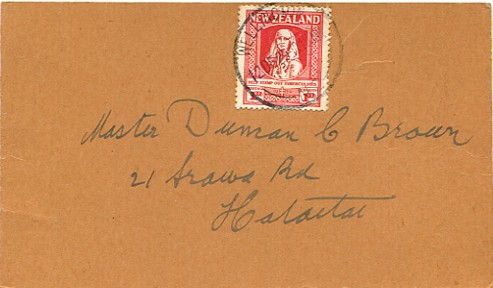
1929 Health on Cover
This plain postcard with the 1929 1d is postmarked in Wellington in the morning of the second day of issue and is postmarked
“12 DE 29 – 10.15”.
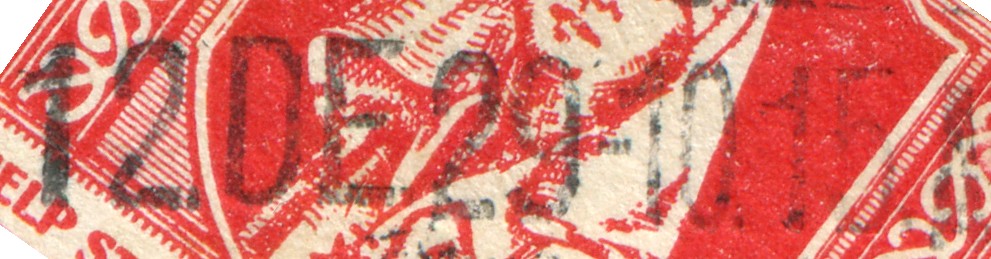 It is from a father to his son.
First day covers were not of great interest in 1929.
This changed in the mid 1930s.
Cover to UK
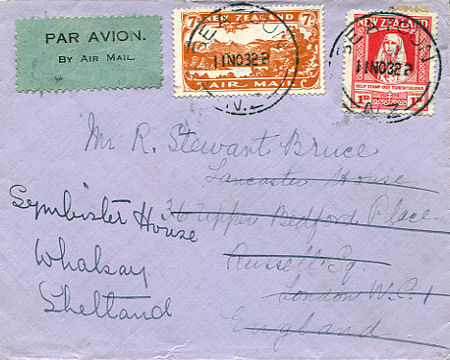
This example of the 1929 1d is postmarked in Seatoun, a suburb of Wellington, on 11th November 1932 and has a London
redirection mark on the back on 21 December.

It would miss the sailing of 11 November and be sent Wellington – Sydney on
the Maunganui on 18 – 22 November.
It would then go by rail from Sydney to Perth and from Fremantle to Colombo on the Maloja on
28 November – 7 December.
Colombo – Karachi was by surface.
Finally it was flown on the Karachi- London service on 14 – 20 December.
The required franking was 8d.
The surface route via North America was faster.
The Niagara left Auckland on 15 November and its mail was due in London on 16 December.
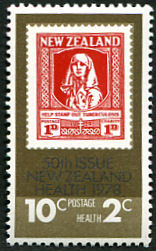
Fiftieth anniversary
The fiftieth issue of health stamps was in 1978
and, to celebrate this, the 10c value depicted the
original issue of 1929.
It was printed in sheets of 100 by Harrison and,
along with a 12c value, in miniature sheets of 6.
They were issued on 2 August 1978 and remained on sale until
30 June 1979.
Three million 10c stamps were printed in large sheets
and there were 275,000 miniature sheets.

next
The above information is taken from The Postage Stamps of
New Zealand Vol 1, published by the
Royal Philatelic Society of New Zealand in 1938.
All scans were made by the author.
Full details, including a plating of the entire sheet of the 1929 issue by Terry Hancox is available
on the New Zealand Society of
Great Britain website.
[1] Clark, R. and Hancox, T., 1929 Health Issue: Position of the Buffer Bars,
The Kiwi, vol 71, pp 66-67, March 2022.