
Two plates were used for the 4d value.
The yellow printings were from plate 20 as were the violet
printings from 1916 until the middle of 1926.
From July 1926 printings were from plate 44 and were
usually in a deep purple.
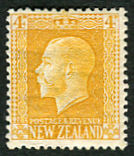
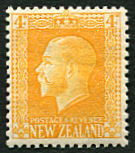
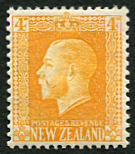
4d yellow
Shades
The date of issue was 30 July 1915.
There were several shades ranging from yellow to orange yellow to yellow orange.
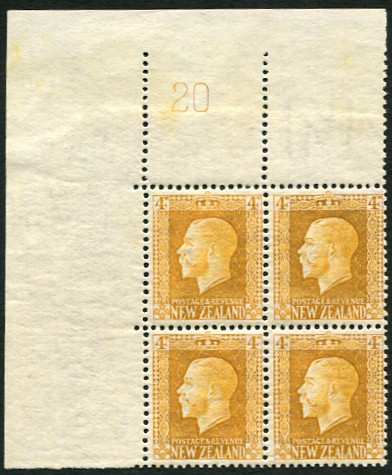
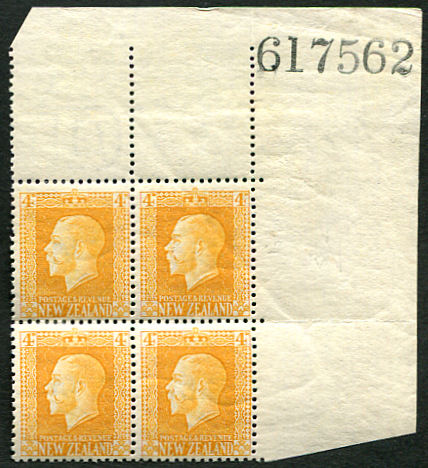
The plate number 20 was at the top left and the sheet number at the top right as shown below.
The top four rows were always perforated 14 x 13½ and so the plate and sheet numbers are
always in that perf.

Two perf pair
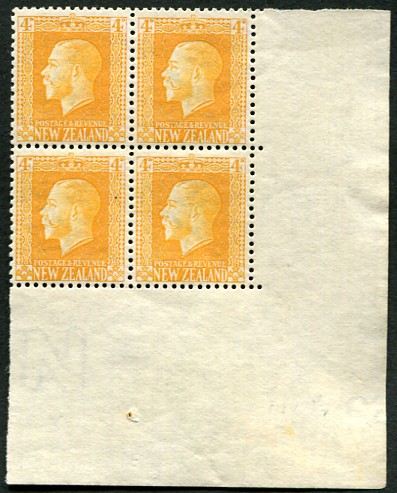
The majority of sheets had the top four rows perf 14 x 13½ and the bottom six
perf 14 x 14½.
Vertical pairs from rows 4 and 5 are known as two perf pairs.
This bottom right hand block shown on the left is perf 14 x 13½ and so is from a small number of sheets
in the initial printing that were perf 14 x 13½ throughout.
4d violet, plate 20
The 4d yellow was replaced by the 4d violet with the first printings in violet being issued
on 7 April 1916.
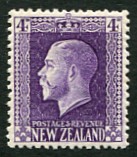
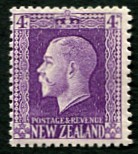
bright violet
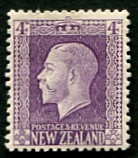
pale violet
dull violet
From 1916 until 1922, the stamps were issued in two perf sheets with the top four rows perf 14 x 13½ and the bottom six
perf 14 x 14½.
From 1922 until 1926, the sheets were perforated 14 x 13½ throughout.
Until 1926, all printings continued to be from plate 20.
According to the catalogues there were two distinctive violet shades (bright violet and dull violet) plus ‘aniline’ variations.
On the other hand, according to [1], there were three distinctive violet shades: bright violet, pale violet and dull violet.
Until 1920, the stamps were issued in bright violet, with pale violet and dull violet taking over in that year.
The examples show my interpretation of the shade differences and are discussed in [2].

Two perf pair
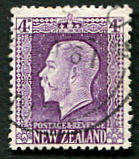
Worn dull violet
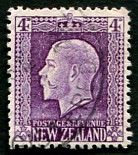
Worn pale violet
Plate 20 became progressively worn.
Such examples are always in pale or dull violet and perf 14 x 13½.
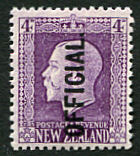
In April 1925, the 4d was issued overprinted OFFICIAL.
It was from sheets that were perf 14 x 13½ throughout and examples are in the worn state of the plate
in pale or dull violet.
In 1926 a new plate numbered 44 was introduced.
4d re-entries, plate 20
Two unusual re-entries exist in stamps from plate 20.
Impressions for different values were held on the transfer roller
used to lay down the plates.
The 4d impression had the 2½d and the 4½d values as
neighbours and
the impression for the 4½d was used in error to lay down the
impression in position Row 1/6 while the impression for the 2½d
was used in position Row 4/10.
Although these positions were re-entered with the correct
impression, traces of the original remain.


2½d entered in error and normal
2½d entered in error
At Row 4/10, parts of the 2½ can be seen in the printed stamps.
The foot of the 2 is clearly visible in the top
left hand value tablet while remains of the ½ are visible in the scrollwork.
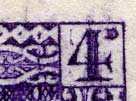
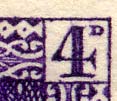
4½d entered in error and normal
4½d entered in error
The traces of the 4½d at Row 1/6 are less clear. There is a
vertical line to the top left of the 4 and another vertical line within
the scrollwork.
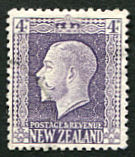
4d purple, plate 44
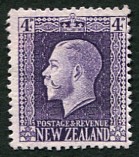

Shades
A new 4d plate 44 was ordered in June 1925 and was sent from London on 13 March 1926.
The 4d was first issued from the new plate in July 1926.
The colour was deep purple.
The impressions on the plate are not as clear as with plate 20 and so the stamps
look as if they are printed from a slightly worn plate.
Virtually all the impressions on plate 44 were retouched.
Some sheets in the initial printing were perf 14 x 13½ throughout, but the great majority were issued from sheets
perf 14 x 14½ throughout.
In 1927, a very small number of sheets were issued perf 14 x 14½ in the top 5 rows and perf 14 x 13½ in the bottom 5.
Only the 5d value also has this combination of perforations.
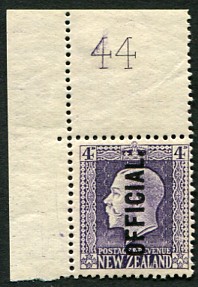
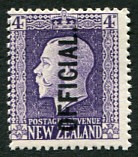
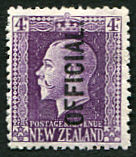
Overprinted Official
In April 1927, the 4d plate 44 was issued overprinted OFFICIAL
from sheets that were perf 14 x 14½ throughout.
Some were printed in a deep bright violet as in the leftmost example on the right
which has no plate wear.
The others are in a dark purple with
the plate single showing more plate wear.


back next
The above information is taken from
The Postage Stamps of New Zealand Vols 1 and 2, published by
the
Royal Philatelic Society of New Zealand in 1938 and 1950
respectively.
[1] A Dating Study of GV Shades, Part 1, G. White,
C.P. Newsletter, vol 42, no.3, pp 3-9, October 1990. (Available in the Research archive section
of the New Zealand Society of Great Britain at www.nzsgb.org.uk )
[2] A Discussion of ‘A Dating Study of GV Shades’, R. Clark, The Kiwi, vol.67, pp 47-49, March, 2018.
All scans were made by the author.