
Until 1 April 1862, postage in New Zealand could be prepaid in cash
instead of by postage stamps.
In such cases, the amount paid was written on the front of the cover or
folded letter in red ink.
The following stampless entire (a folded letter) was sent from
Otago to Irvine in Scotland in 1860.
It has routing instructions via Marseilles. That route
saved up to 72 hours on the journey, but required a 3d per
quarter oz premium over the
standard postage rate to the UK of 6d per ½oz.
There is a large 9d in red ink on the front of the letter
to indicate the amount that had been paid.

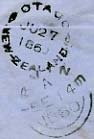
On the back there is an Otago datestamp of 27 June 1860 and
a receiving mark in Irvine of 14 September.
It was therefore 80 days in transit.
The cover was carried from Port Chalmers on 27 June arriving in
Sydney on 12 July.
It then left Sydney on 22 July, arriving in Suez on 4 September.
Leaving Alexandria on 5 September, it arrived in Marseilles on
11 September and London on 12 September.
This Otago datestamp was used from 1852 until 1862
at Port Chalmers which is 11 km from Dunedin.
The Chief Post Office for Otago was moved from Port Chalmers
to Dunedin in 1855.
The route was first to Australia and from there (after 1859) by
P & O steamer via Aden and Suez.
From Suez, mail was carried overland to Alexandria (the Suez
Canal did not open until 1869) where
the mail via Marseilles was separated from the ordinary mail.
The route via Marseilles started in March 1857 and continued
until September 1870.
From 1851 until 1857, senders of letters from New Zealand to
the UK could only pay for the local postage cost (twopence)
while the receiver had to pay
for the cost (eightpence) from New Zealand to Great Britain.
The amount paid in New Zealand was written in red ink
while the cost to the recipient was written in black ink.

back
The above information is taken from:
Australia New Zealand UK Mails to 1880: Rates Routes and
Ships Out and Home, Colin Tabeart, Fareham, 2004.
The Postage Stamps of New Zealand Vols 3 and 7, published by the
Royal Philatelic Society of New Zealand in 1955 and 1988.
All scans were made by the author.