
At a Universal Postal Union Convention held in London, it was agreed
that, from 1 July 1930, mail posted in New Zealand would be accepted
by air services in Australia,
Canada, USA and on the
Karachi – London route.
As there had also been experimental internal airmail flights,
it was decided that special Air Mail stamps should be
produced and
3d, 4d and 7d values were issued on 10 November 1931.
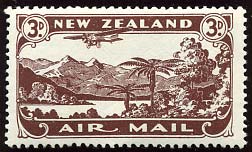
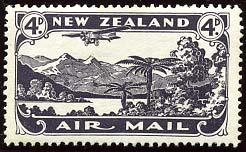
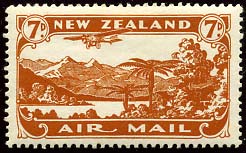
The stamps were designed by L.C. Mitchell of Wellington and the dies
and plates were produced by the Royal Mint in the UK.
They were printed at the Government Printing Office in Wellington.
The paper was Cowan chalk-surfaced paper with NZ and star watermark and
comb perforated 14 x 14½.
Each sheet contained 120 stamps in 10 rows of 12.
The plates only arrived in New Zealand on 4 November and stamps were
printed immediately so that they would be available
for the special
1931 Christmas flight
from Australia to the UK
and the associated
internal flight of 12 November.
As well as these flights, collectors prepared covers to be sent
on various overseas air mail services such as
Perth – Adelaide,
Karachi – London,
Canada and
Sydney – Brisbane.
Highfield Cover, 9 November
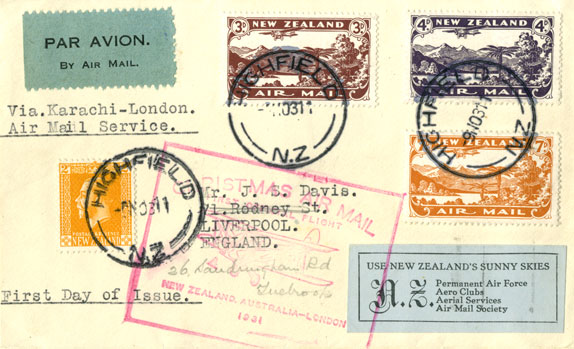
Although the stamps were officially issued on 10 November,
they were distributed to post offices the day before and
some were sold at Highfield (Timaru) on the 9th to Alex Paterson,
the first President of the Air Mail Society of New Zealand.
He used the stamps on various airmail covers, all of which
contain the full set of stamps and are postmarked at
Highfield on 9th November.
The example is addressed via the
Karachi – London service although it was actually flown on the
All Australian
Christmas flight.
First day covers, 10 November

First day covers are surprisingly scarce with most early postmarks
being on 11 November, ready for the special
flight from Invercargill
to Auckland on 12 November.
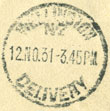
This first cover is postmarked Invercargill on 10 November and
was flown from there to Wellington on 12 November.
It shows an example of the 1d Smiling Boy health stamp in addition to
the 4d airmail to make up the required franking of 5d (2d for normal postage and
3d for flight).
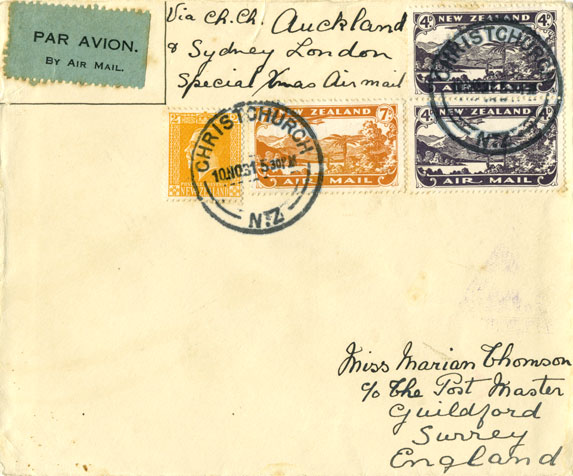
The second example is postmarked on 10 November in Christchurch and was
flown on both the internal flight of 12 November
as well as on the
All Australian
Christmas flight to the UK.
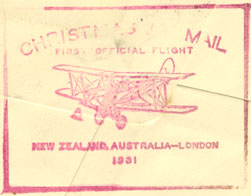
It has the cachet for that flight on the back although there
is plenty of room on the front.
It has the required franking of 1/5 to cover surface postage (2d), internal flight (3d)
and the All Australian Christmas flight (1/-).
There seemed to be a widespread belief that the cost of air mail had to be
paid for by the new airmail stamps which could not be used to pay
surface mail.
As a result, the cover does not contain the full set of airmail stamps as that would
have resulted in deficient postage.
The 5d overprint
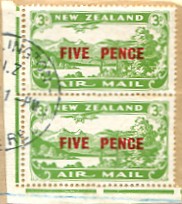

On Christmas Eve 1931 there was a
series of internal flights to carry
Christmas greetings and to publicise the advantages of air mail.
The 3d issue was printed in yellow-green and overprinted 5d
in red especially for these flights.
The stamp was issued on 18 December 1931 and remained on sale
with the other values until
they were all withdrawn on 31 October 1935.
The used example on the right shows the buffer bars.
Trans-Tasman airmail
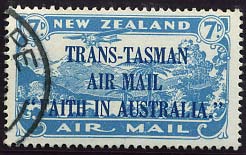
A special issue of the 7d was made on 17 January 1934 for
the first official trans-Tasman airmail
on 17 February 1934.

The printing was in sky blue and overprinted Trans
-Tasman Air Mail “Faith in Australia” on three lines.
The number sold was 83,078.
The stamp was withdrawn on 17 February and unsold copies were destroyed.
The only significant flaw in the overprint is a break in the left hand
stroke of the letter N in IN.
This occurs in every stamp in row 4.
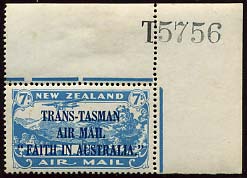
Sheet numbers
There were no plate numbers, but sheet numbers appear in
the margin of each sheet at the top right.
There were buffer bars in the margin to protect the plate from wear.

next
The above information is taken from The Postage Stamps of
New Zealand Vol 1, published by the
Royal Philatelic Society of New Zealand in 1938.
All scans were made by the author.